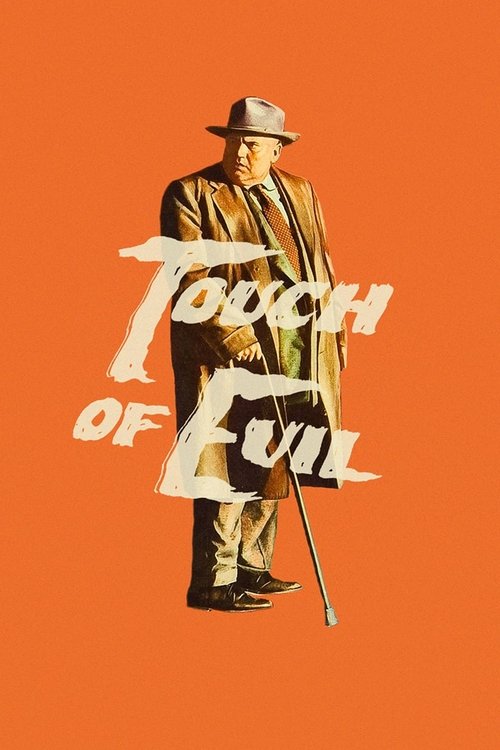
Touch of Evil (1958)
Directed by Orson Welles
No — Touch of Evil is not especially woke, scoring 32 out of 100 on our wokeness meter.
Orson Welles took a middling pulp novel called Badge of Evil and moved it to the border, renaming the hero Miguel Vargas for reasons he described as political.
Consciousness Markers
Welles deliberately made Vargas Mexican to address American racism and border corruption, with Quinlan as an explicitly anti-Mexican bigot.
Centers a Mexican protagonist and border-town Mexican characters, but the lead is played by white actor Charlton Heston in brownface, undercutting authentic representation.
Embeds a critique of racism and corruption in its noir plot, but does not preach or lecture directly.
No LGBTQ+ characters, themes, or subtext.
Janet Leigh's character is primarily a victim and damsel in distress; no feminist agenda.
No environmental or climate themes.
Focuses on police corruption and crime, not anti-capitalist critique.
No body positivity themes.
No neurodivergence themes.
Fictional crime story adapted from a novel; no revisionist history.
Why it received this score
Orson Welles took a middling pulp novel called Badge of Evil and moved it to the border, renaming the hero Miguel Vargas for reasons he described as political. The gesture lands with the weight of a man who understood that a Mexican special prosecutor walking into a corrupt American investigation was a provocation in 1958. Hank Quinlan, bloated and limping, is an anti-Mexican bigot who plants dynamite in shoe boxes and convicts whomever he pleases. The film knows precisely what it is doing here, and it does it without a single speech.
The trouble is the casting. Charlton Heston, a man of granite jaw and zero Latin ancestry, plays Vargas under a layer of bronzer that fools no one and was not meant to. The film surrounds him with actual Mexican faces in the border-town margins, which softens the blow slightly, but the center cannot hold. Janet Leigh spends her honeymoon drugged, kidnapped, and framed, a damsel whose suffering exists to motivate her husband. Nobody in this picture is gay, no one frets about the climate, and the body-positive movement has not yet been invented. The villains are crooked cops and gangsters, not capitalists. There is no sermon.
The rest is craft. The three-minute crane shot, the deep shadows, the sense that a whole rotten town is exhaling. Welles embeds his critique of American racism inside the machinery of noir, letting the audience draw conclusions instead of handing them a pamphlet. It is a serious film about serious rot, and it earns its gravity through atmosphere, not preaching. A sommelier might call it a difficult vintage that has aged beautifully. I would call it a great film that happens to be, by the standards of our current accounting, mostly quiet.
Analysis generated by our Consciousness Algorithm


Synopsis
A border-town bombing draws Mexican investigator Miguel Vargas into a corruption-ridden police investigation led by crooked captain Hank Quinlan, setting off a deadly struggle over power, justice, and truth.
Questions about Touch of Evil
Is Touch of Evil woke?
No — Touch of Evil is not especially woke, scoring 32 out of 100 on our wokeness meter. That earns it a verdict of Based.
Does Touch of Evil have any woke elements?
2 of the 10 markers register at 30 or above, led by Racial Consciousness (65) and Representation Casting (35). On Racial Consciousness: Welles deliberately made Vargas Mexican to address American racism and border corruption, with Quinlan as an explicitly anti-Mexican bigot.
How does Touch of Evil compare to other 1958 movies?
It is the wokest of the 10 films from 1958 we've scored; their average is 8.
How is the Woke Score calculated?
An AI-assisted process researches the film and its reception, scores it 0–100 on ten markers, then combines those into one 0–100 Woke Score. It measures a specific set of 2020s cultural themes, not film quality.