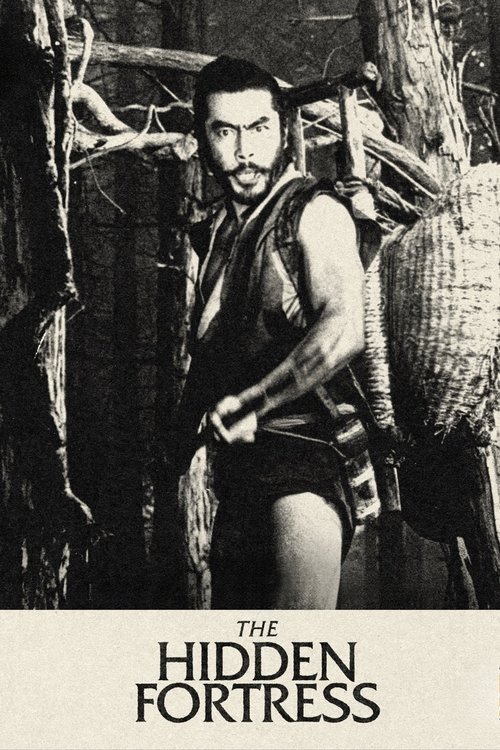
The Hidden Fortress (1958)
Directed by Akira Kurosawa
No — The Hidden Fortress is not woke, scoring 6 out of 100 on our wokeness meter.
Akira Kurosawa's The Hidden Fortress arrives from 1958 with two greedy peasants, a disguised general, and a princess, all trudging across feudal Japan with a fortune in gold hidden in hollow logs.
Consciousness Markers
Princess Yuki has moments of moral authority and agency, but the film is not structured around a modern feminist critique.
The cast is entirely Japanese in a Japanese period film, which is natural casting rather than a modern representation-casting agenda.
There are no LGBTQ+ themes or characters in the film.
The film is set in feudal Japan and does not engage with modern racial consciousness or identity politics.
There is no environmental or climate-related theme.
The peasants' greed is a comic and moral motif, not a systemic anti-capitalist critique.
The film does not address body image or body-positivity themes.
There is no exploration of neurodivergence or mental difference as a theme.
The film is a fictional jidaigeki adventure, not a revisionist historical narrative.
The film is an adventure epic and does not pause for modern moral lecturing.
Why it received this score
Akira Kurosawa's The Hidden Fortress arrives from 1958 with two greedy peasants, a disguised general, and a princess, all trudging across feudal Japan with a fortune in gold hidden in hollow logs. It is a jidaigeki adventure, widescreen and brisk, and it holds up as one of the more purely enjoyable epics in the canon. George Lucas borrowed its structure wholesale, which is the sort of theft that flatters both parties. We come to such a film expecting nothing of the modern cultural apparatus, and the film obliges. Its cast is Japanese because the story is set in Japan. Nobody pauses to explain this. Nobody needs to.
Princess Yuki, played by Misa Uehara, carries a measure of moral authority. She shames the general into buying a captive woman's freedom. She faces execution without flinching and delivers a small speech about the ugliness and beauty of humanity. This is character work, not a program. The film is not built around a critique of patriarchy, and the princess spends much of the runtime pretending to be a deaf-mute for her own protection. A modern reading could be attempted here. The film would not resist it. It simply predates the conversation.
We are left with the gold, the border, the fire festival, and two cowards arguing over a single ryo. Kurosawa balances valor against greed and never stops to lecture us about either. The peasants are greedy because greed is funny and human, not because the film has a position on capital. The result is an adventure that trusts its audience to keep up. In the ledger of contemporary social consciousness, it registers as a relic, and a contented one. The mountain fortress stays hidden, and so does the sermon.
Analysis generated by our Consciousness Algorithm


Synopsis
In feudal Japan, during a bloody war between clans, two cowardly and greedy peasants, soldiers of a defeated army, stumble upon a mysterious man who guides them to a fortress hidden in the mountains.
Questions about The Hidden Fortress
Is The Hidden Fortress woke?
No — The Hidden Fortress is not woke, scoring 6 out of 100 on our wokeness meter. That earns it a verdict of Ultra Based.
Does The Hidden Fortress have any woke elements?
Very few. None of the 10 markers reaches 30, the level where a marker counts as present; the highest is Feminist Agenda at 10.
How does The Hidden Fortress compare to other 1958 movies?
It ranks #3 of the 10 films from 1958 we've scored; their average is 8. The wokest is Touch of Evil (32).
How is the Woke Score calculated?
An AI-assisted process researches the film and its reception, scores it 0–100 on ten markers, then combines those into one 0–100 Woke Score. It measures a specific set of 2020s cultural themes, not film quality.