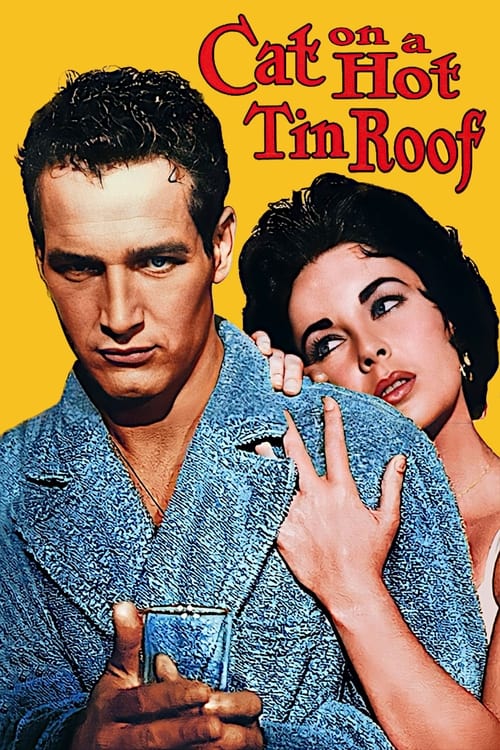
Cat on a Hot Tin Roof (1958)
Directed by Richard Brooks
No — Cat on a Hot Tin Roof is not woke, scoring 6 out of 100 on our wokeness meter.
Richard Brooks adapts a Pulitzer-winning Tennessee Williams play about a Mississippi Delta plantation family, a dying patriarch, and an ex-athlete who has drunk himself into a crutch.
Consciousness Markers
The film centers on Brick's repressed homosexuality and his relationship with Skipper, but the Hays Code forced these themes into subtext and removed explicit references.
Maggie is a complex and assertive female lead, but the film's focus is on her desperation for her husband rather than a feminist agenda.
The cast is entirely white, with no attempt at racial or ethnic diversity in casting.
The film is set on a Mississippi plantation but contains no racial consciousness or commentary on race.
There is no environmental or climate-related theme in the film.
The film depicts family inheritance disputes but does not critique capitalism or wealth in an anti-capitalist manner.
There is no body positivity theme in the film.
Brick's alcoholism and depression are portrayed, but not as neurodivergence in a modern sense.
The film is a fictional drama and does not engage in historical revisionism.
The film is dialogue-driven and explores themes of mendacity, but it does not lecture the audience in a modern activist sense.
Why it received this score
Richard Brooks adapts a Pulitzer-winning Tennessee Williams play about a Mississippi Delta plantation family, a dying patriarch, and an ex-athlete who has drunk himself into a crutch. The screenplay was laundered through the Hays Code, and the central matter of Brick's attachment to his dead teammate Skipper survives only as implication. A studio executive promised to find a substitute for the homosexual angle, and the substitute is a vague guilt that never quite names itself. The subtext is present, and it is doing real work, but it arrives muffled. Newman's performance holds the whole thing together by refusing to explain anything.
Elizabeth Taylor's Maggie is the most assertive presence in the film, a woman who fights for her husband's desire with a desperation the script never questions. That is not a feminist argument so much as a study in marital exhaustion. The plantation setting, meanwhile, produces no Black characters of consequence and no comment on the labor that presumably sustains the cotton. Race simply is not a subject here. Neither is money, despite an inheritance plot that consumes the third act: the family claws over a will, and the film treats this as a matter of appetite, not economics.
Everything else on the ledger reads empty. No environmental anxiety, no body politics, no framing of Brick's alcoholism as neurodivergence, no rewriting of the historical record, and no sermon delivered to the audience. Williams himself told people in line to go home, which is the closest the picture comes to a lecture, and he was not in it. What remains is a well-acted chamber drama about mendacity, inheritance, and a man who cannot say what he means. It is a serious work. It is not an instructive one.
Analysis generated by our Consciousness Algorithm


Synopsis
An alcoholic ex-football player drinks his days away, having failed to come to terms with his sexuality and his real feelings for his football buddy who died after an ambiguous accident. His wife is crucified by her desperation to make him desire her: but he resists the affections of his wife. His reunion with his father—who is dying of cancer—jogs a host of memories and revelations for both father and son.
Questions about Cat on a Hot Tin Roof
Is Cat on a Hot Tin Roof woke?
No — Cat on a Hot Tin Roof is not woke, scoring 6 out of 100 on our wokeness meter. That earns it a verdict of Ultra Based.
Does Cat on a Hot Tin Roof have any woke elements?
1 of the 10 markers register at 30 or above, led by LGBTQ+ Themes (30). On LGBTQ+ Themes: The film centers on Brick's repressed homosexuality and his relationship with Skipper, but the Hays Code forced these themes into subtext and removed explicit references.
How does Cat on a Hot Tin Roof compare to other 1958 movies?
It ranks #3 of the 10 films from 1958 we've scored; their average is 8. The wokest is Touch of Evil (32).
How is the Woke Score calculated?
An AI-assisted process researches the film and its reception, scores it 0–100 on ten markers, then combines those into one 0–100 Woke Score. It measures a specific set of 2020s cultural themes, not film quality.