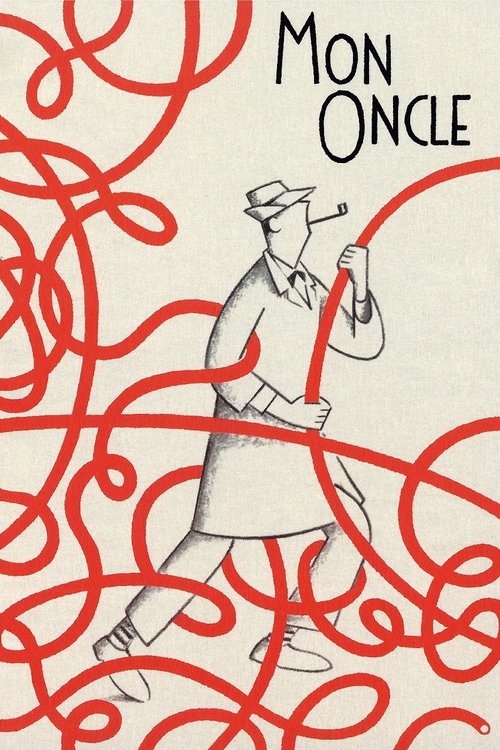
Mon Oncle (1958)
Directed by Jacques Tati
No — Mon Oncle is not especially woke, scoring 25 out of 100 on our wokeness meter.
Jacques Tati's Mon Oncle arrives from 1958, when the phrase consumer society was still a fresh accusation, and takes as its target the Villa Arpel, a house built entirely of right angles and appliances.
Consciousness Markers
The film mocks conspicuous consumption, status-seeking, and the dehumanizing machinery of the Arpels' consumer lifestyle, but from a nostalgic humanist angle rather than a political anti-capitalist one.
The film's themes are delivered almost entirely through visual comedy and near-silent sound design, with barely any dialogue, leaving little room for preachy messaging.
The cast is entirely French and European, with no effort toward diverse or inclusive casting. This is a 1958 French production with a homogenous ensemble.
There are no LGBTQ+ characters or themes anywhere in the film.
The film satirizes the Arpels' rigid gender roles and materialistic domesticity, but only as part of a broader critique of modernity, not as a feminist statement.
No racial themes or consciousness appear in the film; it concerns class and modernity within a white French milieu.
There is no environmental or climate theme; the satire targets architecture and gadgets, not ecology.
No body positivity themes are present.
Hulot is dreamy and socially awkward, but this is comedic characterization rather than any depiction or advocacy of neurodivergence.
The film is not engaged with historical revisionism of any kind.
Why it received this score
Jacques Tati's Mon Oncle arrives from 1958, when the phrase consumer society was still a fresh accusation, and takes as its target the Villa Arpel, a house built entirely of right angles and appliances. The fish-shaped fountain runs only for guests worth impressing. The kitchen deafens. The chairs are hostile to sitting. Tati's point, delivered through a soundtrack in which dialogue serves as ambient noise, is that geometry does not produce likeable people. The film won the Academy Award for Best Foreign Language Film and has been admired ever since, which is a polite way of saying it has been absorbed into the canon and stripped of its capacity to annoy.
There is a complaint against consumption here, and it deserves a modest accounting. The Arpels subordinate their individuality to their possessions. M. Arpel's workplace at Plastac is a factory of automatons. Status is performed through furniture. But the objection is nostalgic and humanist, not political. Tati mourns a crumpled old Paris of cobblestones and idle afternoons. He proposes no alternative economy. French critics at the time called the film reactionary, even Poujadiste, which tells us the politics were legible enough to irritate the left and vague enough to comfort the right. That is the signature of a satire aimed at manners, not systems.
The rest of the ledger is bare. The cast is entirely French and European. The women are satirized as consumers alongside the men, which is a joke about materialism, not a brief for liberation. Nobody discusses race, ecology, bodies, or neurology. Hulot is dreamy and clumsy; that is a comic type, not a diagnosis. Above all, the film refuses to explain itself. Tati lectures no one. He films a doorbell and lets us draw conclusions. It is a nearly silent sermon against noise, and for that restraint it earns our quiet respect.
Analysis generated by our Consciousness Algorithm


Synopsis
Genial, bumbling Monsieur Hulot loves his top-floor apartment in a grimy corner of the city, and cannot fathom why his sister's family has moved to the suburbs. Their house is an ultra-modern nightmare, which Hulot only visits for the sake of stealing away his rambunctious young nephew. Hulot's sister, however, wants to win him over to her new way of life, and conspires to set him up with a wife and job.
Questions about Mon Oncle
Is Mon Oncle woke?
No — Mon Oncle is not especially woke, scoring 25 out of 100 on our wokeness meter. That earns it a verdict of Based.
Does Mon Oncle have any woke elements?
1 of the 10 markers register at 30 or above, led by Eat the Rich (35). On Eat the Rich: The film mocks conspicuous consumption, status-seeking, and the dehumanizing machinery of the Arpels' consumer lifestyle, but from a nostalgic humanist angle rather than a political anti-capitalist one.
How does Mon Oncle compare to other 1958 movies?
It ranks #2 of the 10 films from 1958 we've scored; their average is 8. The wokest is Touch of Evil (32).
How is the Woke Score calculated?
An AI-assisted process researches the film and its reception, scores it 0–100 on ten markers, then combines those into one 0–100 Woke Score. It measures a specific set of 2020s cultural themes, not film quality.