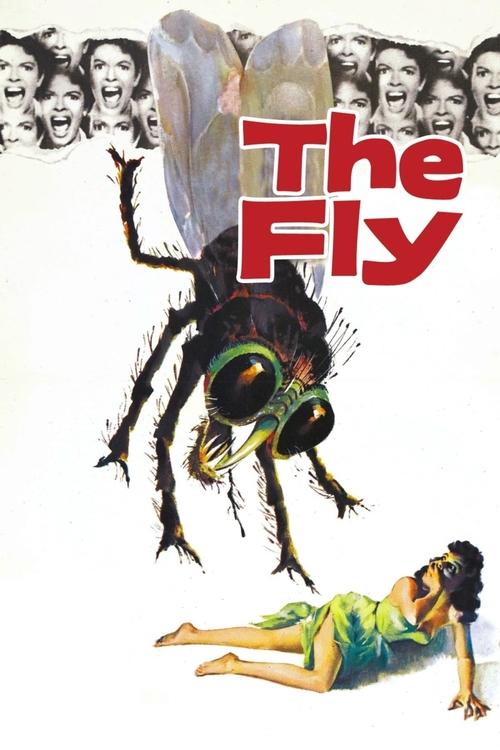
The Fly (1958)
Directed by Kurt Neumann
No — The Fly is not woke, scoring 0 out of 100 on our wokeness meter.
A scientist in Montreal steps into his own matter-transporter and emerges with the head and left arm of a house fly, which is the sort of premise that would once have been considered sufficient for an evening's entertainment.
Consciousness Markers
The cast is entirely white and reflects 1950s Hollywood norms; no deliberate inclusive or color-conscious casting.
No LGBTQ+ characters, themes, or subtext.
Hélène is a central figure, but the film frames her within traditional wife and mother roles; no feminist critique or agenda.
No engagement with race, racism, or racial identity.
No environmental or climate themes.
The story concerns scientific hubris and personal tragedy, not class struggle or anti-capitalist critique.
No body-positive messaging; the mutated body is presented as horror.
No neurodivergent characters or themes.
No historical revisionism; it is a contemporary science-fiction story.
The closing moral about the search for truth is a conventional sci-fi caution, not modern social-justice lecturing.
Why it received this score
A scientist in Montreal steps into his own matter-transporter and emerges with the head and left arm of a house fly, which is the sort of premise that would once have been considered sufficient for an evening's entertainment. Kurt Neumann directs the 1958 original with a flashback structure borrowed from courtroom drama, opening on a murder confession and working backward through domestic calm into basement catastrophe. Patricia Owens carries much of the picture as Hélène, a wife who types notes to her disfigured husband and combs the house for an insect. She is central, undeniably, but she is central in the way that 1950s cinema understood women to be central: keeper of the home, guardian of the child, witness to male ambition. No critique of that arrangement is offered, and none appears to have been intended.
Nor does the film reach for any other contemporary cultural concern. The cast is uniformly white, the setting is a comfortable bourgeois household, and the drama turns entirely on personal catastrophe. The final mutation is presented as horror, which is the point of a horror film, and the altered body is not celebrated but mourned. When François Delambre tells the boy that his father was searching for truth and was careless for one instant, the sentiment is a standard caution about scientific hubris, delivered without sermonizing. It is the kind of closing line that genre pictures of the period produced routinely.
Vincent Price, in an early foray into the macabre, would go on to become the genre's most reliable face. Here he is merely the brother, reasonable and slightly bewildered. The film was a commercial success, spawned two sequels, and was remade by David Cronenberg in 1986 with a greater appetite for the flesh. The original remains a tidy, efficient B-picture, and its cultural footprint is that of a well-made thriller. There is nothing in it that speaks to the preoccupations of a later era, and it makes no effort to pretend otherwise.
Analysis generated by our Consciousness Algorithm


Synopsis
Industrialist François Delambre is called late at night by his sister-in-law, Helene, who tells him that she has just killed her husband. Reluctant at first, she eventually explains to the police that he invented a matter transportation apparatus and, while experimenting on himself, a fly entered the chamber.
Questions about The Fly
Is The Fly woke?
No — The Fly is not woke, scoring 0 out of 100 on our wokeness meter. That earns it a verdict of Ultra Based.
Does The Fly have any woke elements?
No. All 10 markers score zero.
How does The Fly compare to other 1958 movies?
It ranks #7 of the 10 films from 1958 we've scored; their average is 8. The wokest is Touch of Evil (32).
How is the Woke Score calculated?
An AI-assisted process researches the film and its reception, scores it 0–100 on ten markers, then combines those into one 0–100 Woke Score. It measures a specific set of 2020s cultural themes, not film quality.