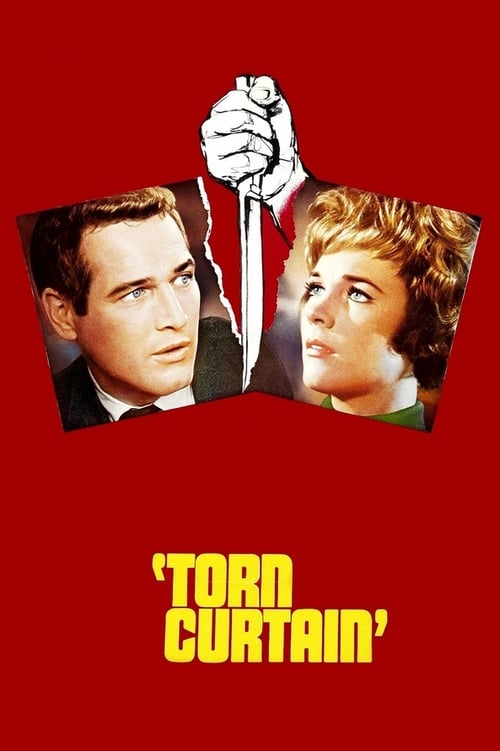
Torn Curtain (1966)
Directed by Alfred Hitchcock
No — Torn Curtain is not woke, scoring 0 out of 100 on our wokeness meter.
Torn Curtain arrives from 1966, a Cold War spy vehicle directed by Alfred Hitchcock and led by Paul Newman and Julie Andrews.
Consciousness Markers
The cast is entirely white, with no meaningful racial or ethnic diversity; supporting players are European character actors but this is not modern representation casting.
No LGBTQ+ characters, themes, or subtext.
Julie Andrews's character is a loyal fiancée and assistant who follows the male lead; the film does not advance a feminist agenda.
No engagement with racial issues or consciousness.
No climate or environmental themes.
A Cold War spy thriller with no critique of capitalism or wealth inequality.
No body positivity themes.
No neurodivergence themes.
A fictional Cold War spy story, not a revisionist historical narrative.
Entertains as a thriller without preaching or delivering modern social lectures.
Why it received this score
Torn Curtain arrives from 1966, a Cold War spy vehicle directed by Alfred Hitchcock and led by Paul Newman and Julie Andrews. The plot concerns an American physicist who appears to defect to East Germany, and the fiancée who follows him, unaware that his betrayal is a ruse. The film is entirely at home in its era's assumptions. The cast is white, the supporting players are European character actors, and Andrews functions as a loyal assistant and romantic appendage. Her screen purpose is to trail after Newman, worry, and look glamorous. No modern identity politics intrude, because none are imagined.
The film has no interest in environmental crisis, economic inequality, body image, neurodiversity, or revising historical memory. Its politics are strictly Cold War geopolitics: East against West, Stasi pursuit, stolen formulas, escape networks. It does not lecture. It wants to thrill. The notorious farmhouse killing of Gromek is long, ugly, and pragmatic, a demonstration of how difficult it is to kill a man. That is Hitchcock's moral instruction, if any: violence is messy, not righteous. There is no sermon about capitalism, no climate crusade, no call for representation. The movie simply is what it is.
As a cultural artifact, Torn Curtain is a studio product, with stars imposed on its director and a rushed production. Its absence of contemporary social consciousness is not a failure of nerve but a matter of historical fact. It offers suspense, matte paintings, a ballet escape, and a leading lady who admitted she merely went along for the ride. The film does not ask to be praised for representation or critique. It asks to be watched as a thriller. On that modest terms, it works often enough, though it remains minor Hitchcock. It is a film from another time, and it has no intention of pretending otherwise.
Analysis generated by our Consciousness Algorithm
Part of


Synopsis
During the Cold War, an American scientist appears to defect to East Germany as part of a cloak and dagger mission to find the formula for a resin solution—but the plan goes awry when his fiancee, unaware of his motivation, follows him across the border.
Questions about Torn Curtain
Is Torn Curtain woke?
No — Torn Curtain is not woke, scoring 0 out of 100 on our wokeness meter. That earns it a verdict of Ultra Based.
Does Torn Curtain have any woke elements?
No. All 10 markers score zero.
How does Torn Curtain compare to other 1966 movies?
It ranks #14 of the 18 films from 1966 we've scored; their average is 7. The wokest is Daisies (28).
How is the Woke Score calculated?
An AI-assisted process researches the film and its reception, scores it 0–100 on ten markers, then combines those into one 0–100 Woke Score. It measures a specific set of 2020s cultural themes, not film quality.