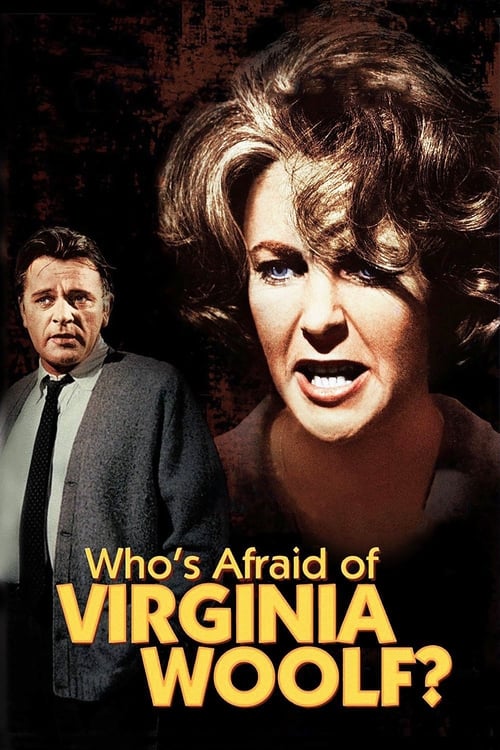
Who's Afraid of Virginia Woolf? (1966)
Directed by Mike Nichols
No — Who's Afraid of Virginia Woolf? is not woke, scoring 6 out of 100 on our wokeness meter.
Mike Nichols made his directorial debut with a black and white adaptation of an Edward Albee play in which four people drink for three hours and destroy each other in a New England living room.
Consciousness Markers
Martha is a ferocious, dominant female character, but the film frames her as a bitter, emasculating 'nasty wife' rather than advancing any feminist thesis. The battle-of-the-sexes dynamic is psychological, not ideological.
The film is famously talky and confrontational, but its verbal energy is aimed at personal cruelty and marital warfare rather than social instruction. There is no didactic messaging directed at the audience.
The credited cast is entirely white, with no attempt at diverse or color-conscious casting. The film's four principals are all Caucasian, and no representation agenda is present.
There are no LGBTQ+ characters, themes, or subtext in the film. The drama concerns heterosexual marriages and their dysfunctions exclusively.
The film engages no racial themes whatsoever; its milieu is a white New England academic elite. No racial consciousness is present.
There is no environmental or climate content in the film. The subject matter is entirely domestic and psychological.
The film contains no critique of capitalism or class-based economic commentary. Academia and marriage are the subjects, not wealth structures.
Elizabeth Taylor gained weight for the role, but the film does not celebrate body diversity or challenge beauty standards as a theme. No body-positivity messaging exists.
No neurodivergent characters or themes are depicted. The characters' dysfunction is framed as marital and alcoholic, not neurological.
The film is a faithful adaptation of a contemporary play with no historical revisionism. It makes no attempt to reinterpret past events through a modern lens.
Why it received this score
Mike Nichols made his directorial debut with a black and white adaptation of an Edward Albee play in which four people drink for three hours and destroy each other in a New England living room. The taxonomy is unusually clean here. There is no social program on offer, no instruction for the audience, no attempt to improve anyone. The film simply watches two marriages rot in real time, and it does so with a patience that would be unthinkable now.
Martha is a ferocious and dominant woman, and casting Elizabeth Taylor in the role was an act of quiet violence against her own screen image. She gained thirty pounds for the part. None of this amounts to a thesis about women. The film treats her as a harridan and a nasty wife, a walking accusation against her husband's manhood, and the war between the sexes is fought with psychology and liquor, not ideology. The academic milieu is entirely white and entirely comfortable, and the film has no interest in remarking on it. There is no racial consciousness, no queer subtext, no critique of the money that built the campus, and no challenge to beauty standards despite the famous weight gain.
The dialogue is relentless and confrontational, which has led some to file the picture under sermonizing. This is a misreading. Every barb is aimed at a spouse, never at the viewer. Nobody turns to the camera to explain what we ought to think about marriage, or America, or anything else. The cruelty is the point, and the closing image of two exhausted people holding hands over a son who never existed lands without a single lesson attached. The film is a masterpiece. It is also, by the standards of our current cultural accounting, nearly empty.
Analysis generated by our Consciousness Algorithm
Part of


Synopsis
A history professor and his wife entertain a young couple who are new to the university's faculty. As the drinks flow, secrets come to light, and the middle-aged couple unload onto their guests the full force of the bitterness, dysfunction, and animosity that defines their marriage.
Questions about Who's Afraid of Virginia Woolf?
Is Who's Afraid of Virginia Woolf? woke?
No — Who's Afraid of Virginia Woolf? is not woke, scoring 6 out of 100 on our wokeness meter. That earns it a verdict of Ultra Based.
Does Who's Afraid of Virginia Woolf? have any woke elements?
Very few. None of the 10 markers reaches 30, the level where a marker counts as present; the highest is Feminist Agenda at 10.
How does Who's Afraid of Virginia Woolf? compare to other 1966 movies?
It ranks #6 of the 18 films from 1966 we've scored; their average is 7. The wokest is Daisies (28).
How is the Woke Score calculated?
An AI-assisted process researches the film and its reception, scores it 0–100 on ten markers, then combines those into one 0–100 Woke Score. It measures a specific set of 2020s cultural themes, not film quality.