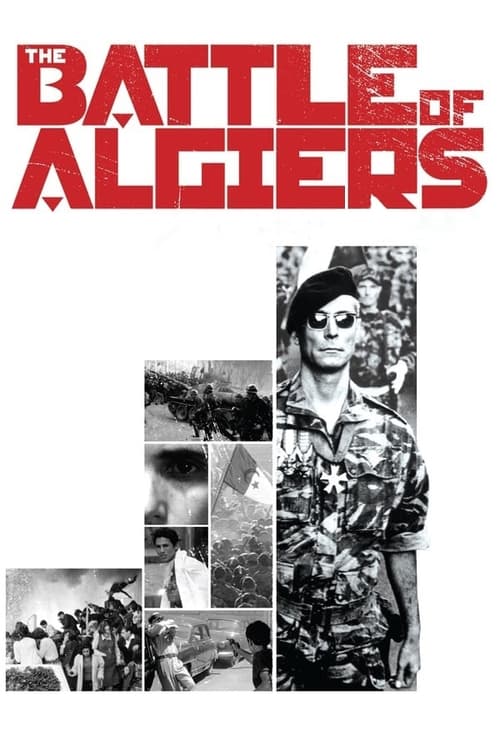
The Battle of Algiers (1966)
Directed by Gillo Pontecorvo
No · Based
How we score movies →Consciousness Markers
Class dimensions of colonialism are present throughout, particularly in the urban setting and the recruitment of working-class Algerians. However, this reflects Marxist film theory rather than contemporary anti-capitalist performance.
The film is deeply anti-colonial and centers Algerian perspectives, but operates from 1960s leftist ideology rather than contemporary racial awareness frameworks. It documents oppression without performing awareness of it.
The film casts Algerian and North African actors in lead roles, but this reflects historical authenticity and narrative necessity rather than contemporary diversity consciousness. The casting is not presented as a corrective statement.
The film presents the Algerian perspective on colonialism, which was counter-historical to dominant Western narratives of the 1960s. Yet it documents events rather than revising them, and uses actual locations and participants.
Women participate in the resistance (Fouzia El Kader), but the film does not emphasize or celebrate female agency as a distinct social issue. Their roles emerge naturally from the liberation struggle.
The film trusts viewers to understand colonialism's injustice through narrative and visual evidence. There is minimal preachy explanation or moral hand-holding, which is contrary to contemporary progressive cinema's tendency toward explicit messaging.
No LGBTQ+ themes or representation present in the film.
No climate-related themes or messaging present.
No body positivity themes or commentary present.
No neurodivergence representation or discussion present.


Synopsis
Paratrooper commander Colonel Mathieu, a former French Resistance fighter during World War II, is sent to Algeria to reinforce efforts to squelch the uprisings of the Algerian War. There he faces Ali la Pointe, a former petty criminal who, as the leader of the Algerian Front de Liberation Nationale, directs terror strategies against the colonial French government occupation. As each side resorts to ever-increasing brutality, no violent act is too unthinkable.
Why it received this score
The Battle of Algiers arrives as a film of genuine historical and political consequence, which is precisely why it scores modestly on contemporary progressive sensibilities. Pontecorvo's 1966 masterwork is unambiguously anti-colonial and sympathetic to the Algerian resistance, presenting the liberation struggle with seriousness and the French occupation as brutal and unjust. Yet the film operates from a mid-twentieth-century leftist framework, not the identity-conscious social awareness that defines 2020s cultural markers. The Algerian characters, portrayed by Algerian and North African actors, are presented as agents of their own liberation rather than as a casting exercise in diversity. This is representation in service of narrative authenticity, not as a conscious corrective to historical erasure.
What distinguishes this film from contemporary progressive cinema is its refusal to perform cultural awareness. There are no lectures about colonialism, no characters who exist primarily to explain oppression to the audience, no moral frameworks that require spelling out. The brutality of both French and Algerian forces is documented with clinical evenhandedness, allowing viewers to draw their own conclusions rather than having them guided by narrative hand-holding. Women participate in the resistance (Fouzia El Kader's role is significant), but the film does not pause to congratulate itself on female agency in liberation movements. Class consciousness runs throughout, yet this emerges from the material conditions of colonialism rather than from preachy social messaging.
The film's enduring influence on activist cinema and its adoption by various liberation movements speaks to its political power, but also to its distance from contemporary progressivism. It is a work that trusts the audience to understand colonialism's injustice without requiring constant affirmation of that understanding. By the standards of modern social consciousness filmmaking, this restraint reads as a deficit rather than a strength. The result is a film that remains politically serious without performing seriousness, which is perhaps why subsequent generations have had to add that performance themselves.
Analysis generated by our Consciousness Algorithm
Critic Reviews
“A prototype of news-footage realism, the film makes shrewd use of handheld sloppiness, misjudged focus, overexposure, and you-are-there camera upset; the payoff is the scent of authentic panic.”
“Like all masterpieces, it speaks to later ages as powerfully and intelligently as to its own.”
“Achieves its success through a combination of attitude and technique, uniting, to exceptional effect, a way of viewing the world morally while looking at it physically.”
“It's back in a handsome new black-and-white print, and it's still powerful stuff -- you can see why Pauline Kael wrote that it was "probably the only film that has ever made middle-class audiences believe in the necessity of bombing innocent people."”