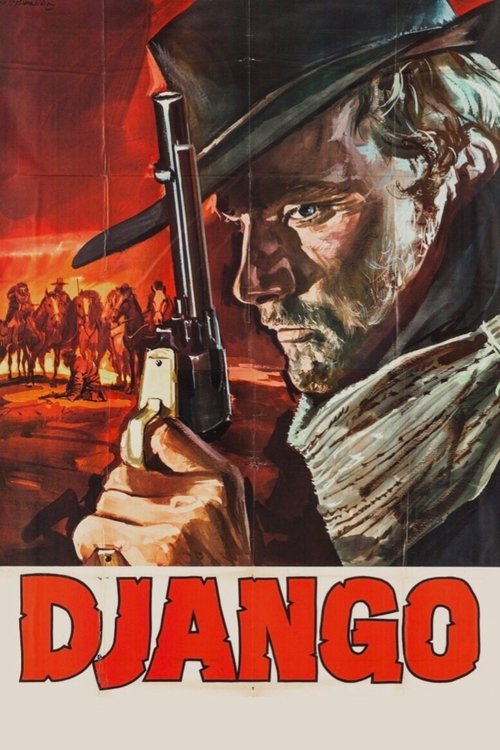
Django (1966)
Directed by Sergio Corbucci
No — Django is not woke, scoring 18 out of 100 on our wokeness meter.
Sergio Corbucci's Django (1966) arrives dragging its coffin and its reputation, a mud-caked unofficial riff on Kurosawa's Yojimbo that has spent six decades being mistaken for something more programmatic than it is.
Consciousness Markers
Major Jackson's Red Shirts are an explicit KKK analogue who use Mexican peons for target practice, and the film's leftist Italian creators built the villainy around racial terror — a genuine engagement with racism, though framed as 1960s anti-fascist politics rather than modern identity discourse.
Corbucci was a self-described left-wing political director, and the plot turns on greed for stolen gold, corrupt authority, and revolutionaries funding insurgency against a government — a mud-and-blood class-inflected cynicism rather than an explicit eat-the-rich sermon.
The cast is entirely white European (Nero, Nusciak, Bódalo, Fajardo), and the mixed-race prostitute María is played by white Italian actress Loredana Nusciak; the only nod is the narrative inclusion of a mixed-race co-protagonist, with no deliberate diverse casting.
The film shows rather than tells, delivering its politics through corpses, machine guns, and a coffin; there is no preaching, only a bleak, sardonic tone.
María is a damsel who is whipped, crucified, rescued, wounded, and begs to be taken along; Django's killing of an attempted rapist is a moral beat, not a feminist program.
No LGBTQ+ characters, themes, or subtext of any kind appear in the film.
No environmental or climate themes whatsoever; the mud is aesthetic, not allegorical.
No body-positivity themes; the film's treatment of the body is purely visceral violence.
Django's crushed hands are a physical disability used for a grim final gag (a nod to guitarist Django Reinhardt), not a neurodivergence theme.
The film is a loose unofficial riff on Kurosawa's Yojimbo set in a fictional border town, not a rewriting of real historical events for ideological ends.
Why it received this score
Sergio Corbucci's Django (1966) arrives dragging its coffin and its reputation, a mud-caked unofficial riff on Kurosawa's Yojimbo that has spent six decades being mistaken for something more programmatic than it is. On the matter of casting, the film offers almost nothing to admire. Franco Nero, José Bódalo, Loredana Nusciak, Eduardo Fajardo: a uniformly white European ensemble, with the mixed-race prostitute María handed to a white Italian actress. The character's mixed parentage exists in the script as texture, not as a casting principle. No LGBTQ presence of any kind registers. María is whipped, crucified, rescued, wounded, and finally reduced to begging Django to take her along, which is a damsel's arc with extra lashings.
Where the film does engage the culture is race, and it does so with some conviction. Major Jackson's Red Shirts are a hooded Klan analogue who use Mexican peons for target practice, and Corbucci reportedly studied Klan newsreel footage while writing them. This is anti-fascist politics of the 1960s, not contemporary identity discourse, but the engagement is genuine. The politics of money are present and unspoken: stolen gold, corrupt authority, revolutionaries funding an insurgency. Corbucci was a self-described left-wing director, and the film's class cynicism is real, though it is delivered through greed and betrayal instead of a speech.
The remaining categories are barren. No climate allegory, the mud is aesthetic. No body positivity, the body here is only a site for violence. No neurodivergence, since Django's crushed hands are a grim joke about the guitarist Django Reinhardt. No revisionist history, only a fictional border town. And no lecturing whatsoever. The film argues with corpses, machine guns, and a coffin, and it lets the audience do the arithmetic.
Analysis generated by our Consciousness Algorithm


Synopsis
A coffin-dragging gunslinger and a prostitute become embroiled in a bitter feud between a Klan of Southern racists and a band of Mexican Revolutionaries.
Questions about Django
Is Django woke?
No — Django is not woke, scoring 18 out of 100 on our wokeness meter. That earns it a verdict of Ultra Based.
Does Django have any woke elements?
1 of the 10 markers register at 30 or above, led by Racial Consciousness (40). On Racial Consciousness: Major Jackson's Red Shirts are an explicit KKK analogue who use Mexican peons for target practice, and the film's leftist Italian creators built the villainy around racial terror — a genuine engagement with racism, though framed as 1960s anti-fascist politics rather than modern identity discourse.
How does Django compare to other 1966 movies?
It ranks #3 of the 18 films from 1966 we've scored; their average is 7. The wokest is Daisies (28).
How is the Woke Score calculated?
An AI-assisted process researches the film and its reception, scores it 0–100 on ten markers, then combines those into one 0–100 Woke Score. It measures a specific set of 2020s cultural themes, not film quality.