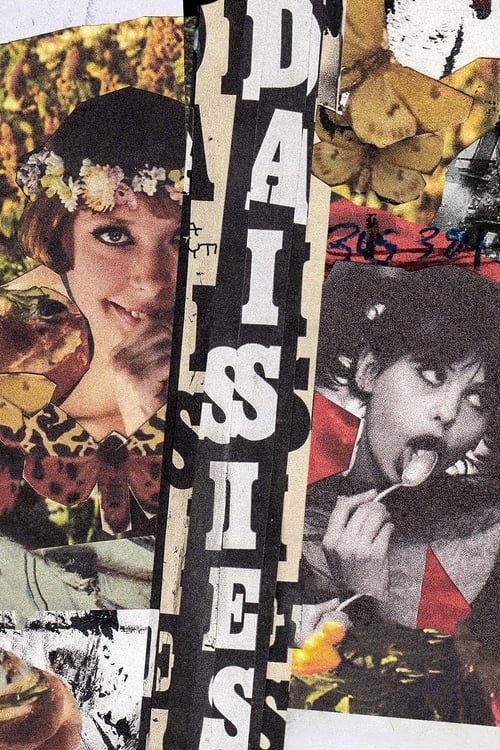
Daisies (1966)
Directed by Věra Chytilová
No · Based
How we score movies →Consciousness Markers
The destruction of consumption and property has anti-capitalist resonance, though the film's anarchism is too aestheticized and uncommitted to constitute genuine political critique.
Female characters subvert authority and patriarchal norms through destruction, but the film lacks explicit feminist consciousness or messaging about gender justice.
Two female protagonists in lead roles is notable for 1966, though their gender is not the basis of their narrative function or the film's meaning.
The film is deliberately non-preachy and refuses to explain or moralize its anarchic vision, operating through visual and narrative disruption rather than exposition.
No LGBTQ+ themes or representation present in the film.
No racial themes, racial consciousness, or engagement with racial justice appear in this Czechoslovak film.
No environmental or climate-related themes present in the narrative.
No body positivity messaging or representation present in the film.
No neurodivergence representation or themes present.
The film does not engage in revisionist history or reinterpretation of historical events.


Synopsis
Two teenage girls embark on a series of destructive pranks in which they consume and destroy the world around them.
Why it received this score
Věra Chytilová's "Daisies" arrives to us as a genuinely anarchic film, though one must be cautious about retrofitting modern cultural categories onto work created in 1966 Czechoslovakia. The two female protagonists operate as agents of chaos and destruction in a patriarchal society, which has led some contemporary critics to read the film as proto-feminist or even proto-woke in its rejection of social order. Yet the film's radical posture flows from Soviet-era avant-garde sensibilities and existential rebellion rather than from the specific constellation of progressive identity politics that characterize contemporary social consciousness.
The film's visual style, its formal experimentation, and its deliberate rejection of narrative convention all serve an anarchic rather than a progressive political project. The girls consume and destroy indiscriminately, their rampage devoid of the consciousness-raising or awareness-building that modern progressive cinema insists upon. There is no lesson learned, no system critiqued for its injustices, no marginalized voice uplifted. The destruction is ornamental, aesthetic, almost playful in its refusal of meaning. The government's decision to ban the film for twenty years speaks to its perceived danger as an anarchic work, not as a work of social justice advocacy.
We might say that "Daisies" occupies an interesting historical position: it was revolutionary in its time, and its female protagonists do subvert authority, but the subversion operates on a register entirely separate from contemporary progressive sensibilities. The film is too anarchic, too committed to pure negation, too uninterested in building alternatives or centering marginalized perspectives. It remains a work of genuine artistic radicalism, but one that predates and operates outside the framework of modern woke cinema.
Analysis generated by our Consciousness Algorithm
Critic Reviews
“There's a vibrating chaos at the heart ofDaisies, considered the most significant achievement in Czech cinema. It's a study of patriarchy through the eyes of two cartoon-like women whose behaviors and antics are intentionally exaggerated.”
“Daisies is a great piece of cinematic art, a bizarre comedy that you can't look away from, with a trenchant social commentary that is just as relevant today as it was over 50 years ago.”
“But even asDaisieswas the subject of controversy, the film itself already seemed to come up with the perfect rebuttal to that very notion and that there only makes a case for why it remains one of the most fascinating pieces of1960'scinema ever to have been made.”
“"Daisies" reminds us to indulge slightly in our fleeting time, but not attempt to take back from the world what it takes from us, a parable in moderation and patience and one we still need 60 years later.”