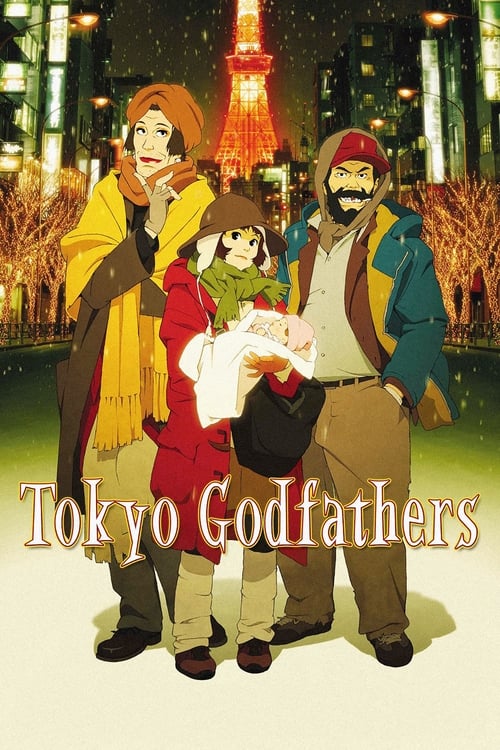
Tokyo Godfathers (2003)
Directed by Satoshi Kon
No — Tokyo Godfathers is not especially woke, scoring 32 out of 100 on our wokeness meter.
Satoshi Kon's Tokyo Godfathers arrives with a premise that could have been engineered for a lecture.
Consciousness Markers
Hana is a transgender woman whose identity is treated with genuine warmth and complexity, including reflections on motherhood and her past as a drag performer. This is substantial, sympathetic queer representation well ahead of its era.
The three leads are homeless outcasts — an alcoholic, a runaway teen, and a transgender woman — placing society's discarded at the center with unusual dignity for 2003. Hana in particular is a fully realized transgender character rather than a punchline.
Strong and varied female characters (Miyuki, Hana, Sachiko) drive much of the emotional core, but the film is organized around family and redemption rather than any explicit feminist thesis.
The protagonists' homelessness and the city's indifference gesture toward social critique, but Kon explicitly rejected framing them as societal victims; the story is about personal recovery, not economic indictment.
The film wears its messages lightly, favoring miracle-tinged coincidence and tragicomic warmth over preaching; Kon deliberately avoided making his homeless leads into moral spokespersons.
The film is a Japanese story with Japanese characters, and a Latino hitman and his Spanish-speaking wife appear as incidental figures. There is no racial-consciousness commentary or theme.
Hana, a large transgender woman, is portrayed without mockery, but the film makes no thematic argument about body image or self-acceptance.
No environmental or climate content whatsoever.
No neurodivergence themes or characters.
No historical revisionism; the film is a contemporary fable set in present-day Tokyo.
Why it received this score
Satoshi Kon's Tokyo Godfathers arrives with a premise that could have been engineered for a lecture. Three homeless people in Tokyo, an alcoholic, a runaway teenager, and a transgender woman, find an abandoned infant in the trash on Christmas Eve and set out to return her. The material is loaded. Kon, to his credit, declines to fire it. The film treats its discarded protagonists with a dignity that was uncommon in 2003, granting each a full interior life and a private grief, then sending them through a chain of improbable coincidences that plays like a secular miracle.
Hana, the transgender woman, is the heart of the thing. She is written with warmth and complexity, mourning a lover, reflecting on a drag career, hungering for motherhood, and at no point is she the joke. For a mainstream animated feature two decades ago, this is substantial and sympathetic treatment, and it holds up. The film also hands its emotional engine to women: Hana, Miyuki, and the desperate mother Sachiko. That said, the story is organized around family and recovery, not around any thesis about gender or power, so the progressive content sits inside the drama instead of on top of it.
What the film refuses to do is more instructive than what it does. Kon was explicit that his homeless leads are not victims of an economy, and the movie bears him out: the city is indifferent, but the problem is personal, not structural. There is no environmental allegory, no sermon on the body, no historical revisionism. The messages are worn lightly, delivered through slapstick and coincidence. We classify it, therefore, as a work of quiet social awareness, ahead of its moment in casting and in its portrait of Hana, and mercifully free of the pulpit.
Analysis generated by our Consciousness Algorithm
Part of


Synopsis
On Christmas Eve, three homeless people living on the streets of Tokyo discover a newborn baby among the trash and set out to find its parents.
Questions about Tokyo Godfathers
Is Tokyo Godfathers woke?
No — Tokyo Godfathers is not especially woke, scoring 32 out of 100 on our wokeness meter. That earns it a verdict of Based.
Does Tokyo Godfathers have any woke elements?
2 of the 10 markers register at 30 or above, led by LGBTQ+ Themes (68) and Representation Casting (58). On LGBTQ+ Themes: Hana is a transgender woman whose identity is treated with genuine warmth and complexity, including reflections on motherhood and her past as a drag performer.
How does Tokyo Godfathers compare to other 2003 movies?
It ranks #8 of the 150 films from 2003 we've scored; their average is 12. The wokest is Mona Lisa Smile (60).
How is the Woke Score calculated?
An AI-assisted process researches the film and its reception, scores it 0–100 on ten markers, then combines those into one 0–100 Woke Score. It measures a specific set of 2020s cultural themes, not film quality.