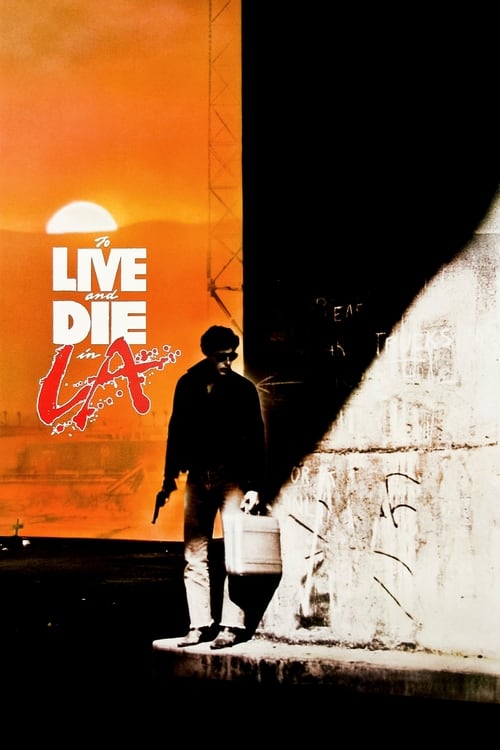
To Live and Die in L.A. (1985)
Directed by William Friedkin
No — To Live and Die in L.A. is not woke, scoring 4 out of 100 on our wokeness meter.
William Friedkin's 1985 neo-noir arrives from a lean $6 million budget and a former Secret Service agent's manuscript, and it carries the fingerprints of neither committee nor cause.
Consciousness Markers
The cast is overwhelmingly white and male, with Steve James in a minor supporting role and no deliberate diversity casting. The film's authenticity-driven ensemble reflects 1985 norms rather than any representational agenda.
The two significant female characters are a sexual-extortion informant and a girlfriend who betrays the villain; both exist as instruments of the male plot. No feminist critique or agency is on offer.
No LGBTQ+ characters, themes, or subtext of any kind appear in this neo-noir procedural.
An Asian-American undercover FBI agent (Thomas Ling) appears, but his ethnicity is incidental and carries no racial commentary or consciousness.
No environmental themes whatsoever.
The film concerns counterfeiting and law-enforcement corruption, not class warfare or economic critique. No eat-the-rich sentiment.
No body-positivity themes or messaging.
No neurodivergence themes or characters.
A fictional crime story drawn from a novel; no historical revisionism.
A lean, cynical genre exercise that shows rather than preaches. It offers no moralizing lecture on its themes of obsession and corruption.
Why it received this score
William Friedkin's 1985 neo-noir arrives from a lean $6 million budget and a former Secret Service agent's manuscript, and it carries the fingerprints of neither committee nor cause. The cast is a wall of white men in bad ties, with Steve James granted a supporting slot that exists because the plot required a body, not a statement. Debra Feuer and Darlanne Fluegel occupy the two female roles on offer, one a girlfriend who sells out the villain, the other an informant kept compliant through sexual extortion. The film observes this arrangement without comment, and it has no interest in commenting.
No same-sex currents surface anywhere in the narrative. No racial consciousness animates the proceedings, even when an Asian-American undercover agent wanders into the crossfire and dies for the convenience of the plot. There is no environmental sermon, no class warfare, no celebration of the body in its many forms, no diagnosis of the neurodivergent mind. The film is too busy watching a man drive the wrong way down a freeway while his passenger screams.
What remains is a picture that trusts its audience to draw conclusions. It shows obsession, corruption, and the slow moral collapse of John Vukovich, and it never stops to explain what we should feel about any of it. No narrator arrives to instruct us on the sins of the carceral state or the counterfeit economy. Friedkin points the camera and lets the ugliness breathe. This is either a relic of a less self-conscious era or a quiet rebuke to our own. Either way, it earns its standing as a document of genre craft, and it leaves the classification ledger nearly blank. Nearly. A few faint marks remain, and we record them without enthusiasm.
Analysis generated by our Consciousness Algorithm


Synopsis
When his longtime partner on the force is killed, reckless U.S. Secret Service agent Richard Chance vows revenge, setting out to nab dangerous counterfeit artist Eric Masters.
Questions about To Live and Die in L.A.
Is To Live and Die in L.A. woke?
No — To Live and Die in L.A. is not woke, scoring 4 out of 100 on our wokeness meter. That earns it a verdict of Ultra Based.
Does To Live and Die in L.A. have any woke elements?
Very few. None of the 10 markers reaches 30, the level where a marker counts as present; the highest is Representation Casting at 8.
How does To Live and Die in L.A. compare to other 1985 movies?
It ranks #33 of the 68 films from 1985 we've scored; their average is 8. The wokest is The Color Purple (62).
How is the Woke Score calculated?
An AI-assisted process researches the film and its reception, scores it 0–100 on ten markers, then combines those into one 0–100 Woke Score. It measures a specific set of 2020s cultural themes, not film quality.