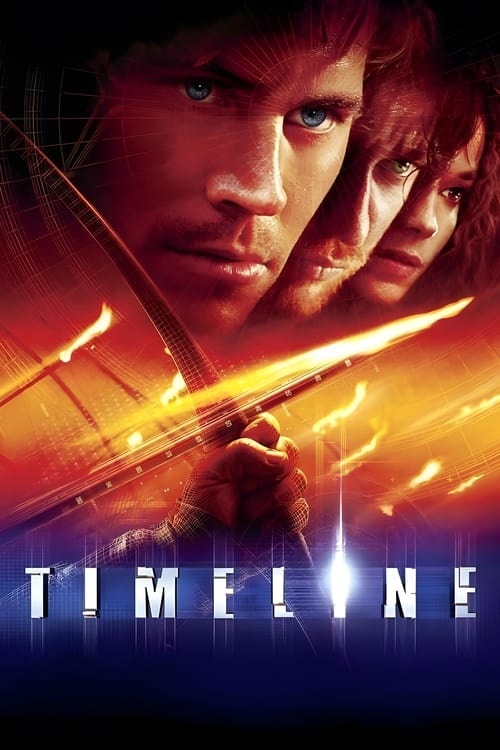
Timeline (2003)
Directed by Richard Donner
No — Timeline is not woke, scoring 9 out of 100 on our wokeness meter.
Michael Crichton's novel receives a workmanlike disinterment from Richard Donner, who trades the author's quantum fussiness for mud, horses, and Gerard Butler at full volume.
Consciousness Markers
The ITC Corporation is a greedy, reckless enterprise whose executives endanger lives and sabotage rescue efforts to protect profits, giving the film a mild corporate-villain streak.
Kate Erickson is a competent archaeology student who contributes to the escape and battle, and Lady Claire is a historical martyr figure, but neither is framed through an explicit feminist lens.
The cast is overwhelmingly white and European, with Frances O'Connor and Anna Friel providing the only notable female presence; no meaningful diverse or non-traditional casting choices are evident.
The film is a pulpy action-adventure with little didacticism; any exposition about quantum mechanics or medieval history is functional rather than preachy.
There is no LGBTQ+ content, subtext, or character in the film whatsoever.
The film engages no racial themes; its medieval French and modern academic settings are uniformly white with no commentary on race.
No environmental or climate themes appear in the story.
No body-positivity themes or messaging are present.
No neurodivergent characters or themes are depicted.
The film is a time-travel adventure that plays with the Hundred Years' War, but it does not revise history for ideological purposes; the protagonist ultimately restores the original timeline.
Why it received this score
Michael Crichton's novel receives a workmanlike disinterment from Richard Donner, who trades the author's quantum fussiness for mud, horses, and Gerard Butler at full volume. A cluster of archaeology students fall through a wormhole into 1357 Dordogne to retrieve their stranded professor, and the film devotes its opening act to a New Mexico corporate campus where nervous executives explain that the teleportation device was never intended to move people anywhere. The antagonist is a company, ITC, whose president would let a rescue party perish before absorbing a writedown. That is as close as the picture comes to an argument. Greed is bad, the boardroom is chilly, and a former employee, warped by too many trips through the machine, nurses a genuine grievance about being lied to regarding his own cellular decay. He gets a monologue and then a sword.
The ensemble is white, European, and largely interchangeable, with Frances O'Connor and Anna Friel supplying the only notable female presence. O'Connor's Kate is competent, useful in a fight, and permitted to sway a battle by leading soldiers through a monastery tunnel. Nobody frames this as a statement, and the film has no interest in making it one. There is no racial text, no queer text, no environmental text, no meditation on bodies or minds that depart from a narrow norm. The medieval setting is a backdrop for swordplay, not a site of historical reconsideration, and the protagonist's final act is to restore the timeline exactly as he found it. The movie is not arguing with the past. It is using the past as a location.
What remains is a sullen, overcast adventure that opened at number twelve and vanished, one of the more expensive shrugs of its decade. The screenplay reduces a clever premise to a chase, and Donner, a reliable craftsman, directs it without conviction. No sermonizing intrudes, no lecture, no moment where the film pauses to instruct its audience on how to feel about the fourteenth century. It simply wants to get everyone home, and it fails at that with a kind of grim professionalism. We are left with a relic, and like the knight in the sarcophagus, it holds a hand that no longer reaches back.
Analysis generated by our Consciousness Algorithm
Part of


Synopsis
A group of archaeological students become trapped in the past when they go there to retrieve their professor. The group must survive in 14th century France long enough to be rescued.
Questions about Timeline
Is Timeline woke?
No — Timeline is not woke, scoring 9 out of 100 on our wokeness meter. That earns it a verdict of Ultra Based.
Does Timeline have any woke elements?
Very few. None of the 10 markers reaches 30, the level where a marker counts as present; the highest is Eat the Rich at 22.
How does Timeline compare to other 2003 movies?
It ranks #64 of the 150 films from 2003 we've scored; their average is 12. The wokest is Mona Lisa Smile (60).
How is the Woke Score calculated?
An AI-assisted process researches the film and its reception, scores it 0–100 on ten markers, then combines those into one 0–100 Woke Score. It measures a specific set of 2020s cultural themes, not film quality.