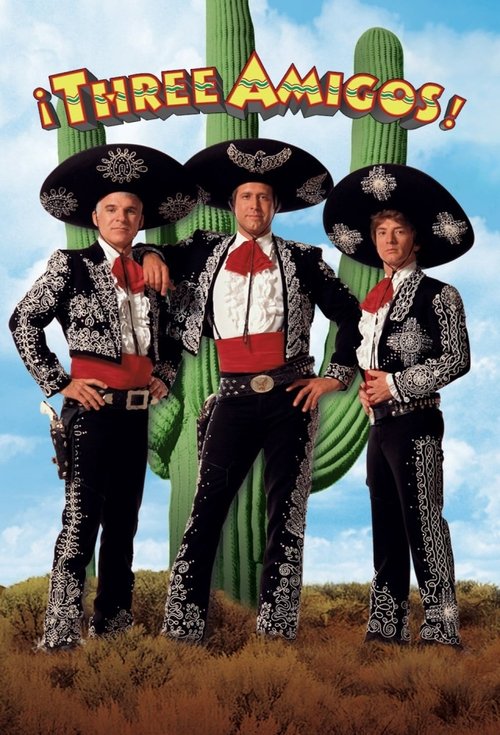
¡Three Amigos! (1986)
Directed by John Landis
No — ¡Three Amigos! is not woke, scoring 8 out of 100 on our wokeness meter.
¡Three Amigos! arrives from 1986, a year in which a Western spoof could still be assembled from three comedians, a sweeping orchestral score by Elmer Bernstein, and a Randy Newman songbook, with nobody pausing to ask what the material was saying about anything.
Consciousness Markers
The cast features Mexican actors (Alfonso Arau, Tony Plana, Patrice Martinez) playing Mexican characters, but this is natural, period-appropriate casting for a 1986 Western spoof rather than a modern representation initiative.
The studio producer Flugleman is a mildly greedy caricature who fires the Amigos over salary demands, but the film makes no sustained anti-capitalist argument.
The Mexican village setting is treated as comedic backdrop for a Hollywood spoof, with no engagement of racial consciousness or systemic critique.
Carmen functions as a damsel who summons the heroes and is later kidnapped; the film offers no feminist framing or commentary.
This is a slapstick musical comedy with no didactic or preachy messaging; the closest it comes to a moral is the throwaway motto 'our reward is that justice has been done.'
No LGBTQ+ characters, themes, or subtext of any kind appear in the film.
No environmental or climate themes are present.
No body positivity themes or messaging appear.
No neurodivergence themes or characters are present.
The film is a broad parody of Western tropes, not a revisionist reworking of history or historical figures.
Why it received this score
¡Three Amigos! arrives from 1986, a year in which a Western spoof could still be assembled from three comedians, a sweeping orchestral score by Elmer Bernstein, and a Randy Newman songbook, with nobody pausing to ask what the material was saying about anything. The answer, examined with the solemnity this archive demands, is very little. Three unemployed silent film actors are mistaken for gunfighters by the residents of Santa Poco, they flee, they return, they win. The film is a machine for jokes, and it runs on slapstick, musical numbers, and the sight of Chevy Chase falling down.
On the matter of casting, the production hired Mexican and Mexican American performers (Alfonso Arau as El Guapo, Tony Plana as Jefe, Patrice Martinez as Carmen) to play Mexican characters, which in 1986 counted as ordinary professional practice instead of a stated initiative. The village itself serves as comedic scenery, a place where the heroes are pampered and the bandits are loud, and no systemic observation is offered or wanted. Carmen summons the heroes, gets kidnapped, and waits. Joe Mantegna's studio chief fires the trio over a salary dispute, a mild joke about money that stops well short of a thesis on capital.
What remains is the film's closing sentiment, that justice itself is the reward, delivered as a punchline and then abandoned. There is no sermon here, no lesson appended to the final reel, no sense that the audience is being instructed in how to live. This is a comedy that wants nothing from us but laughter, and it mostly gets it. Some vintages are simply not built for the cellar.
Analysis generated by our Consciousness Algorithm


Synopsis
A trio of unemployed silent film actors are mistaken for real heroes by a small Mexican village in search of someone to stop a malevolent bandit.
Questions about ¡Three Amigos!
Is ¡Three Amigos! woke?
No — ¡Three Amigos! is not woke, scoring 8 out of 100 on our wokeness meter. That earns it a verdict of Ultra Based.
Does ¡Three Amigos! have any woke elements?
Very few. None of the 10 markers reaches 30, the level where a marker counts as present; the highest is Representation Casting at 15.
How does ¡Three Amigos! compare to other 1986 movies?
It ranks #17 of the 62 films from 1986 we've scored; their average is 7. The wokest is Star Trek IV: The Voyage Home (42).
How is the Woke Score calculated?
An AI-assisted process researches the film and its reception, scores it 0–100 on ten markers, then combines those into one 0–100 Woke Score. It measures a specific set of 2020s cultural themes, not film quality.