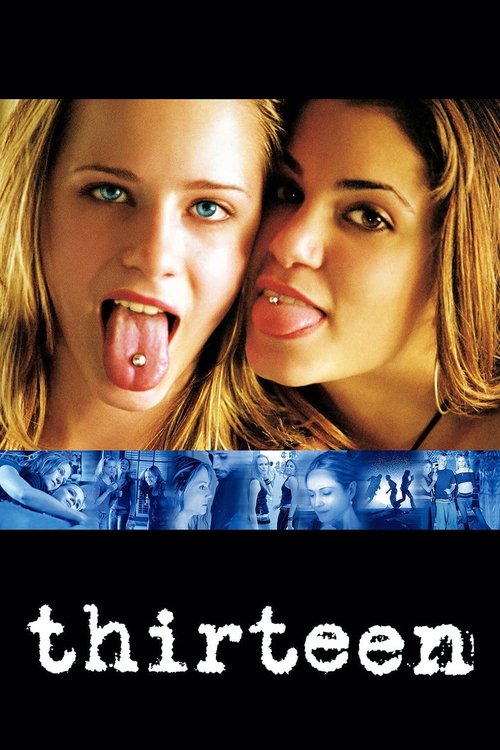
Thirteen (2003)
Directed by Catherine Hardwicke
No — Thirteen is not woke, scoring 18 out of 100 on our wokeness meter.
Catherine Hardwicke's directorial debut arrives from 2003, a year before the culture began keeping the ledgers we now keep.
Consciousness Markers
A woman-directed, woman-co-written film centered entirely on female characters and a mother-daughter relationship, with Hardwicke noting the all-female cast made studios wary; the feminist content is structural rather than polemical.
The cast is overwhelmingly white, with only incidental background diversity; the film makes no effort at representative casting as a statement.
The film is a raw cinéma-vérité depiction rather than a sermon; it shows consequences without explicitly preaching a message to the audience.
There is a brief same-sex kiss between Tracy and Evie, but it is framed as part of their shared spiral of transgressive behavior rather than as LGBTQ identity or romance.
The film gestures at consumerism and status-signaling through shopping and shoplifting, but offers no systemic anti-capitalist critique.
The film engages no racial themes whatsoever; its milieu is affluent white Los Angeles suburbia.
No environmental or climate content of any kind.
No body-positivity themes; the film depicts self-harm and a botched plastic surgery without any body-acceptance framing.
No neurodivergence content; Tracy's struggles are framed as behavioral and environmental, not neurological.
No historical subject matter to revise.
Why it received this score
Catherine Hardwicke's directorial debut arrives from 2003, a year before the culture began keeping the ledgers we now keep. It was written in six days with Nikki Reed, then fourteen, drawn from her own early adolescence, and shot on super 16mm over twenty-four days with a hand-held camera that gives the whole thing the texture of a documentary. Tracy, thirteen, drifts from honors student to shoplifter, inhalant user, and self-harmer under the guidance of the popular Evie. The film watches. It does not explain.
The feminist architecture is real and structural. Every central character is a woman, the emotional engine is a mother-daughter relationship, and Hardwicke has said plainly that studios were terrified of a rated-R picture about a teenage girl with an all-female cast. That registers. Elsewhere the ledger is thin. The casting is overwhelmingly white and the setting is affluent Los Angeles suburbia, so racial consciousness never enters the room. A single same-sex kiss occurs between the girls, but the film treats it as one more item on a menu of transgression, not as identity. Shoplifting and status-signaling gesture at consumerism without ever building a case against the system that produces them.
The remaining categories sit empty, and honestly. There is no climate content, no body-acceptance framing (self-harm and a botched surgery are simply shown), no neurodivergence, no history to revise. Most tellingly, there is no sermon. The film shows a girl spinning alone on a merry-go-round, screaming, and then it stops. Hardwicke trusts us to draw the conclusion ourselves. In the current taxonomy that restraint reads as almost quaint, a reminder that a film can be devastating without ever telling the audience what to think.
Analysis generated by our Consciousness Algorithm


Synopsis
When 13-year-old Tracy befriends Evie, the most popular girl in school, her life is turned upside down as Evie introduces her to a world of sex, drugs, and money. But it isn’t long before Tracy’s new lifestyle begins to take a heavy toll on her and her family.
Questions about Thirteen
Is Thirteen woke?
No — Thirteen is not woke, scoring 18 out of 100 on our wokeness meter. That earns it a verdict of Ultra Based.
Does Thirteen have any woke elements?
1 of the 10 markers register at 30 or above, led by Feminist Agenda (42). On Feminist Agenda: A woman-directed, woman-co-written film centered entirely on female characters and a mother-daughter relationship, with Hardwicke noting the all-female cast made studios wary; the feminist content is structural rather than polemical.
How does Thirteen compare to other 2003 movies?
It ranks #33 of the 150 films from 2003 we've scored; their average is 12. The wokest is Mona Lisa Smile (60).
How is the Woke Score calculated?
An AI-assisted process researches the film and its reception, scores it 0–100 on ten markers, then combines those into one 0–100 Woke Score. It measures a specific set of 2020s cultural themes, not film quality.