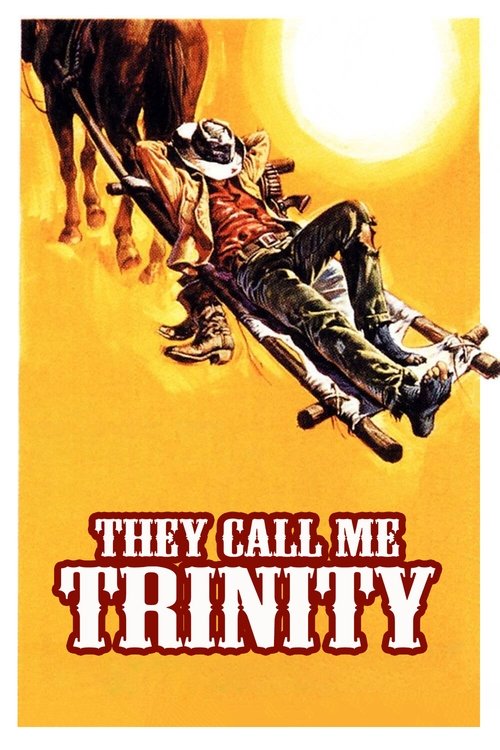
They Call Me Trinity (1970)
Directed by Enzo Barboni
No — They Call Me Trinity is not woke, scoring 5 out of 100 on our wokeness meter.
Enzo Barboni's They Call Me Trinity arrives from 1970 with a lean cultural inventory.
Consciousness Markers
Major Harriman is a wealthy land baron driving farmers off their valley, a standard Western villain trope rather than a modern eat-the-rich critique.
The cast is entirely white European actors, with no diverse casting or representation considerations whatsoever.
No LGBTQ+ characters, themes, or subtext appear anywhere in the film.
The two Mormon sisters exist only as objects of Trinity's romantic interest, and women play no agentive role in the story.
Mexican bandits and Mormon settlers appear as stock Western archetypes with no engagement of racial identity or consciousness.
The land dispute concerns grazing rights and horse theft, not any environmental or climate theme.
No body positivity themes; the film trades in slapstick physical comedy without any commentary on body image.
No neurodivergent characters or themes are present.
The film is a comedic parody of the Western genre, not a revisionist reframing of historical events.
The film is pure slapstick entertainment with no didactic or preachy messaging.
Why it received this score
Enzo Barboni's They Call Me Trinity arrives from 1970 with a lean cultural inventory. Terence Hill plays the title gunslinger, a man of unnaturally fast hands and limited ambition. Bud Spencer plays his brother Bambino, a horse thief currently impersonating a sheriff while he waits for his gang to leave prison. Together they defend a settlement of pacifist Mormons from Major Harriman, a land baron who wants their valley for grazing. The film was shot in Abruzzo, became one of the most successful Italian exports of its era, and later lent its theme song to Quentin Tarantino. What it did not do was carry any of the progressive freight we now routinely inspect for. There is nothing here to inspect.
The cast is uniformly white European. The two Mormon sisters exist to be courted and then abandoned once Trinity learns that Mormon life requires labor, prayer, and discipline. They possess no interiority worth the runtime. Mexican bandits and Mormon settlers function as genre furniture, their identities unexamined and unremarked. No character is queer. No character is neurodivergent. No body is celebrated, no ecosystem is defended, no history is reframed. The land dispute concerns unbranded horses and grazing rights, which is to say it concerns property, and the film resolves it with a cattle brand and a punchline. Major Harriman is a wealthy man who sends bullies to harass farmers. That is the whole of his villainy. It is the oldest shape in the Western, not a critique of capital.
The comedy is physical. Beans are eaten in a single take after a day of fasting. Men fall off horses. Nobody lectures anybody about anything, which in this house counts as a virtue. The film is pleasant, weightless, and ideologically inert. We grade it accordingly, with one grudging nod toward the land baron, and then we move on.
Analysis generated by our Consciousness Algorithm


Synopsis
The simple story has the pair coming to the rescue of peace-loving Mormons when land-hungry Major Harriman sends his bullies to harass them into giving up their fertile valley. Trinity and Bambino manage to save the Mormons and send the bad guys packing with slapstick humor instead of excessive violence, saving the day.
Questions about They Call Me Trinity
Is They Call Me Trinity woke?
No — They Call Me Trinity is not woke, scoring 5 out of 100 on our wokeness meter. That earns it a verdict of Ultra Based.
Does They Call Me Trinity have any woke elements?
Very few. None of the 10 markers reaches 30, the level where a marker counts as present; the highest is Eat the Rich at 8.
How does They Call Me Trinity compare to other 1970 movies?
It ranks #12 of the 23 films from 1970 we've scored; their average is 8. The wokest is Little Big Man (38).
How is the Woke Score calculated?
An AI-assisted process researches the film and its reception, scores it 0–100 on ten markers, then combines those into one 0–100 Woke Score. It measures a specific set of 2020s cultural themes, not film quality.