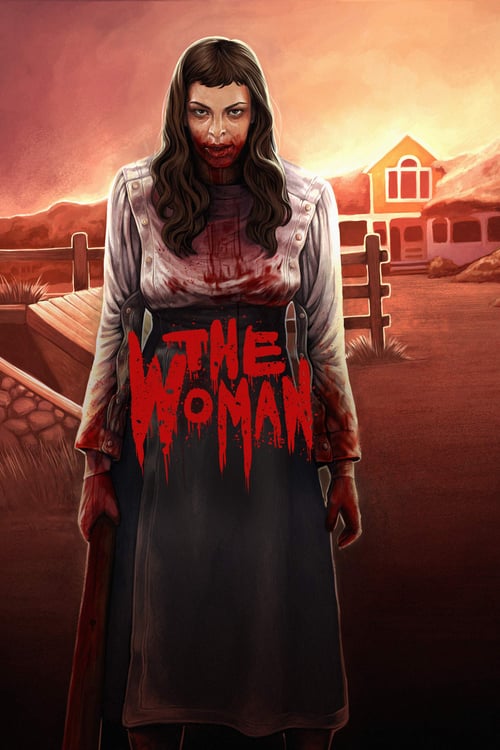
The Woman (2011)
Directed by Lucky McKee
No — The Woman is not woke, scoring 14 out of 100 on our wokeness meter.
Lucky McKee's The Woman arrives as a sequel to Offspring, an adaptation of the novel he wrote with Jack Ketchum, and a study in the outer limits of the revenge picture.
Consciousness Markers
The film is a brutal rape-and-revenge horror that stages the destruction of a misogynistic, sadistic patriarch by a feral woman, and gives its female victims (Belle, Peggy) moments of rebellion and solidarity. It reads as feminist-inflected in theme, though filtered through exploitation-horror conventions rather than explicit advocacy.
The principal cast is overwhelmingly white and non-diverse; the only notable 'representation' is a female lead and a female-driven revenge narrative, which is not what this marker tracks.
Themes of misogyny and abuse are delivered viscerally through violence rather than through speeches or didactic messaging; there is essentially no lecturing.
No LGBTQ+ characters, relationships, or themes appear anywhere in the film.
Race is never a subject or subtext; the film's conflicts are entirely intra-family and gendered.
No environmental or climate themes are present.
The villain is a deranged country lawyer, but the film targets patriarchal abuse and sadism, not economic class or capitalism.
The body is treated as a site of gore, torture, and violation, the antithesis of body-positivity messaging.
Mental illness is invoked only as a horror-villain trope (the 'mentally deranged' Chris), which is stigmatizing rather than affirming representation.
The film is a contemporary fictional horror story with no historical re-framing.
Why it received this score
Lucky McKee's The Woman arrives as a sequel to Offspring, an adaptation of the novel he wrote with Jack Ketchum, and a study in the outer limits of the revenge picture. A feral woman, last of a cannibal clan, is captured by Chris Cleek, a country lawyer of surpassing awfulness, who chains her in a cellar and instructs his family to civilize her. What follows is a long, methodical inventory of cruelty: boiling water, a power washer, pliers, a barn full of dogs, and a secret daughter who lives among them. The film has no interest in subtlety, and no interest in telling us what to think about any of it.
That reticence is the picture's most distinguishing feature. Its gender politics are unmistakable, a misogynistic patriarch dismantled by the woman he tried to tame, with the women around him finding brief moments of rebellion and solidarity before the mower blade arrives. None of this is announced. The film argues through viscera, not speeches, and the sermonizing that so often accompanies such material is absent. It is exploitation cinema with a grudge, and it trusts the audience to draw its own conclusions.
Where the film is silent, it is genuinely silent. Race never enters the frame as subject or subtext. Neither does class, despite a villain who happens to be a lawyer. There is no environmental conscience, no queer presence, no affirmation of the body as anything but a site of violation. Mental illness appears only as a label for the monster, which is the oldest and least defensible use of it. What remains is a nasty, single-minded piece of work, and it knows exactly what it is.
Analysis generated by our Consciousness Algorithm


Synopsis
A lawyer puts his family in jeopardy when he captures the last member of a violent clan and tries to forcibly tame her.
Questions about The Woman
Is The Woman woke?
No — The Woman is not woke, scoring 14 out of 100 on our wokeness meter. That earns it a verdict of Ultra Based.
Does The Woman have any woke elements?
1 of the 10 markers register at 30 or above, led by Feminist Agenda (42). On Feminist Agenda: The film is a brutal rape-and-revenge horror that stages the destruction of a misogynistic, sadistic patriarch by a feral woman, and gives its female victims (Belle, Peggy) moments of rebellion and solidarity.
How does The Woman compare to other 2011 movies?
It ranks #65 of the 245 films from 2011 we've scored; their average is 11. The wokest is Paul (68).
How is the Woke Score calculated?
An AI-assisted process researches the film and its reception, scores it 0–100 on ten markers, then combines those into one 0–100 Woke Score. It measures a specific set of 2020s cultural themes, not film quality.