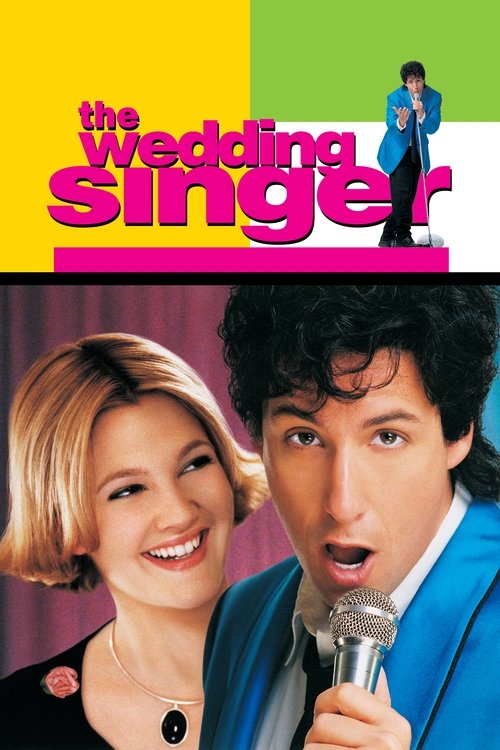
The Wedding Singer (1998)
Directed by Frank Coraci
No — The Wedding Singer is not woke, scoring 6 out of 100 on our wokeness meter.
The Wedding Singer arrives from 1998, a romantic comedy set in 1985, and it regards the past as a costume rack.
Consciousness Markers
Carrie Fisher was reportedly brought in to balance the female perspective and Barrymore's Julia gets genuine interiority, but the film remains a conventional rom-com where the woman is largely the prize to be won.
A faint money-versus-love thread runs through the plot via Glenn the cheating bond investor and Holly's suggestion that Julia is marrying for financial security, but it is a plot device rather than a critique of wealth.
The cast is overwhelmingly white, with the only notable non-white or minority presence being Alexis Arquette's Boy George impersonation played as a broad gag; no meaningful diverse casting.
The film is a light romantic comedy with no preachy messaging; any moralizing is limited to the gentle 'be honest about your feelings' resolution.
The Boy George drag impersonation is a comedic set piece, not an exploration of LGBTQ+ identity or themes; no queer content of substance.
No engagement with race or racial themes whatsoever; the 1985 New Jersey setting is uniformly white.
No environmental content of any kind.
No body-positivity themes; the film trades in standard 1990s romantic-comedy appearance norms.
No neurodivergent characters or themes present.
The 1980s setting is affectionate nostalgia, not a revisionist reframing of historical events.
Why it received this score
The Wedding Singer arrives from 1998, a romantic comedy set in 1985, and it regards the past as a costume rack. Adam Sandler plays Robbie, a wedding singer abandoned at the altar, and Drew Barrymore plays Julia, a waitress engaged to a bond trader. The film's cultural inventory is almost entirely white, suburban, and heterosexual, with Alexis Arquette's Boy George impersonation functioning as a broad punchline instead of any real engagement with queer identity. The 1980s here are nostalgia, not history, and no racial or environmental argument disturbs the reception hall.
Where the film shows faint signs of a more contemporary sensibility, they remain faint. Carrie Fisher was reportedly brought in to strengthen the female perspective, and Barrymore's Julia receives enough interiority to feel like a person with doubts and desires. Yet the plot still treats her as the prize waiting at the end of a chase. A minor money-versus-love thread surfaces through Glenn the cheating investor and Holly's suggestion that Julia is marrying for security, but the film uses wealth as a romantic obstacle, not as a target. There is no body-positive or neurodivergent material, and no lecture beyond the gentle instruction to be honest about feelings.
This is a pleasant, formula-bound comedy, and its low ideological temperature is part of its endurance. It wants to make us hum along to "Grow Old with You," not to reorganize society. The result is a film that can be enjoyed as a star vehicle and a period jukebox, while offering almost nothing for the modern cultural auditor. We file it under harmless nostalgia, with a few soft progressive gestures that never harden into a program. That may be the most 1998 thing about it.
Analysis generated by our Consciousness Algorithm


Synopsis
Robbie, a local rock star turned wedding singer, is dumped on the day of his wedding. Meanwhile, waitress Julia finally sets a wedding date with her fiancée Glenn. When Julia and Robbie meet and hit it off, they find that things are more complicated than anybody thought.
Questions about The Wedding Singer
Is The Wedding Singer woke?
No — The Wedding Singer is not woke, scoring 6 out of 100 on our wokeness meter. That earns it a verdict of Ultra Based.
Does The Wedding Singer have any woke elements?
Very few. None of the 10 markers reaches 30, the level where a marker counts as present; the highest is Feminist Agenda at 15.
How does The Wedding Singer compare to other 1998 movies?
It ranks #75 of the 118 films from 1998 we've scored; their average is 12. The wokest is Show Me Love (60).
How is the Woke Score calculated?
An AI-assisted process researches the film and its reception, scores it 0–100 on ten markers, then combines those into one 0–100 Woke Score. It measures a specific set of 2020s cultural themes, not film quality.