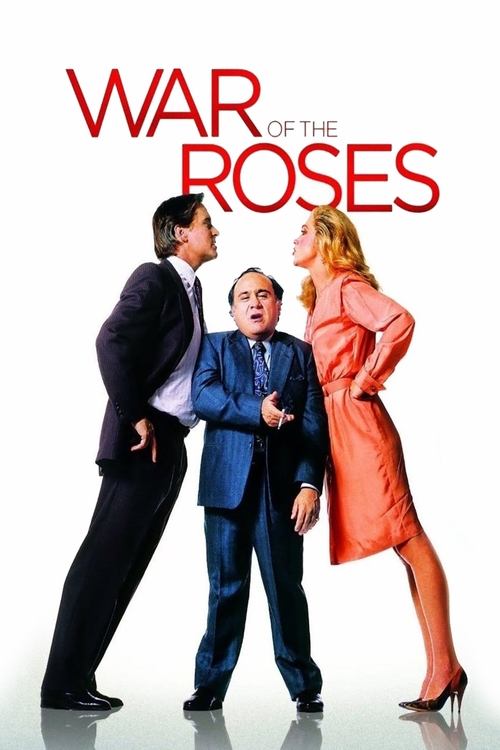
The War of the Roses (1989)
Directed by Danny DeVito
No — The War of the Roses is not woke, scoring 13 out of 100 on our wokeness meter.
Danny DeVito's The War of the Roses arrives from 1989, a year when a divorce comedy could still end with both parties dead on a marble floor and be sold as a date movie.
Consciousness Markers
The film satirizes materialism and the couple's obsessive attachment to possessions and the house, but it is a critique of personal greed rather than a systemic eat-the-rich polemic.
Barbara's arc touches on regret over domestic sacrifice and a desire for financial independence, but the film frames this as a misanthropic battle of the sexes rather than a feminist statement.
The film is caustic and darkly comic but never preaches; its moral about divorce lawyers is delivered through farce rather than sermon.
The cast is uniformly white with no meaningful diversity, and the film makes no comment on representation whatsoever.
There are no LGBTQ+ characters, themes, or subtext anywhere in this heterosexual divorce satire.
Race is entirely absent from the film's concerns; it is a story about wealthy white professionals destroying each other.
No environmental or climate themes appear in the film.
No body positivity themes are present.
No neurodivergence themes or characters are present.
The film is a contemporary satire with no historical revisionism.
Why it received this score
Danny DeVito's The War of the Roses arrives from 1989, a year when a divorce comedy could still end with both parties dead on a marble floor and be sold as a date movie. Michael Douglas and Kathleen Turner play Oliver and Barbara Rose, a Washington couple whose eighteen-year marriage curdles into a property dispute with fatalities. The title borrows from the Wars of the Roses, and the film earns the allusion. This is not a story about two people who fell out of love. It is a story about two people who would sooner destroy a house than let the other keep it.
Turner's Barbara carries a real grievance. She surrendered a career to build a home, and when the children leave she finds the arrangement hollow. The film grants her that regret and then declines to make a case of it. Her awakening becomes one more weapon in a symmetrical slaughter, and the screenplay keeps its sympathies evenly distributed, which is to say it withholds them from everyone. The couple's fixation on objects, the antiques, the Morgan, the house itself, invites a reading about materialism, though the target is personal avarice, not the economic order that produced it. Race, sexuality, the climate, the body, the mind: none of it intrudes. This is a closed world of prosperous white professionals, and the film is content to leave it closed.
DeVito, who also plays the lecherous attorney Gavin D'Amato, frames the whole disaster as a cautionary tale told to a client. The moral is practical, not political. Be generous to the point of discomfort, or go home and remember why you married. The film never lectures, never sermonizes, and never pretends its miserable couple stands for anything larger than itself. It is a nasty, well-made thing, and it knows precisely what it is.
Analysis generated by our Consciousness Algorithm


Synopsis
Barbara and Oliver Rose live happily as a married couple. When Barbara starts to wonder what life would be like without Oliver and likes what she sees, the two begin a campaign to force each other to leave their house, with their divorce lawyer D'Amato caught in the middle.
Questions about The War of the Roses
Is The War of the Roses woke?
No — The War of the Roses is not woke, scoring 13 out of 100 on our wokeness meter. That earns it a verdict of Ultra Based.
Does The War of the Roses have any woke elements?
Very few. None of the 10 markers reaches 30, the level where a marker counts as present; the highest is Eat the Rich at 20.
How does The War of the Roses compare to other 1989 movies?
It ranks #16 of the 68 films from 1989 we've scored; their average is 10. The wokest is Do the Right Thing (72).
How is the Woke Score calculated?
An AI-assisted process researches the film and its reception, scores it 0–100 on ten markers, then combines those into one 0–100 Woke Score. It measures a specific set of 2020s cultural themes, not film quality.