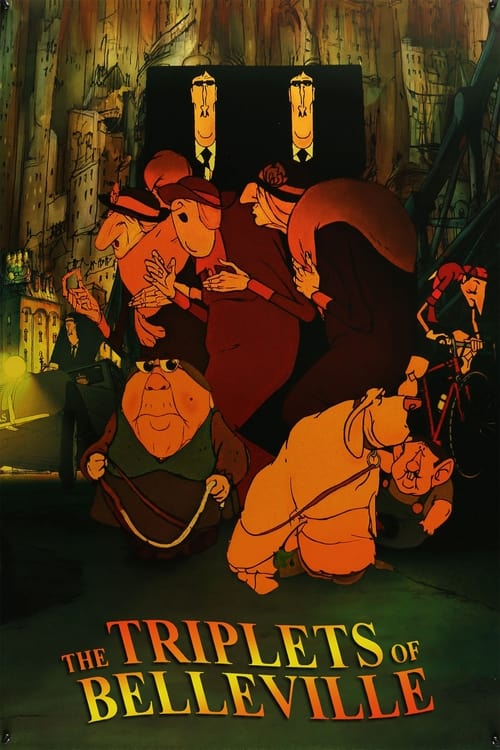
The Triplets of Belleville (2003)
Directed by Sylvain Chomet
No — The Triplets of Belleville is not woke, scoring 9 out of 100 on our wokeness meter.
For a film with almost no dialogue, The Triplets of Belleville carries an enormous amount of noise.
Consciousness Markers
Madame Souza and the Triplets are women driving the rescue narrative, but the film offers no feminist argument or commentary; their gender is incidental to a silent-comedy adventure.
The film centers on an elderly woman and a trio of aged female music-hall singers, and its Belleville setting blends New York, Montreal and Quebec. This is idiosyncratic character design rather than modern representation casting, and the cast is otherwise homogeneous.
The mafia's gambling machine and the satirical depiction of Belleville's bloated commercialism carry a mild anti-consumerist edge, but it is aesthetic whimsy rather than an economic critique.
No LGBTQ+ characters, themes, or subtext appear anywhere in the film.
The film engages no racial themes or commentary whatsoever.
There is no environmental or climate content in the film.
The film's exaggerated, grotesque body caricatures (including the obese dog Bruno) are comic stylization, not a body-positivity message.
Champion's childhood melancholy is a narrative device, not a depiction or advocacy of neurodivergence.
The film is a fictional, largely wordless fable with no historical revisionism.
With almost no dialogue and a reliance on pantomime and music, the film contains no didactic or preachy messaging.
Why it received this score
For a film with almost no dialogue, The Triplets of Belleville carries an enormous amount of noise. Bicycle wheels are hammered like dulcimers. Vacuum cleaners wheeze like bagpipes. A hound named Bruno barks at every passing train. Sylvain Chomet's 2003 feature follows Madame Souza, an elderly woman of few words and great resolve, as she pedals across an ocean to retrieve her kidnapped grandson from the mafia. Belleville itself is a composite of New York, Montreal and Quebec City, drawn in grotesque, ink-washed proportions. It is a silent-comedy adventure with an accordion for a soul.
The cast of consequence is almost entirely elderly women: Souza, plus the three music-hall singers she falls in with, who play a refrigerator shelf and a newspaper as instruments. That our heroines are old, unglamorous and largely wordless is an idiosyncratic choice, not a statement. Their gender is incidental to the machinery of the plot, which would function identically with any three retired performers. Belleville's bloated commercialism, all billboards and bulbous tourists, earns a satirical glance. The mafia's gambling contraption turns human bodies into a power source, which is a fine image and nothing more. The critique is aesthetic whimsy, a cartoonist's sneer, not an economic argument.
Everything else is absent. No romance, no identity politics, no sermon. The film's exaggerated bodies, Bruno included, are caricature and not commentary on health or self-image. Champion's childhood melancholy is a plot device. The Tour de France appears as a spectacle of exhaustion, not as a national myth in need of correction. This is a wordless fable, warmly received and rightly so, and it will endure on the strength of its draughtsmanship. On the scale of contemporary social consciousness it registers as a faint hum: a nod for putting old women at the center of an adventure, a shrug toward consumer excess, and silence for the rest. The picture is strange and gorgeous. It is also, by the standards we are obliged to apply, nearly innocent.
Analysis generated by our Consciousness Algorithm


Synopsis
When her grandson is kidnapped during the Tour de France, Madame Souza and her beloved pooch Bruno team up with the Belleville Sisters—an aged song-and-dance team from the days of Fred Astaire—to rescue him.
Questions about The Triplets of Belleville
Is The Triplets of Belleville woke?
No — The Triplets of Belleville is not woke, scoring 9 out of 100 on our wokeness meter. That earns it a verdict of Ultra Based.
Does The Triplets of Belleville have any woke elements?
Very few. None of the 10 markers reaches 30, the level where a marker counts as present; the highest is Feminist Agenda at 20.
How does The Triplets of Belleville compare to other 2003 movies?
It ranks #64 of the 150 films from 2003 we've scored; their average is 12. The wokest is Mona Lisa Smile (60).
How is the Woke Score calculated?
An AI-assisted process researches the film and its reception, scores it 0–100 on ten markers, then combines those into one 0–100 Woke Score. It measures a specific set of 2020s cultural themes, not film quality.