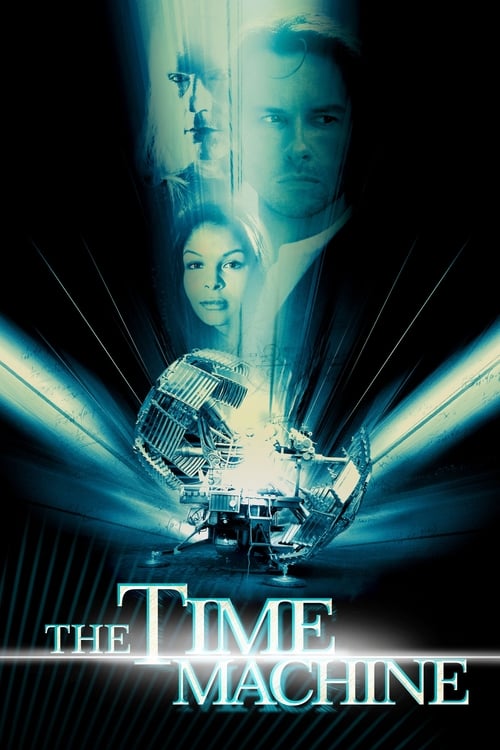
The Time Machine (2002)
Directed by Simon Wells
No — The Time Machine is not woke, scoring 8 out of 100 on our wokeness meter.
The Time Machine arrives with the solemn bearing of a picture that believes it is about Big Ideas: the mutability of fate, the cost of obsession, the grandfather paradox delivered with a straight face by Jeremy Irons in a great deal of prosthetic makeup.
Consciousness Markers
The future Eloi are notably multiracial, and Black actors appear in supporting roles, though the film does not frame this as a social-justice statement.
Alex mildly prefers pure research over business, but there is no systemic anti-capitalist or eat-the-rich argument.
No LGBTQ+ characters or themes are present.
Mara is primarily a love interest and rescue objective; the film offers no feminist critique or agenda.
Diverse casting exists, but the story does not engage with racial consciousness or racial commentary.
The lunar disaster is a plot device, not a climate-crusade message.
No body-positivity themes or messaging.
Alex is an eccentric inventor, but the film does not frame this through modern neurodivergence concepts.
The film is a loose adaptation/remake, not a revisionist historical narrative.
Exposition about time paradoxes and Morlock society is delivered, but it is plot mechanics rather than social lecturing.
Why it received this score
The Time Machine arrives with the solemn bearing of a picture that believes it is about Big Ideas: the mutability of fate, the cost of obsession, the grandfather paradox delivered with a straight face by Jeremy Irons in a great deal of prosthetic makeup. Simon Wells, directing his great-grandfather's novel with more reverence than clarity, moves the action from London to New York and ladles on a romantic subplot involving a fiancee who must die twice for the plot to function. The result is a handsomely mounted, faintly exhausting contraption, all brass fittings and swirling time-lapse photography, that treats its own philosophical questions the way a magician treats a volunteer from the audience: briefly, and with a tendency to make them disappear.
The film's social consciousness is incidental at best. The future Eloi are a conspicuously multiracial tribe, and Orlando Jones appears as a holographic librarian, but nobody in the screenplay pauses to remark upon it, which is to the picture's credit. The closest the film comes to a thesis about the economic order is Alex's mild preference for pure research over the business world, a preference expressed once and then abandoned for ape-suited monsters. There is no systematic indictment of capital here, no sermon about the climate, no lecture about history's forgotten. The Morlocks eat people because they are hungry, not because the screenplay has a point to make about it.
Instead we get a chase through a collapsing cave and a moral about letting go, delivered with the subtlety of a falling anvil. Guy Pearce has since disowned the film. Samantha Mumba does what the role asks. The makeup team earned an Academy Award nomination and the picture opened at number one, proving that nostalgia and brass goggles can carry a great deal of narrative dead weight. As cultural documents go, this one is nearly inert, a handsome antique that says nothing and means it.
Analysis generated by our Consciousness Algorithm
Part of


Synopsis
Hoping to alter the events of the past, a 19th-century inventor instead travels 800,000 years into the future, where he finds mankind divided into two warring races.
Questions about The Time Machine
Is The Time Machine woke?
No — The Time Machine is not woke, scoring 8 out of 100 on our wokeness meter. That earns it a verdict of Ultra Based.
Does The Time Machine have any woke elements?
1 of the 10 markers register at 30 or above, led by Representation Casting (30). On Representation Casting: The future Eloi are notably multiracial, and Black actors appear in supporting roles, though the film does not frame this as a social-justice statement.
How does The Time Machine compare to other 2002 movies?
It ranks #75 of the 150 films from 2002 we've scored; their average is 12. The wokest is Far from Heaven (78).
How is the Woke Score calculated?
An AI-assisted process researches the film and its reception, scores it 0–100 on ten markers, then combines those into one 0–100 Woke Score. It measures a specific set of 2020s cultural themes, not film quality.