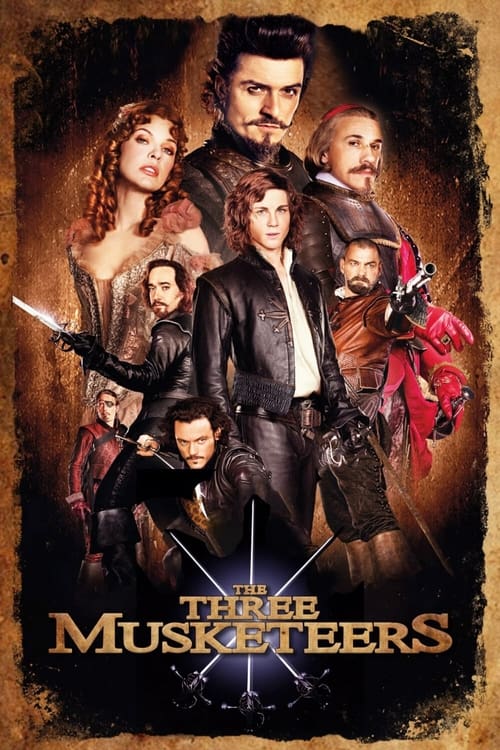
The Three Musketeers (2011)
Directed by Paul W. S. Anderson
No — The Three Musketeers is not woke, scoring 5 out of 100 on our wokeness meter.
Paul W. S. Anderson's 2011 adaptation of Alexandre Dumas arrives with airships, da Vinci blueprints, and a cast assembled for cheekbones and period tailoring.
Consciousness Markers
Milla Jovovich's Milady de Winter is a capable, scheming double agent who acts on her own terms, but she is a villainous femme fatale rather than a vehicle for any feminist argument.
The cast is overwhelmingly white European, with no deliberate diversity casting or commentary on representation; the ensemble is assembled for star power and period-appropriate looks, not inclusion.
There are no LGBTQ+ characters, themes, or subtext anywhere in the swashbuckling plot.
The film engages no racial themes or commentary whatsoever; it is a 17th-century European adventure populated entirely by white characters.
No environmental or climate themes appear; the airships and battles are pure spectacle.
The conflict is dynastic and political (Richelieu scheming for the throne), with no critique of wealth, class, or capitalism.
No body-positivity themes or messaging are present.
No neurodivergent characters or themes are depicted.
The film freely adds clockpunk airships and da Vinci blueprints to Dumas's tale, but this is genre embellishment, not the ideological rewriting of history the marker denotes.
The film is a breezy, disposable action-adventure with no preachy messaging or moralizing monologues.
Why it received this score
Paul W. S. Anderson's 2011 adaptation of Alexandre Dumas arrives with airships, da Vinci blueprints, and a cast assembled for cheekbones and period tailoring. The musketeers bicker, the cardinal schemes, and Milla Jovovich's Milady de Winter betrays everyone in sight before leaping from an airship on her own terms. It is a breezy, disposable thing, and it knows it.
We searched this film for social consciousness the way a sommelier searches a cloudy vintage for cork. The ensemble is white European by default, drawn from the available pool of actors who look correct in a doublet, and nobody in the production appears to have given the matter a thought. Milady is a capable schemer who answers to no man, which registers as faint feminist texture until we recall she is a villain and the film's actual moral center is a teenage boy from Gascony. No racial themes surface. No environmental anxieties intrude upon the airship battles. The poor are not discussed, because there are no poor, only dukes.
There is no LGBTQ+ content, no body-positive messaging, no neurodivergent characters, and no rewriting of history beyond the addition of clockwork dirigibles, which is genre indulgence and not ideology. The film lectures no one. It has no thesis about the modern world, no sermon tucked into the swordplay, no monologue explaining what we are meant to feel. It simply wants to sell tickets and 3D glasses, and it does so with a shrug. Tarantino liked it. The rest of us watched the clouds and waited.
And so the ledger closes on a production that aspired to nothing beyond spectacle and achieved precisely that. There is a strange integrity in a film this uninterested in improving anyone. It offers swordplay, airships, and Orlando Bloom in a wig, and it asks for nothing in return but the price of admission. We classify it accordingly, with no hard feelings and no further comment.
Thematic tags: book adaptation, being based on Dumas's 1844 novel. No other tags apply; it is not a remake of a prior film, it opened fourth in North America, and it won no awards of consequence.
{"thematic_tags": ["book_adaptation"]}
Wait, I need to output only the JSON object.
{"review": "Paul W. S. Anderson's 2011 adaptation of Alexandre Dumas arrives with airships, da Vinci blueprints, and a cast assembled for cheekbones and period tailoring. The musketeers bicker, the cardinal schemes, and Milla Jovovich's Milady de Winter betrays everyone in sight before leaping from an airship on her own terms. It is a breezy, disposable thing, and it knows it.
We searched this film for social consciousness the way a sommelier searches a cloudy vintage for cork. The ensemble is white European by default, drawn from the available pool of actors who look correct in a doublet, and nobody in the production appears to have given the matter a thought. Milady is a capable schemer who answers to no man, which registers as faint feminist texture until we recall she is a villain and the film's actual moral center is a teenage boy from Gascony. No racial themes surface. No environmental anxieties intrude upon the airship battles. The poor are not discussed, because there are no poor, only dukes.
There is no LGBTQ+ content, no body-positive messaging, no neurodivergent characters, and no rewriting of history beyond the addition of clockwork dirigibles, which is genre indulgence and not ideology. The film lectures no one. It has no thesis about the modern world, no sermon tucked into the swordplay, no monologue explaining what we are meant to feel. It simply wants to sell tickets and 3D glasses, and it does so with a shrug. Tarantino liked it. The rest of us watched the clouds and waited.", "thematic_tags": ["book_adaptation"]}
Analysis generated by our Consciousness Algorithm


Synopsis
The hot-headed young D'Artagnan along with three former legendary but now down on their luck Musketeers must unite and defeat a beautiful double agent and her villainous employer from seizing the French throne and engulfing Europe in war.
Questions about The Three Musketeers
Is The Three Musketeers woke?
No — The Three Musketeers is not woke, scoring 5 out of 100 on our wokeness meter. That earns it a verdict of Ultra Based.
Does The Three Musketeers have any woke elements?
Very few. None of the 10 markers reaches 30, the level where a marker counts as present; the highest is Feminist Agenda at 10.
How does The Three Musketeers compare to other 2011 movies?
It ranks #165 of the 245 films from 2011 we've scored; their average is 11. The wokest is Paul (68).
How is the Woke Score calculated?
An AI-assisted process researches the film and its reception, scores it 0–100 on ten markers, then combines those into one 0–100 Woke Score. It measures a specific set of 2020s cultural themes, not film quality.