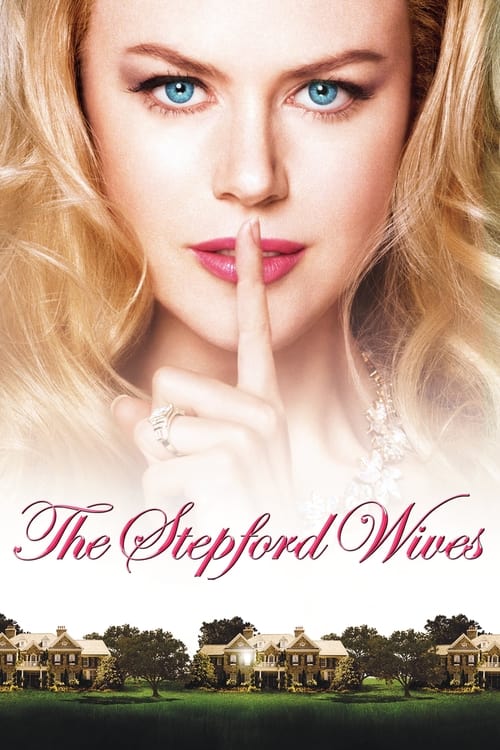
The Stepford Wives (2004)
Directed by Frank Oz
No — The Stepford Wives is not especially woke, scoring 35 out of 100 on our wokeness meter.
The 2004 Stepford Wives arrives as the second adaptation of Ira Levin's novel, a production that reportedly endured test-screening panic and reshoots until its original dark satire had been sanded into something smoother.
Consciousness Markers
The film is built on a feminist satire of patriarchal control, featuring a feminist writer, Bobbie, and a plot about men literally reprogramming women into submissive wives. The ending has the women take over the town and retrain their husbands, though the campy tone dilutes the critique.
Roger Bannister is a flamboyant gay architect with a partner, Jerry, and his transformation into a conformist Stepford husband is a significant subplot. The film treats his sexuality as a natural part of the story while using it to critique forced conformity.
The cast is overwhelmingly white, but includes a prominent gay male character in Roger Bannister, played by Roger Bart. This is not a modern diversity casting effort, but the presence of a queer supporting lead gives it some representation value.
The film delivers its feminist and conformity themes through broad comedy and camp rather than direct preaching. It has a message, but it is not structured as a lecture.
The film has no racial themes, no significant non-white characters, and does not engage with racial consciousness in any form.
There is no environmental or climate-related content in the film.
The film does not critique capitalism or wealth inequality; its satire targets gender conformity and suburban patriarchy, not economic systems.
The film depicts unrealistic physical perfection and objectification for satirical purposes, but it does not promote body positivity or challenge beauty standards in a modern body-positive sense.
There is no exploration or representation of neurodivergence in the film.
The film is a science fiction satire and a remake, not a historical narrative, so it does not engage in revisionist history.
Why it received this score
The 2004 Stepford Wives arrives as the second adaptation of Ira Levin's novel, a production that reportedly endured test-screening panic and reshoots until its original dark satire had been sanded into something smoother. What remains is a film that wants to skewer suburban patriarchy and settles for camp. Frank Oz has assembled Nicole Kidman, Bette Midler, Glenn Close, and Christopher Walken, then given them little to do beyond decorating a premise that was sharper when it was colder.
On the matter of social consciousness, the film is a curious specimen. Its central conceit, husbands inserting nanochips into their wives to produce poised, submissive helpmeets, is feminist satire with real teeth, and the screenplay knows it. Bobbie Markowitz, the recovering-alcoholic novelist, states the case plainly, and the conclusion, in which the wives seize the town and place their husbands under house arrest for retraining, is a genuine inversion of the source material's bleakness. The film also grants a prominent supporting role to Roger Bannister, a flamboyant gay architect whose reprogramming into a bland State Senate candidate forms a substantial subplot. His sexuality is treated as ordinary, which in 2004 was not nothing. The cast, however, remains overwhelmingly white.
Elsewhere the cupboard is bare. The villain is not capital but a brain surgeon with a grudge, so there is no economic critique to speak of. There is no environmental conscience, no engagement with body image beyond the satirical exaggeration of it, no neurodivergent characters, and no historical revisionism, since the story is science fiction and its own prior adaptation. The messaging arrives through broad comedy and zingers, not sermons, which keeps the lecturing to a minimum. Critics were unkind, and the box office declined sharply after opening weekend. A film about forced conformity that was itself conformed by committee is a joke the movie did not intend to make.
Analysis generated by our Consciousness Algorithm
Part of


Synopsis
What does it take to become a Stepford wife, a woman perfect beyond belief? Ask the Stepford husbands, who've created this high-tech, terrifying little town.
Questions about The Stepford Wives
Is The Stepford Wives woke?
No — The Stepford Wives is not especially woke, scoring 35 out of 100 on our wokeness meter. That earns it a verdict of Based.
Does The Stepford Wives have any woke elements?
2 of the 10 markers register at 30 or above, led by Feminist Agenda (70) and LGBTQ+ Themes (60). On Feminist Agenda: The film is built on a feminist satire of patriarchal control, featuring a feminist writer, Bobbie, and a plot about men literally reprogramming women into submissive wives.
How does The Stepford Wives compare to other 2004 movies?
It ranks #11 of the 178 films from 2004 we've scored; their average is 12. The wokest is Tropical Malady (62).
How is the Woke Score calculated?
An AI-assisted process researches the film and its reception, scores it 0–100 on ten markers, then combines those into one 0–100 Woke Score. It measures a specific set of 2020s cultural themes, not film quality.