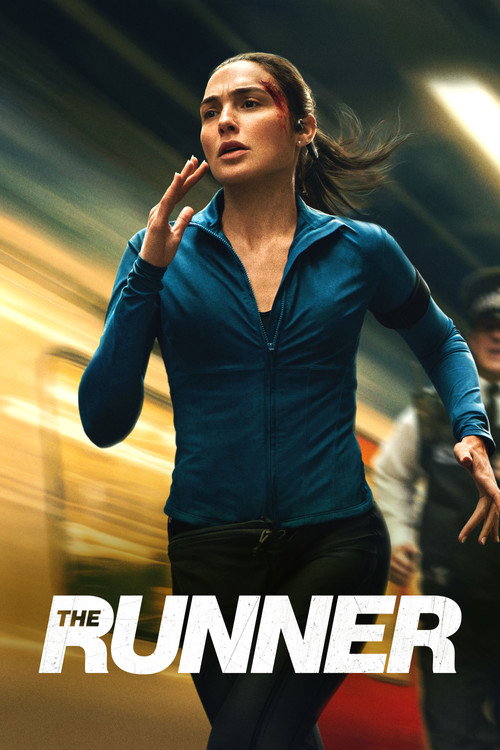
The Runner (2026)
Directed by Kevin Macdonald
No — The Runner is not woke, scoring 6 out of 100 on our wokeness meter.
Kevin Macdonald's The Runner arrives with a premise engineered for velocity: a London prosecutor named Maia Marten, mid-morning jog, receives word that her son has been taken, and spends the next ninety minutes sprinting across the city while a caller in her ear issues instructions.
Consciousness Markers
The London-set cast includes Alfred Enoch as Ted and other non-white supporting actors, but the film does not foreground or comment on representation.
The protagonist is a capable female lawyer and mother in an action-thriller role, but the film advances no explicit feminist argument.
No LGBTQ+ characters, themes, or subtext are present.
Race is not a thematic concern, and no racial consciousness or commentary appears in the story.
There is no climate-related theme, message, or imagery.
The film features a crime boss and a prosecutor but contains no eat-the-rich or anti-capitalist critique.
No body-positivity themes or messaging are present.
The son's diabetes is a medical condition, not a neurodivergence theme, and no neurodivergent representation is explored.
The film is a contemporary fictional thriller with no historical revisionism.
The film is a fast-paced kidnapping thriller and does not pause for didactic social or political lecturing.
Why it received this score
Kevin Macdonald's The Runner arrives with a premise engineered for velocity: a London prosecutor named Maia Marten, mid-morning jog, receives word that her son has been taken, and spends the next ninety minutes sprinting across the city while a caller in her ear issues instructions. Gal Gadot runs. She runs through Camden, along the Regent's Canal, down into the Underground, over Waterloo Bridge, and off a barge, in a real-time contraption that critics greeted with something close to physical resentment. The Rotten Tomatoes consensus called it empty and frantic. That verdict seems fair, though the film does possess a certain grim efficiency. It knows what it is, and what it is happens to be a woman running very fast for a long time.
The sociological inventory is thin. Maia is a capable professional and a mother, and the role asks nothing of her gender beyond the standard maternal stakes of a kidnapping plot. No argument is advanced, no thesis defended. Alfred Enoch appears as Ted, a colleague and romantic interest, and other non-white performers fill out the London cast, all of them present as people rather than as statements. Race never becomes a subject. The villain is a crime boss and the heroine is a prosecutor, which would seem to invite some commentary on the machinery of wealth and justice, but the film has no interest in that. The son's diabetes functions as a timer, not a theme. Insulin pumps and glucagon are deployed as plot mechanics, and no condition of mind or body is held up for our edification.
What the film conspicuously lacks is any urge to instruct. It does not pause between footfalls to explain the surveillance state, though it gestures at one. It does not sermonize about anything at all, which in an era of heavily annotated entertainment is almost restful. The Runner is not a lecture. It is barely a thriller. There is a kind of integrity in that.
Analysis generated by our Consciousness Algorithm

Synopsis
Maia Marten, a brilliant London lawyer, has her life shattered by a single call on her morning run: her son has been taken. To get him back, she must keep running, obey every ruthless command, and trust no one-each second a test of how far a mother will go to save her child.
Questions about The Runner
Is The Runner woke?
No — The Runner is not woke, scoring 6 out of 100 on our wokeness meter. That earns it a verdict of Ultra Based.
Does The Runner have any woke elements?
Very few. None of the 10 markers reaches 30, the level where a marker counts as present; the highest is Representation Casting at 15.
How does The Runner compare to other 2026 movies?
It ranks #524 of the 800 films from 2026 we've scored; their average is 23. The wokest is Between Us (89).
How is the Woke Score calculated?
An AI-assisted process researches the film and its reception, scores it 0–100 on ten markers, then combines those into one 0–100 Woke Score. It measures a specific set of 2020s cultural themes, not film quality.