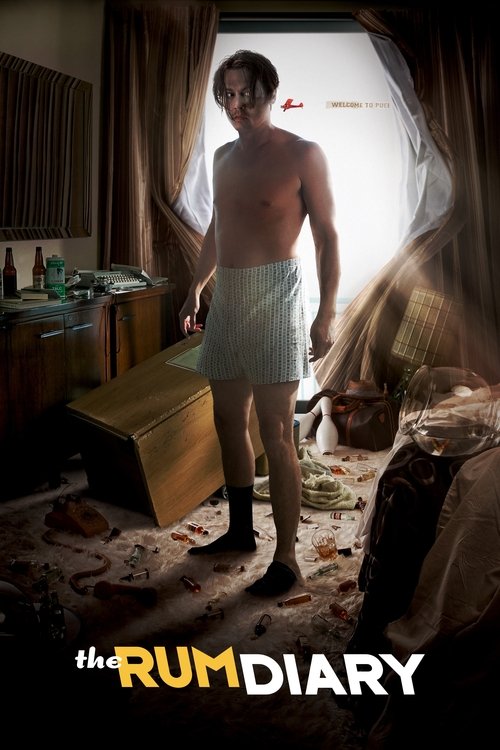
The Rum Diary (2011)
Directed by Bruce Robinson
No — The Rum Diary is not woke, scoring 19 out of 100 on our wokeness meter.
The Rum Diary arrives in 1960 Puerto Rico with a bottle in each hand and no fixed destination.
Consciousness Markers
The central conflict involves shady property developers, PR whitewashing, and corporate exploitation of Puerto Rico, giving the film a genuine if understated anti-greed streak.
The film gestures at San Juan poverty, US military use of the island as an artillery range, and colonial exploitation, but these remain atmospheric backdrop to Kemp's personal journey rather than a racial-consciousness thesis.
The cast is overwhelmingly white, with Puerto Rican and local characters (Amaury Nolasco, Giovanni Ribisi's Moburg) present as colorful background texture rather than as a deliberate representational statement.
Sanderson's resort scheme targets a 'pristine' island, giving a mild environmental-destruction undertone, though it is framed as corruption rather than a climate crusade.
Kemp's climactic exposé carries a mild message about journalistic integrity, but the film is rambling and amiable rather than preachy or didactic.
Amber Heard's Chenault is a muse/femme-fatale figure whose nudity and provocative dancing serve the male protagonist's arc; there is no feminist critique of gender roles.
The only faintly queer-adjacent element is Papa Nebo, described as an intersex witch doctor, played for exotic local color rather than as an LGBTQ+ theme.
No body-positivity themes are present; the film's treatment of the body is limited to drinking, vomiting, and titillation.
No neurodivergence themes; the characters' erratic behavior is attributed to alcohol and drugs, not framed as neurodivergent identity.
The film is a period piece set in 1960 Puerto Rico and makes no attempt to revise or reinterpret historical record for ideological ends.
Why it received this score
The Rum Diary arrives in 1960 Puerto Rico with a bottle in each hand and no fixed destination. Bruce Robinson adapts Hunter S. Thompson's long-shelved novel into a loose, amiable drifter's comedy, following Johnny Depp's Paul Kemp as he drinks his way through a failing San Juan newspaper and stumbles into a land deal built on whitewashed brochures and other people's poverty. The film's most legible conviction is its distaste for the developers, and that contempt registers more strongly than anything else in the picture.
The social furniture is arranged with the care of a hotel lobby. Chenault, played by Amber Heard, exists to be wet, naked, and a source of friction between two men. The camera studies her, and the screenplay gives her nothing to hold. Puerto Rican characters drift through as scenery: angry dancers, a witch doctor of ambiguous anatomy, a bartender with opinions about tourists. The poverty Kemp keeps noticing is real enough to supply atmosphere and never organizes itself into an argument. The island becomes a location, not a subject.
The closing act offers a modest sermon on journalistic integrity, delivered while the protagonist is on hallucinogens, which takes some of the sting out of it. Otherwise the film declines to lecture. It prefers to wander. This is a picture about a man learning to write honestly inside a corrupt little economy, and it is content to let that theme bleed into the rum instead of pressing it. For a story built on colonial exploitation and press cowardice, the temperature stays cool. A sommelier would call it a light-bodied vintage, faintly corked, pleasant enough with ice.
Analysis generated by our Consciousness Algorithm


Synopsis
Tired of the noise and madness of New York and the crushing conventions of late Eisenhower-era America, itinerant journalist Paul Kemp travels to the pristine island of Puerto Rico to write for a local San Juan newspaper run by the downtrodden editor Lotterman. Adopting the rum-soaked lifestyle of the late ‘50s version of Hemingway’s 'The Lost Generation', Paul soon becomes entangled with a very attractive American woman and her fiancée, a businessman involved in shady property development deals. It is within this world that Kemp ultimately discovers his true voice as a writer and integrity as a man.
Questions about The Rum Diary
Is The Rum Diary woke?
No — The Rum Diary is not woke, scoring 19 out of 100 on our wokeness meter. That earns it a verdict of Ultra Based.
Does The Rum Diary have any woke elements?
1 of the 10 markers register at 30 or above, led by Eat the Rich (45). On Eat the Rich: The central conflict involves shady property developers, PR whitewashing, and corporate exploitation of Puerto Rico, giving the film a genuine if understated anti-greed streak.
How does The Rum Diary compare to other 2011 movies?
It ranks #32 of the 245 films from 2011 we've scored; their average is 11. The wokest is Paul (68).
How is the Woke Score calculated?
An AI-assisted process researches the film and its reception, scores it 0–100 on ten markers, then combines those into one 0–100 Woke Score. It measures a specific set of 2020s cultural themes, not film quality.