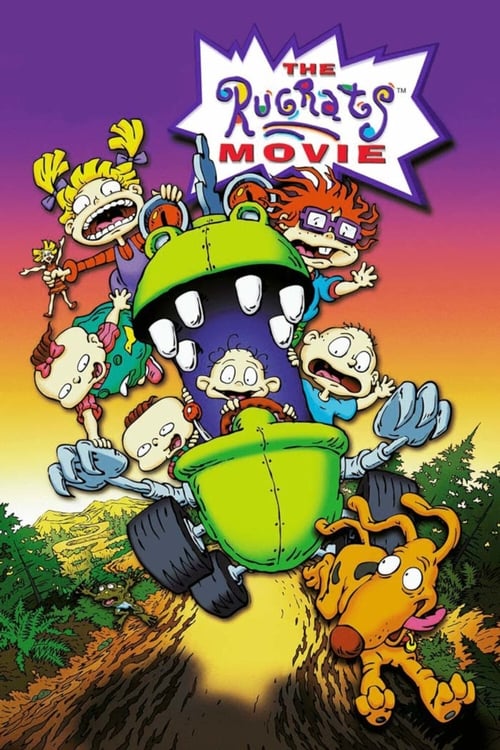
The Rugrats Movie (1998)
Directed by Norton Virgien
No — The Rugrats Movie is not woke, scoring 6 out of 100 on our wokeness meter.
The Rugrats Movie arrives in 1998 as a modest expansion of a Nickelodeon cartoon about diaper-clad toddlers, and it conducts itself with the quiet confidence of a property that has no interest in addressing the cultural questions of a later decade.
Consciousness Markers
The voice cast includes Whoopi Goldberg, Busta Rhymes, Margaret Cho, and Cree Summer in supporting roles, but these are incidental hires rather than a deliberate diversity-forward casting statement.
Female characters like Didi and the domineering Angelica exist in traditional sitcom-mom and bratty-cousin roles, with no feminist framing or commentary.
No LGBTQ+ characters, themes, or subtext appear anywhere in the film.
Susie Carmichael and other characters of color appear naturally in the ensemble, but the film makes no racial commentary or consciousness its subject.
The film has no environmental or climate themes whatsoever.
No critique of capitalism, wealth, or class structures is present in this toddler adventure.
No body positivity themes or messaging about body image appear in the film.
No neurodivergence themes or neurodivergent-coded characters are present.
The film is a straightforward fictional adventure with no historical revisionism.
This is a light children's adventure about sibling jealousy; it delivers no moralizing lecture to its audience.
Why it received this score
The Rugrats Movie arrives in 1998 as a modest expansion of a Nickelodeon cartoon about diaper-clad toddlers, and it conducts itself with the quiet confidence of a property that has no interest in addressing the cultural questions of a later decade. The plot concerns Tommy Pickles and his resentment toward his new brother Dil, a squalling infant who commandeers his toys and his parents' attention. What follows is a wilderness adventure involving circus monkeys, a wolf, and a Reptar wagon. In the taxonomy we are obliged to maintain, the film is a near-total blank.
The voice cast includes Whoopi Goldberg, Busta Rhymes, Margaret Cho, and Cree Summer in supporting turns. This is a diverse roster, but the film treats it as a staffing decision, not a statement, and the characters of color move through the ensemble without the screenplay ever noticing them. Didi Pickles and the bratty Angelica occupy the familiar sitcom stations of mother and cousin, and the film extends them no further. On the remaining markers we find nothing to report. There is no romantic subtext of any kind, no engagement with climate, no critique of wealth, no meditation on body image, and no neurodivergent coding. The forest is simply a forest.
What the film offers instead is sibling jealousy rendered at toddler scale, resolved when Tommy chooses to protect the brother he resented. It is a gentle lesson, delivered without a podium. The picture made a great deal of money and spawned two sequels, which tells us something about 1998 that requires no further elaboration from this desk. We score it accordingly and move on to the next screening.
THEMATIC TAGS: box_office_number_one, based on a television series (not a listed tag category). Applicable listed tags: box_office_number_one only. It is not a sequel, remake, true story, book adaptation, superhero film, or Oscar winner. The film reached number one at the US domestic box office in its opening weekend, grossing $27.3 million and beating Enemy of the State, which satisfies the box office criterion. No other listed thematic tag applies to this production.
{"review": "The Rugrats Movie arrives in 1998 as a modest expansion of a Nickelodeon cartoon about diaper-clad toddlers, and it conducts itself with the quiet confidence of a property that has no interest in addressing the cultural questions of a later decade. The plot concerns Tommy Pickles and his resentment toward his new brother Dil, a squalling infant who commandeers his toys and his parents' attention. What follows is a wilderness adventure involving circus monkeys, a wolf, and a Reptar wagon. In the taxonomy we are obliged to maintain, the film is a near-total blank.\n\nThe voice cast includes Whoopi Goldberg, Busta Rhymes, Margaret Cho, and Cree Summer in supporting turns. This is a diverse roster, but the film treats it as a staffing decision, not a statement, and the characters of color move through the ensemble without the screenplay ever noticing them. Didi Pickles and the bratty Angelica occupy the familiar sitcom stations of mother and cousin, and the film extends them no further. On the remaining markers we find nothing to report. There is no romantic subtext of any kind, no engagement with climate, no critique of wealth, no meditation on body image, and no neurodivergent coding. The forest is simply a forest.\n\nWhat the film offers instead is sibling jealousy rendered at toddler scale, resolved when Tommy chooses to protect the brother he resented. It is a gentle lesson, delivered without a podium. The picture made a great deal of money and spawned two sequels, which tells us something about 1998 that requires no further elaboration from this desk. We score it accordingly and move on to the next screening.", "thematic_tags": ["box_office_number_one"]}
Analysis generated by our Consciousness Algorithm
Part of


Synopsis
The Pickles family welcome a new arrival, Dil, whose constant crying and need for attention quickly exhaust the other toddlers. Seeking to return the "broken" baby to the hospital, the gang embarks on a journey in a Reptar Wagon that inadvertently veers off course, leaving them stranded in a vast, dangerous forest. While facing off against escaped circus monkeys and a predatory wolf, Tommy must overcome his own resentment to protect his brother and make it back home.
Questions about The Rugrats Movie
Is The Rugrats Movie woke?
No — The Rugrats Movie is not woke, scoring 6 out of 100 on our wokeness meter. That earns it a verdict of Ultra Based.
Does The Rugrats Movie have any woke elements?
Very few. None of the 10 markers reaches 30, the level where a marker counts as present; the highest is Representation Casting at 15.
How does The Rugrats Movie compare to other 1998 movies?
It ranks #75 of the 118 films from 1998 we've scored; their average is 12. The wokest is Show Me Love (60).
How is the Woke Score calculated?
An AI-assisted process researches the film and its reception, scores it 0–100 on ten markers, then combines those into one 0–100 Woke Score. It measures a specific set of 2020s cultural themes, not film quality.