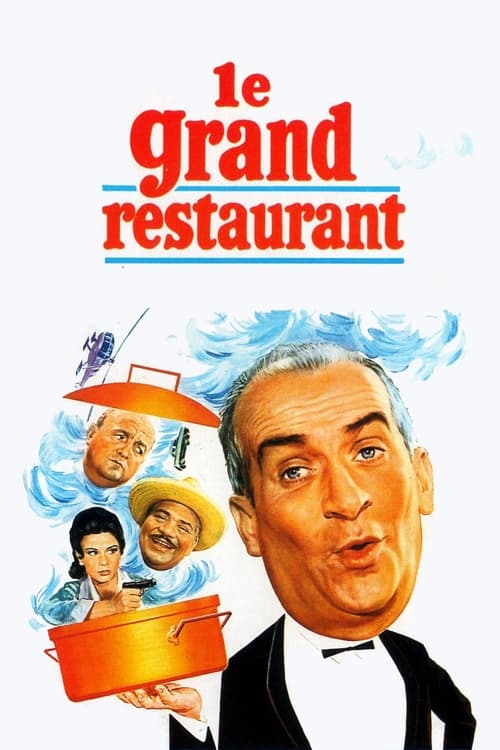
The Restaurant (1966)
Directed by Jacques Besnard
No — The Restaurant is not woke, scoring 0 out of 100 on our wokeness meter.
Here we have a 1966 French farce in which Louis de Funès runs a grand Parisian restaurant, bullies his staff, fawns over the wealthy, and watches a Latin American president vanish in a cloud of flambéed sugar.
Consciousness Markers
The cast is a uniformly white European ensemble of French and Italian character actors; the Latin American president and his aides are played without any modern representational intent.
No LGBTQ+ characters, themes, or subtext of any kind appear in this 1966 slapstick comedy.
The lone prominent female character, Sophia, is a loyal aide in a comedic kidnapping plot; there is no feminist framing whatsoever.
A fictional Latin American revolution subplot exists purely as farce; it carries no racial consciousness or commentary.
No environmental or climate themes are present.
The restaurant setting and its fawning-to-the-rich proprietor are played for laughs, not as a critique of capital.
No body-positivity themes or messaging appear.
No neurodivergence themes or characters are present.
The film is a wholly fictional farce with no historical revisionism.
This is a broad physical comedy of exploding desserts and Alpine chases; it lectures no one about anything.
Why it received this score
Here we have a 1966 French farce in which Louis de Funès runs a grand Parisian restaurant, bullies his staff, fawns over the wealthy, and watches a Latin American president vanish in a cloud of flambéed sugar. The plot then repairs to the Alps for a snowbound chase. This is cinema as confection, and it is presented to us with the sober craft of a pastry chef who has never once been asked to justify the calories.
The film's cultural inventory is, by the standards we now apply, remarkably bare. The ensemble is uniformly European. The fictional republic and its revolution serve as slapstick furniture, a running gag about national anthems and misplaced heads of state. The single prominent woman is a dutiful aide in a kidnapping plot. Nobody in the Alps pauses to interrogate capital, or the climate, or the body, or the mind. Monsieur Septime's sycophancy toward his paying guests is offered as a joke about restaurant culture, not an indictment of the owning class. In 1966 nobody thought to ask a comedy for a thesis, and the comedy, to its credit, had none to hand over.
The picture's only agenda is the precise timing of a collapsing dessert trolley. It is a machine built to produce a laugh, then a second laugh, then a third, and it never once turns to address the audience about how to live. Whether that constitutes artistic poverty or artistic hygiene will depend entirely on the viewer's appetite. I record it, as is my duty, and move along. The soufflé explodes twice. So, in the end, does nothing else.
Analysis generated by our Consciousness Algorithm


Synopsis
A great French restaurant's owner, Monsieur Septime, is thrust into intrigue and crime, when one of his famous guests disappears.
Questions about The Restaurant
Is The Restaurant woke?
No — The Restaurant is not woke, scoring 0 out of 100 on our wokeness meter. That earns it a verdict of Ultra Based.
Does The Restaurant have any woke elements?
No. All 10 markers score zero.
How does The Restaurant compare to other 1966 movies?
It ranks #14 of the 18 films from 1966 we've scored; their average is 7. The wokest is Daisies (28).
How is the Woke Score calculated?
An AI-assisted process researches the film and its reception, scores it 0–100 on ten markers, then combines those into one 0–100 Woke Score. It measures a specific set of 2020s cultural themes, not film quality.