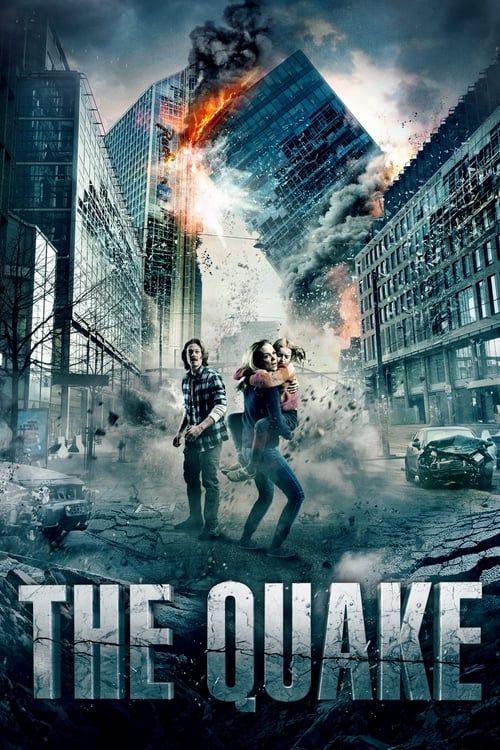
The Quake (2018)
Directed by John Andreas Andersen
No — The Quake is not woke, scoring 3 out of 100 on our wokeness meter.
Norwegian disaster cinema has settled into a comfortable groove, and The Quake, a sequel to The Wave, occupies it with the confidence of a film that knows exactly what it is: a geologist, an estranged family, and a fault line beneath Oslo.
Consciousness Markers
A closing title card notes Norway's seismic risk, but this is a factual public-safety footnote rather than a sustained sermon.
The cast is a uniformly white Norwegian ensemble with no deliberate diversity casting; the lone South Asian name appears in an uncredited bit part with no narrative weight.
No LGBTQ+ characters, relationships, or themes appear anywhere in the film.
Idun is a working professional and the film has a competent female supporting character in Marit, but this is standard disaster-movie characterization with no feminist thesis.
No engagement with race, racism, or racial identity; the film is entirely concerned with geology and family survival.
The threat is seismic, not climatic; the film makes no environmental or climate-change argument.
No critique of capitalism, wealth, or class structures; the antagonist is tectonic plates.
No body-positivity themes or messaging of any kind.
No neurodivergent characters or themes are present.
The film is a fictional disaster narrative with no historical revisionism.
Why it received this score
Norwegian disaster cinema has settled into a comfortable groove, and The Quake, a sequel to The Wave, occupies it with the confidence of a film that knows exactly what it is: a geologist, an estranged family, and a fault line beneath Oslo. The antagonist here is the planet's crust. There is no boardroom of villains, no extractive corporation to blame, no allegory about warming seas. The earth simply moves, and people are crushed. In an era when even a tidal wave might be drafted into an argument, this one declines the invitation entirely.
Kristoffer Joner returns as Kristian, a man hollowed out by the 250 deaths he could not prevent, keeping a shrine in a sealed room. His wife Idun works on the thirty-fourth floor of a hotel, and she is competent, employed, and unbothered by any thesis. Marit, the dead colleague's daughter, tags along with core samples and performs the same function a young man would have performed. Nobody remarks on this. Nobody remarks on anything, which is the point. The cast is uniformly Norwegian, uniformly white, and the film treats this as a fact of geography, not a statement. The earthquake kills without consulting demographics.
At the end, a title card informs us that Norway has more seismic activity than anywhere north of the Alps and that a major quake is expected. It is a public-safety notice, delivered plainly, and it constitutes the film's entire instructional payload. We have here a vintage of remarkable restraint. A disaster film that wants only to shake the seats and get everyone home. The sommelier notes: mineral, austere, faintly Nordic. Score accordingly.
Analysis generated by our Consciousness Algorithm


Synopsis
A geologist races against time to save his estranged wife and two children when a devastating earthquake strikes Oslo, Norway.
Questions about The Quake
Is The Quake woke?
No — The Quake is not woke, scoring 3 out of 100 on our wokeness meter. That earns it a verdict of Ultra Based.
Does The Quake have any woke elements?
Very few. None of the 10 markers reaches 30, the level where a marker counts as present; the highest is Lecture Energy at 5.
How does The Quake compare to other 2018 movies?
It ranks #282 of the 325 films from 2018 we've scored; their average is 20. The wokest is Return (92).
How is the Woke Score calculated?
An AI-assisted process researches the film and its reception, scores it 0–100 on ten markers, then combines those into one 0–100 Woke Score. It measures a specific set of 2020s cultural themes, not film quality.