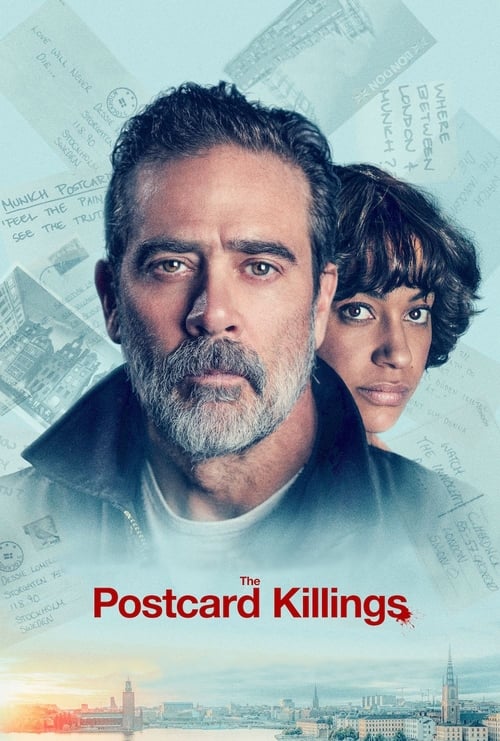
The Postcard Killings (2020)
Directed by Danis Tanović
No — The Postcard Killings is not woke, scoring 5 out of 100 on our wokeness meter.
Danis Tanović won an Academy Award for No Man's Land and has now applied his talents to a James Patterson serial-killer adaptation in which a grieving New York detective chases a murderer across European capitals.
Consciousness Markers
The cast is internationally varied, with Cush Jumbo as a prominent Black British actress playing an American journalist, but this is natural ensemble casting rather than a self-conscious representation statement.
Famke Janssen and Cush Jumbo hold substantial roles, but the film makes no argument about gender, patriarchy, or women's agency; they are simply characters in a procedural.
No LGBTQ+ characters, relationships, or themes appear anywhere in the film.
The film features a Black actress in a lead-adjacent role but engages with no racial themes, commentary, or consciousness whatsoever.
No environmental or climate themes are present in this serial-killer thriller.
The film contains no critique of wealth, capitalism, or class structures.
No body-positivity themes or messaging appear in the film.
No neurodivergent characters or themes are depicted.
The film is a fictional crime story with no historical revisionism or reframing of real events.
The film is a straightforward genre potboiler with no didactic messaging or moral lecturing to the audience.
Why it received this score
Danis Tanović won an Academy Award for No Man's Land and has now applied his talents to a James Patterson serial-killer adaptation in which a grieving New York detective chases a murderer across European capitals. The result is a potboiler of the most functional kind: bodies in London, postcards in Stockholm, a German policeman along for the ride. Jeffrey Dean Morgan broods with professional commitment. The film was released in March 2020, at a moment when nobody was going to the cinema, and critics were unkind. This is a film that knows exactly what it is and does not pretend otherwise, which is its own modest virtue.
For the purposes of cultural classification, the film is a near-vacuum, and I mean that as a compliment to its honesty. The cast is international by necessity of the plot, with Cush Jumbo, a Black British actress, playing an American journalist based in Sweden. That is ensemble casting, not a statement. Famke Janssen and Jumbo both occupy substantial roles, but the screenplay advances no argument about gender, power, or women's agency. They are characters in a procedural, and the procedural is indifferent to their demographics. No romantic subplot reaches for meaning. No villain monologue explains the social condition. The killer kills because the plot requires it.
There is no environmental sermon, no class critique, no body-positivity arc, no neurodivergent subplot, no reframing of history, and no moment in which the audience is instructed how to feel about the world beyond the desire to see a murderer caught. The film is a genre exercise, and it lectures no one. A sequel has been announced, with Renny Harlin attached and Morgan and Janssen returning. We can expect more postcards, more capitals, and, presumably, the same resolute incuriosity about the human condition. There is something almost restful in that.
Analysis generated by our Consciousness Algorithm


Synopsis
After suffering a personal tragedy, and desperate for justice, Jacob Kanon, a veteran New York City police detective, embarks on the search for a twisted killer who is leaving a bloody trail of elaborate murders across Europe.
Questions about The Postcard Killings
Is The Postcard Killings woke?
No — The Postcard Killings is not woke, scoring 5 out of 100 on our wokeness meter. That earns it a verdict of Ultra Based.
Does The Postcard Killings have any woke elements?
Very few. None of the 10 markers reaches 30, the level where a marker counts as present; the highest is Representation Casting at 12.
How does The Postcard Killings compare to other 2020 movies?
It ranks #184 of the 227 films from 2020 we've scored; their average is 21. The wokest is One Night in Miami... (83).
How is the Woke Score calculated?
An AI-assisted process researches the film and its reception, scores it 0–100 on ten markers, then combines those into one 0–100 Woke Score. It measures a specific set of 2020s cultural themes, not film quality.