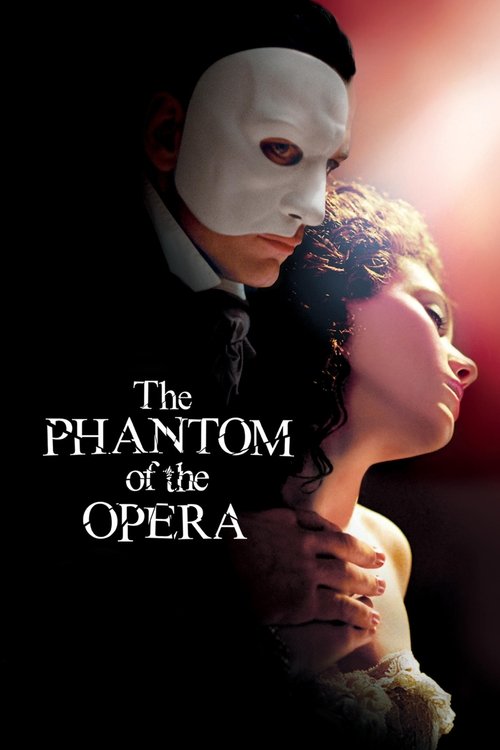
The Phantom of the Opera (2004)
Directed by Joel Schumacher
No — The Phantom of the Opera is not woke, scoring 0 out of 100 on our wokeness meter.
Joel Schumacher's 2004 adaptation of Andrew Lloyd Webber's stage musical, itself drawn from Gaston Leroux's 1910 novel, arrives in a fog of gold leaf and organ chords and shows no interest in the cultural debates of a later decade.
Consciousness Markers
The principal cast is uniformly white, with only a minor non-white actor in a portrait role. No deliberate diversity casting.
No LGBTQ+ characters, themes, or subtext.
Christine is a romantic prize pursued by two men; the narrative upholds traditional gender roles without feminist critique.
No engagement with race, racism, or racial identity.
No environmental themes or climate concerns.
The opera managers are comic foils, not symbols of capitalist critique.
The Phantom's disfigurement is a tragic plot device, not a modern body-positivity statement.
The Phantom's obsession is framed as romantic tragedy, not neurodivergence.
Period setting is decorative; no historical revisionism.
The film aims to entertain with music and melodrama, not to deliver social lectures.
Why it received this score
Joel Schumacher's 2004 adaptation of Andrew Lloyd Webber's stage musical, itself drawn from Gaston Leroux's 1910 novel, arrives in a fog of gold leaf and organ chords and shows no interest in the cultural debates of a later decade. The Paris Opera House is rendered in shadow and candlelight, the chandelier falls on schedule, and the plot concerns a masked composer who murders his way toward a soprano's affections. The triangle of Phantom, Christine, and Raoul runs on jealousy and possession, the sort of doomed Romanticism that nineteenth-century fiction specialized in. The film wants to be swooned at. It does not want to be argued with.
On the matter of social consciousness, the cupboard is bare, and not by accident. The principal cast is uniformly white, the gender arrangements are those of a Victorian melodrama, and Christine functions as a prize to be won by whichever man sings more forcefully. The Phantom's disfigurement is a gothic plot device with no modern aspirations toward self-acceptance. The opera managers, Firmin and Andre, are buffoons with ledgers, which makes them comic relief instead of a critique of commerce. There is no race consciousness, no climate anxiety, no liberation theology lurking in the catacombs. Minnie Driver's Carlotta is camp, and camp is not a politics.
The result is a clean slate, an artifact from a period when a musical could simply be a musical. The film earned mixed notices and three Academy Award nominations, losing all of them, and audiences handed it an A anyway, which tells us something about the divide between critics and people who like songs. Its historical setting is decorative. Its villain is tragic. Its ending is a rose on a grave. We can search the corridors for a sermon and find only a mirror. Nothing to report, and the nothing is sincere.
{"thematic_tags": ["remake", "book_adaptation"]}
Analysis generated by our Consciousness Algorithm


Synopsis
The deformed Phantom who haunts the Paris Opera House causes murder and mayhem in an attempt to make the woman he loves a star.
Questions about The Phantom of the Opera
Is The Phantom of the Opera woke?
No — The Phantom of the Opera is not woke, scoring 0 out of 100 on our wokeness meter. That earns it a verdict of Ultra Based.
Does The Phantom of the Opera have any woke elements?
No. All 10 markers score zero.
How does The Phantom of the Opera compare to other 2004 movies?
It ranks #151 of the 178 films from 2004 we've scored; their average is 12. The wokest is Tropical Malady (62).
How is the Woke Score calculated?
An AI-assisted process researches the film and its reception, scores it 0–100 on ten markers, then combines those into one 0–100 Woke Score. It measures a specific set of 2020s cultural themes, not film quality.