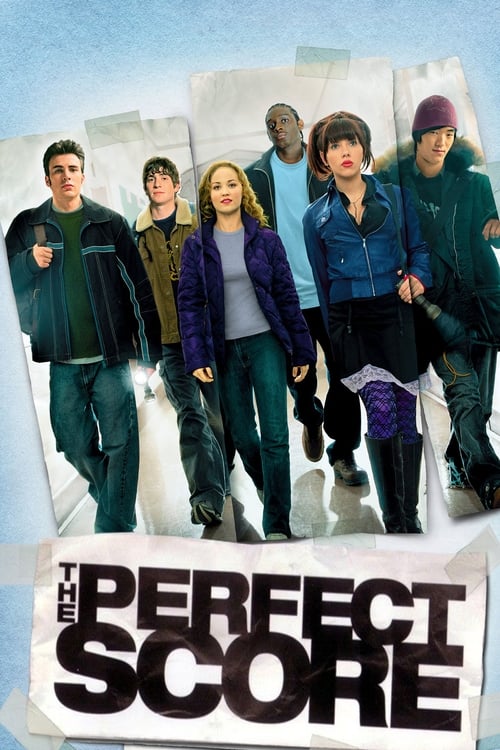
The Perfect Score (2004)
Directed by Brian Robbins
No — The Perfect Score is not especially woke, scoring 28 out of 100 on our wokeness meter.
The Perfect Score arrives from 2004 with the weary confidence of a film that has studied The Breakfast Club and learned the wrong lessons from it.
Consciousness Markers
The ensemble is genuinely multiracial for 2004 — a Black basketball star (Darius Miles), an Asian-American tech prodigy (Leonardo Nam), and a Black mother figure — but the diversity is woven into the story without commentary or box-ticking intent.
The film frames the SAT and the ETS testing industry as an arbitrary gatekeeper blocking ordinary kids' futures, a mild anti-institutional critique, though it never indicts wealth or class directly.
Desmond's need for a 900 to secure a basketball scholarship gestures at how standardized testing gates opportunity, but race is never named or examined as a structural issue.
Anna and Francesca have some agency — Anna seeks independence from her parents, Francesca joins for the thrill — but the film is a boys' caper at heart and offers no feminist argument.
The film gestures at a moral about cheating and the testing system, but critics noted it never explores its 'potentially socially relevant premise,' keeping the sermon light and the caper front-and-center.
No LGBTQ+ characters, themes, or subtext appear anywhere in the heist plot or its romantic pairings.
No environmental themes or climate content of any kind.
No body-positive messaging or diverse body representation is present.
Roy is a stoner slacker who turns out to be a gifted programmer, but his arc is framed as hidden intelligence rather than neurodivergence.
No historical revisionism; the film is a contemporary fictional teen caper.
Why it received this score
The Perfect Score arrives from 2004 with the weary confidence of a film that has studied The Breakfast Club and learned the wrong lessons from it. Six New Jersey teenagers, each blocked from a desired future by a standardized test, conspire to rob the Educational Testing Service. The ensemble is notably mixed for its era: a Black basketball star, an Asian-American programmer, a Black mother who dispenses wisdom in the third act. None of this is announced. The film simply casts them and moves on, which in hindsight reads as almost quaint.
The film's one gesture toward social argument is its suspicion of the testing industry, an institution that gates opportunity behind a number. That is a mild anti-institutional posture, not an economic one. Nobody here is poor in a way the script cares to examine. The critique stays safely inside the walls of a Princeton office park, and the caper, being a caper, wins out over any sermon. Critics at the time complained the film failed to explore its socially relevant premise. They were correct, though the restraint is its own small mercy.
What the film does not contain is equally instructive. There is no queer subtext, no environmental conscience, no interest in bodies or brains that deviate from the norm. Roy the stoner is revealed as a gifted programmer, which the film treats as hidden intelligence, not as a neurological condition. Anna and Francesca possess a flicker of agency, though the camera belongs to the boys. The result is a mild, forgettable heist comedy that gestures at rebellion and then hands in its homework on time. It placed fifth on its opening weekend and deserved the quiet that followed. Some films are not suppressed by history. They are simply filed away by it, alphabetically, without ceremony, next to the other MTV productions that mistook a soundtrack for a thesis.
Thematic tags: []
Analysis generated by our Consciousness Algorithm
Part of


Synopsis
Six high school seniors decide to break into the Princeton Testing Center so they can steal the answers to their upcoming SAT tests and all get perfect scores.
Questions about The Perfect Score
Is The Perfect Score woke?
No — The Perfect Score is not especially woke, scoring 28 out of 100 on our wokeness meter. That earns it a verdict of Based.
Does The Perfect Score have any woke elements?
1 of the 10 markers register at 30 or above, led by Representation Casting (45). On Representation Casting: The ensemble is genuinely multiracial for 2004 — a Black basketball star (Darius Miles), an Asian-American tech prodigy (Leonardo Nam), and a Black mother figure — but the diversity is woven into the story without commentary or box-ticking intent.
How does The Perfect Score compare to other 2004 movies?
It ranks #16 of the 178 films from 2004 we've scored; their average is 12. The wokest is Tropical Malady (62).
How is the Woke Score calculated?
An AI-assisted process researches the film and its reception, scores it 0–100 on ten markers, then combines those into one 0–100 Woke Score. It measures a specific set of 2020s cultural themes, not film quality.