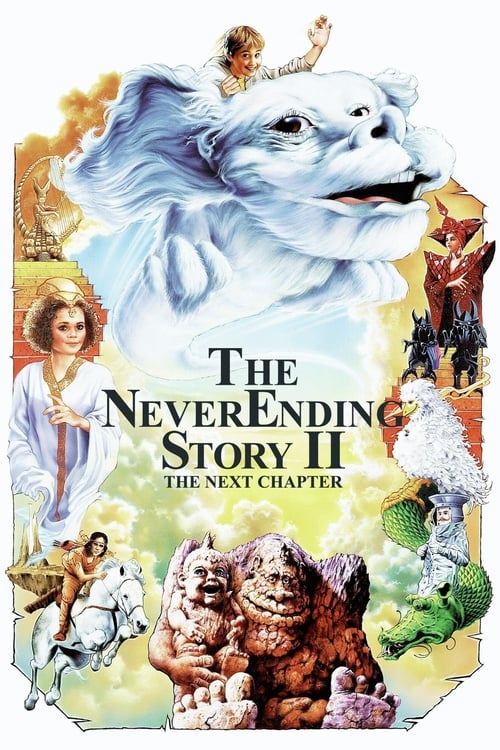
The NeverEnding Story II: The Next Chapter (1990)
Directed by George T. Miller
No — The NeverEnding Story II: The Next Chapter is not woke, scoring 0 out of 100 on our wokeness meter.
The NeverEnding Story II: The Next Chapter arrives in 1990 as a sequel to a beloved film, adapted from the back half of a novel the author had spent years litigating over.
Consciousness Markers
The film carries a gentle moral about courage and compassion ('wish for her to have a heart'), but it is generic children's-fable messaging rather than modern preachy lecture energy.
The cast is uniformly white with no diverse or color-conscious casting choices; the film predates any such considerations.
No LGBTQ+ characters, themes, or subtext appear anywhere in the story.
Female characters like the Childlike Empress and the sorceress Xayide exist as fantasy archetypes, but the film advances no feminist agenda or commentary.
The film engages no racial themes or commentary whatsoever.
The 'Emptiness' is a magical force of evil, not an environmental or climate allegory.
No economic critique or eat-the-rich sentiment is present.
No body positivity themes or messaging appear in the film.
No neurodivergent characters or themes are present.
The film is pure fantasy with no historical subject matter to revise.
Why it received this score
The NeverEnding Story II: The Next Chapter arrives in 1990 as a sequel to a beloved film, adapted from the back half of a novel the author had spent years litigating over. One can almost respect the sheer administrative grimness of it: fourteen drafts, a year of pre-production, over six hundred children auditioned, all to produce a movie that currently sits at fourteen percent on Rotten Tomatoes. The story concerns Bastian, a boy with a fear of heights, who returns to Fantasia to confront an evil sorceress named Xayide and a spreading force called the Emptiness. He loses a memory with every wish. This is, structurally, the most interesting thing about the film, and it is largely squandered on armored giants and a spy who looks like a startled umbrella.
The cast is uniformly white, which is simply what casting looked like in a German-American children's fantasy in 1990, and the film offers no comment on this, having no concept that comment was available. The female characters, the Childlike Empress and the scheming Xayide, function as archetypes rather than arguments. No romantic or identity subtext stirs beneath the surface. The Emptiness is a magical malevolence, not a stand-in for any environmental anxiety, and nobody in Fantasia has a thought to spare for the means of production. The film's moral, that compassion can undo a villain by giving her a heart, is a gentle fable of the sort children's cinema has dispensed for a century. It lectures no one. It merely hopes you will be slightly kinder.
What remains is a curious artifact. A franchise built on a book about the dangers of wishful thinking, undermined by a production that wished for three soundstages and received one. It is not a film with a message for our moment. It is a film with a message for 1990, delivered quietly, and mostly to children who have since grown up and forgotten it.
Analysis generated by our Consciousness Algorithm


Synopsis
Once again, Bastian is transported to the world of Fantasia which he recently managed to save from destruction. However, the land is now being destroyed by an evil sorceress, Xayide, so he must join up with Atreyu and face the Emptiness once more.
Questions about The NeverEnding Story II: The Next Chapter
Is The NeverEnding Story II: The Next Chapter woke?
No — The NeverEnding Story II: The Next Chapter is not woke, scoring 0 out of 100 on our wokeness meter. That earns it a verdict of Ultra Based.
Does The NeverEnding Story II: The Next Chapter have any woke elements?
Very few. None of the 10 markers reaches 30, the level where a marker counts as present; the highest is Lecture Energy at 5.
How does The NeverEnding Story II: The Next Chapter compare to other 1990 movies?
It ranks #54 of the 68 films from 1990 we've scored; their average is 9. The wokest is Nightbreed (60).
How is the Woke Score calculated?
An AI-assisted process researches the film and its reception, scores it 0–100 on ten markers, then combines those into one 0–100 Woke Score. It measures a specific set of 2020s cultural themes, not film quality.