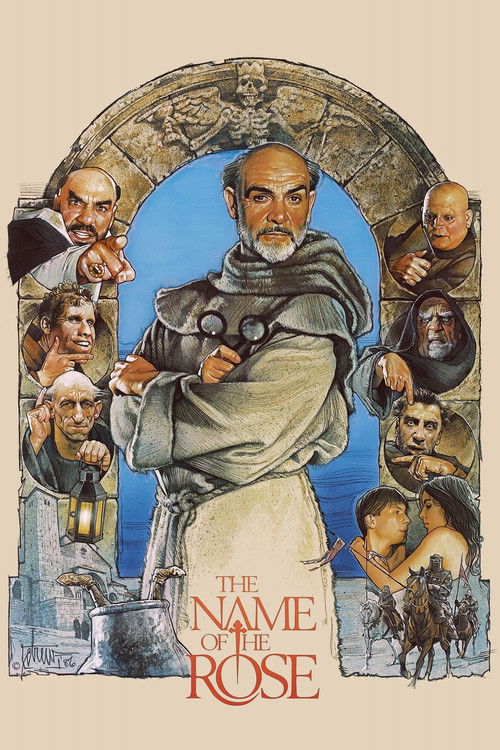
The Name of the Rose (1986)
Directed by Jean-Jacques Annaud
No — The Name of the Rose is not woke, scoring 12 out of 100 on our wokeness meter.
The Name of the Rose arrives in 1986 with Sean Connery in a tonsure, Christian Slater as his apprentice, and a body count that accumulates with monastic patience.
Consciousness Markers
Director Annaud deliberately insisted on casting Swiss actor Urs Althaus, a black man, as the translator Venantius, over the objections of US casting agencies who proposed only white actors. This is a conscious, if modest, act of non-traditional casting for a 1986 medieval film.
The casting of a black monk as a translator reflects a mild awareness of medieval Moorish intellectualism, but race is never a thematic concern of the narrative.
The film contrasts the opulent, hoarded wealth of the abbey and its forbidden library against the poverty of the surrounding peasants, but this is a medieval religious critique rather than a modern anti-capitalist statement.
Theological debate and the clash between faith and reason feature in the plot, but Eco himself noted the film stripped out the novel's theological and political substance, leaving little overt preaching.
No LGBTQ+ themes or characters appear in the film.
The only significant female character, the peasant Girl, is a near-wordless plot device used for Adso's sexual awakening and later victimized by the Inquisition. No feminist agenda is present.
No environmental or climate themes are present.
The grotesque hunchback Salvatore is presented as a figure of horror and heresy, not as a body-positivity statement.
No neurodivergence themes are present.
The film is a straightforward historical mystery set in the 14th century, not a revisionist reframing of history.
Why it received this score
The Name of the Rose arrives in 1986 with Sean Connery in a tonsure, Christian Slater as his apprentice, and a body count that accumulates with monastic patience. Jean-Jacques Annaud spent four years assembling a multi-ethnic cast of distinctive faces, and the result treats the fourteenth century as a lived-in place rather than a costume drama. The murders are solved by deduction, the library is a labyrinth, and the Inquisition arrives on schedule to ruin everything. It is a handsome production and a grim one.
The social consciousness on display is mild and largely incidental. Annaud insisted on a black actor, Urs Althaus, as the translator Venantius, against the objections of American casting agencies, a gesture that registers as thoughtful without ever hardening into a thesis. The film never pauses to comment on it, which is to its credit. The abbey hoards its books and its gold while peasants outside trade their dignity for bread, though that critique belongs to medieval monasticism and not to any modern economic sermon. The one woman of consequence exists to awaken Adso and then to be tortured, and the film concedes in its closing narration that she never even earned a name.
Where the novel argued, the film mostly prowls. Umberto Eco complained that the adaptation kept the lettuce and discarded the theology and the politics, and he was correct, though the residue is a better movie than his sandwich metaphor suggests. What survives is atmosphere, poison on the page, and a burning library. The sermonizing is confined to a few exchanges about whether Christ ever laughed, a modest dose for a film about heresy. The whole enterprise holds its ideas loosely and its candlelight beautifully, which is a defensible way to spend two hours.
Analysis generated by our Consciousness Algorithm


Synopsis
14th-century Franciscan monk William of Baskerville and his young novice arrive at a conference to find that several monks have been murdered under mysterious circumstances. To solve the crimes, William must rise up against the Church's authority and fight the shadowy conspiracy of monastery monks using only his intelligence; which is considerable.
Questions about The Name of the Rose
Is The Name of the Rose woke?
No — The Name of the Rose is not woke, scoring 12 out of 100 on our wokeness meter. That earns it a verdict of Ultra Based.
Does The Name of the Rose have any woke elements?
1 of the 10 markers register at 30 or above, led by Representation Casting (30). On Representation Casting: Director Annaud deliberately insisted on casting Swiss actor Urs Althaus, a black man, as the translator Venantius, over the objections of US casting agencies who proposed only white actors.
How does The Name of the Rose compare to other 1986 movies?
It ranks #11 of the 62 films from 1986 we've scored; their average is 7. The wokest is Star Trek IV: The Voyage Home (42).
How is the Woke Score calculated?
An AI-assisted process researches the film and its reception, scores it 0–100 on ten markers, then combines those into one 0–100 Woke Score. It measures a specific set of 2020s cultural themes, not film quality.