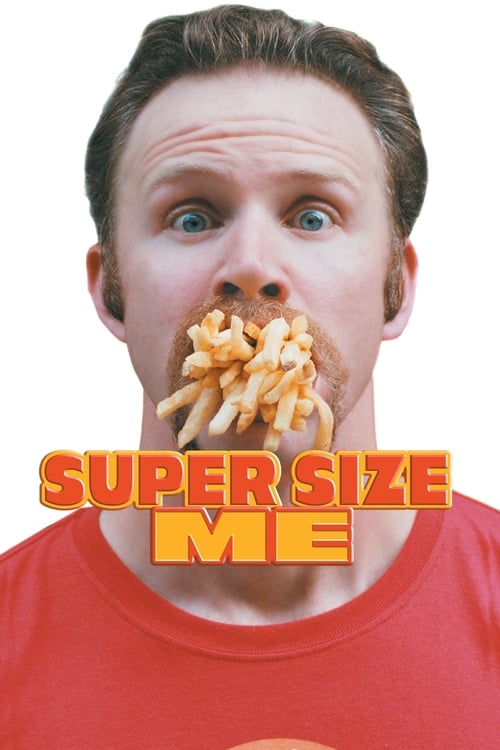
Super Size Me (2004)
Directed by Morgan Spurlock
No — Super Size Me is not especially woke, scoring 38 out of 100 on our wokeness meter.
Super Size Me arrived in 2004 as a stunt dressed in a lab coat, and two decades later it remains exactly that.
Consciousness Markers
As an advocacy documentary, it explicitly argues a thesis and ends with a rhetorical challenge, giving it a moderate lecturing quality.
The documentary critiques McDonald's and the fast-food industry for prioritizing profit over public health, but it stops short of a systemic anti-capitalist argument.
The cast is composed largely of health professionals and Spurlock himself; no emphasis on diverse representation as a thematic element.
No LGBTQ+ characters, themes, or advocacy appear in the film.
The film touches on Spurlock's sex drive and his girlfriend's vegan cooking, but it does not advance a feminist agenda.
Obesity and fast-food marketing are discussed in general public-health terms, without a racial-justice or racial-consciousness framework.
Environmental or climate concerns are absent; the focus is personal health and corporate nutrition practices.
The film frames obesity and weight gain as a health crisis rather than promoting body acceptance or size positivity.
No neurodivergence themes or representation are present.
It is a contemporary self-experiment, not a revisionist historical narrative.
Why it received this score
Super Size Me arrived in 2004 as a stunt dressed in a lab coat, and two decades later it remains exactly that. Morgan Spurlock eats three McDonald's meals a day for thirty days, walks about as much as the average American, and watches his liver, cholesterol, and mood deteriorate on camera. The premise is simple, the execution is brisk, and the audience is never in doubt about where the argument is heading. It is a documentary built around a single man's digestive tract, and it knows it.
The film carries almost none of the cultural markers that would later define a certain strain of advocacy cinema. Its cast is doctors, nutritionists, and Spurlock himself, with no interest in representation as a theme. There are no LGBTQ threads, no feminist argument, no racial framework attached to the obesity statistics. Climate concerns do not surface. Body positivity is actively absent: the film treats weight gain as a crisis to be reversed, and its epilogue celebrates the shedding of the pounds. Neurodivergence does not enter the frame, and history is not revised, only reported from the present tense of a thirty-day experiment.
Where the film does lean forward is in its irritation with corporate behavior. McDonald's is portrayed as a machine that markets calories to children and profits from the damage, and Spurlock lets that accusation sit without pushing it into a broader indictment of the economic order. The closing rhetorical question and the cartoon tombstone give the proceedings a sermonizing finish. The lecturing is real but moderate, more exasperated than ideological. It is a film that wants you to feel bad about a Happy Meal, not to rethink the system that sells it.
Analysis generated by our Consciousness Algorithm


Synopsis
Morgan Spurlock subjects himself to a diet based only on McDonald's fast food three times a day for thirty days without exercising to try to prove why so many Americans are fat or obese. He submits himself to a complete check-up by three doctors, comparing his weight along the way, resulting in a scary conclusion.
Questions about Super Size Me
Is Super Size Me woke?
No — Super Size Me is not especially woke, scoring 38 out of 100 on our wokeness meter. That earns it a verdict of Based.
Does Super Size Me have any woke elements?
2 of the 10 markers register at 30 or above, led by Lecture Energy (55) and Eat the Rich (40). On Lecture Energy: As an advocacy documentary, it explicitly argues a thesis and ends with a rhetorical challenge, giving it a moderate lecturing quality.
How does Super Size Me compare to other 2004 movies?
It ranks #9 of the 178 films from 2004 we've scored; their average is 12. The wokest is Tropical Malady (62).
How is the Woke Score calculated?
An AI-assisted process researches the film and its reception, scores it 0–100 on ten markers, then combines those into one 0–100 Woke Score. It measures a specific set of 2020s cultural themes, not film quality.