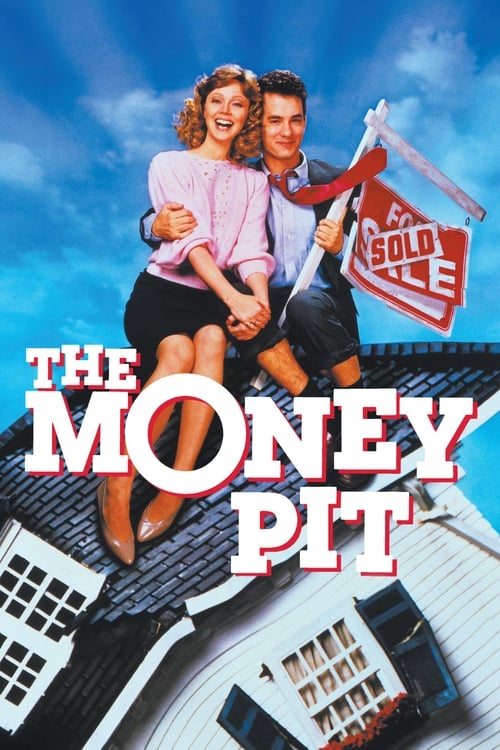
The Money Pit (1986)
Directed by Richard Benjamin
No — The Money Pit is not woke, scoring 4 out of 100 on our wokeness meter.
The Money Pit arrives from 1986, a year when a Hollywood comedy could still concern itself entirely with a staircase collapsing.
Consciousness Markers
The film satirizes greedy contractors, an unscrupulous realtor, and con artists, but its target is the financial misery of renovation, not capitalism or class. It is a consumer-comedy, not an eat-the-rich polemic.
The cast is overwhelmingly white, with Wendell Pierce appearing in a single throwaway paramedic role and Yakov Smirnoff as a Russian stereotype. No meaningful representation casting agenda is present.
Shelley Long is a co-lead as a classical musician, but the film treats her primarily as a romantic partner and comedic foil. There is no feminist critique or agenda.
No LGBTQ+ characters, themes, or subtext appear anywhere in the film.
Race is entirely absent as a subject; the film is a white suburban home-ownership comedy with no racial consciousness whatsoever.
No environmental or climate themes are present.
No body positivity themes or messaging appear.
No neurodivergent characters or themes are present.
The film is a straightforward contemporary comedy with no historical revisionism.
The film is pure slapstick with no preachy messaging or moral instruction of any kind.
Why it received this score
The Money Pit arrives from 1986, a year when a Hollywood comedy could still concern itself entirely with a staircase collapsing. Tom Hanks and Shelley Long buy a Long Island mansion for $200,000, watch it disintegrate around them, and bicker about fidelity while contractors assure them the work will take two weeks. Richard Benjamin directs with the brisk indifference of a man who knows the house is the real star. The film is a loose remake of Mr. Blandings Builds His Dream House, and it inherits that picture's concerns without alteration: property, money, and the quiet humiliation of the middle class.
On the question of social consciousness, the cupboard is bare. The cast is white to a man, with Wendell Pierce surfacing as a paramedic for a single scene and Yakov Smirnoff present as a Russian caricature. There is no LGBTQ+ presence, no racial subject, no environmental concern, no body politics, no neurodivergent character. Shelley Long plays a classical musician, which is a job, not a thesis. The film's anger lands on contractors, realtors, and con artists, which reads as a complaint about renovation costs, not a critique of capital. The swindlers flee to Brazil. That is the full extent of the economic analysis.
The film preaches nothing to anyone, which in 1986 was simply called comedy. Ebert dismissed it as one monotonous sight gag after another, and he was not wrong, though the sustained Rube Goldberg sequence earns its grudging respect. The result is a document of a vanished mode: a studio comedy that wanted only to make an audience laugh at a bathtub falling through a floor. We classify it, we file it, we move on.
Analysis generated by our Consciousness Algorithm
Part of


Synopsis
After being evicted from their Manhattan apartment, a couple buy what looks like the home of their dreams—only to find themselves saddled with a bank-account-draining nightmare. Struggling to keep their relationship together as their rambling mansion falls to pieces around them, the two watch in hilarious horror as everything—including the kitchen sink—disappears into the Money Pit.
Questions about The Money Pit
Is The Money Pit woke?
No — The Money Pit is not woke, scoring 4 out of 100 on our wokeness meter. That earns it a verdict of Ultra Based.
Does The Money Pit have any woke elements?
Very few. None of the 10 markers reaches 30, the level where a marker counts as present; the highest is Eat the Rich at 10.
How does The Money Pit compare to other 1986 movies?
It ranks #28 of the 62 films from 1986 we've scored; their average is 7. The wokest is Star Trek IV: The Voyage Home (42).
How is the Woke Score calculated?
An AI-assisted process researches the film and its reception, scores it 0–100 on ten markers, then combines those into one 0–100 Woke Score. It measures a specific set of 2020s cultural themes, not film quality.