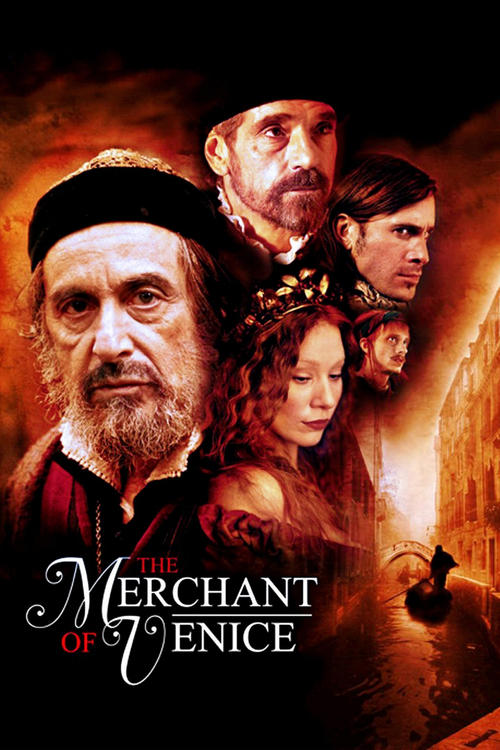
The Merchant of Venice (2004)
Directed by Michael Radford
No — The Merchant of Venice is not especially woke, scoring 34 out of 100 on our wokeness meter.
The Merchant of Venice, Michael Radford's 2004 adaptation of the Shakespeare play, arrives with a solemnity that suggests it knows the weight of its source material.
Consciousness Markers
The film emphasizes a love triangle between Bassanio, Antonio, and Portia, including a kiss between Bassanio and Antonio.
The film opens with a montage of Jewish persecution and centers on antisemitism in Venice, but it is a historical Shakespeare adaptation rather than modern racial justice.
Portia is a strong, intelligent woman who cross-dresses as a lawyer and outsmarts the men, though this is inherent to Shakespeare's text.
The opening text and contextualization of antisemitism have a didactic quality, but it is not a modern social justice lecture.
Mostly white cast; Zuleikha Robinson (mixed heritage) plays Jessica, but there is no deliberate diverse or color-conscious casting.
The play involves moneylending and merchant capitalism, but the film does not advance a modern anti-capitalist critique.
No environmental or climate themes.
No body positivity themes.
No neurodivergence themes.
A Shakespeare adaptation, not a historical revision.
Why it received this score
The Merchant of Venice, Michael Radford's 2004 adaptation of the Shakespeare play, arrives with a solemnity that suggests it knows the weight of its source material. The film opens with a montage of Jewish persecution in Venice, a heavy-handed contextualization that functions as a preemptive apology for the antisemitism to follow. Al Pacino's Shylock is a tragic figure, and the film's racial consciousness is historical in nature, not a modern social justice crusade. The cast is overwhelmingly white, with Zuleikha Robinson as Jessica providing a lone note of mixed heritage, though this feels incidental rather than a deliberate statement on representation. The production's engagement with prejudice is earnest but confined to the 16th century.
Where the film does display a more contemporary sensibility is in its handling of the Bassanio-Antonio-Portia triangle. Radford emphasizes the homoerotic charge between the two men, culminating in a kiss that lends the proceedings a distinct LGBTQ+ resonance. Portia, played by Lynn Collins, is a proto-feminist figure who disguises herself as a lawyer and outwits the men, but this is Shakespeare's design, not a modern intervention. The play's moneylending plot offers a faint anti-capitalist murmur, yet the film avoids any explicit critique of merchant capitalism. The opening text and the careful framing of Shylock's plight carry a lecturing tone, a mild sermonizing about tolerance that stops short of full-blown modern activism.
Conspicuously absent are any gestures toward climate concerns, body positivity, neurodivergence, or revisionist history. The film is content to be a faithful, if uneven, adaptation, and its social consciousness remains rooted in the 16th century. We are left with a respectable production that engages with prejudice and desire but never fully commits to the progressive pieties of our current moment. It is a curious artifact: too earnest to be dismissed, too restrained to be radical. The overall effect is that of a sommelier presenting a vintage that is well made but lacks the fashionable notes of the season.
Analysis generated by our Consciousness Algorithm


Synopsis
Venice, 1596. Bassanio begs his friend Antonio, a prosperous merchant, to lend him a large sum of money so that he can woo Portia, a very wealthy heiress; but Antonio has invested his fortune abroad, so they turn to Shylock, a Jewish moneylender, and ask him for a loan.
Questions about The Merchant of Venice
Is The Merchant of Venice woke?
No — The Merchant of Venice is not especially woke, scoring 34 out of 100 on our wokeness meter. That earns it a verdict of Based.
Does The Merchant of Venice have any woke elements?
3 of the 10 markers register at 30 or above, led by LGBTQ+ Themes (45), Racial Consciousness (40) and Feminist Agenda (35). On LGBTQ+ Themes: The film emphasizes a love triangle between Bassanio, Antonio, and Portia, including a kiss between Bassanio and Antonio.
How does The Merchant of Venice compare to other 2004 movies?
It ranks #13 of the 178 films from 2004 we've scored; their average is 12. The wokest is Tropical Malady (62).
How is the Woke Score calculated?
An AI-assisted process researches the film and its reception, scores it 0–100 on ten markers, then combines those into one 0–100 Woke Score. It measures a specific set of 2020s cultural themes, not film quality.