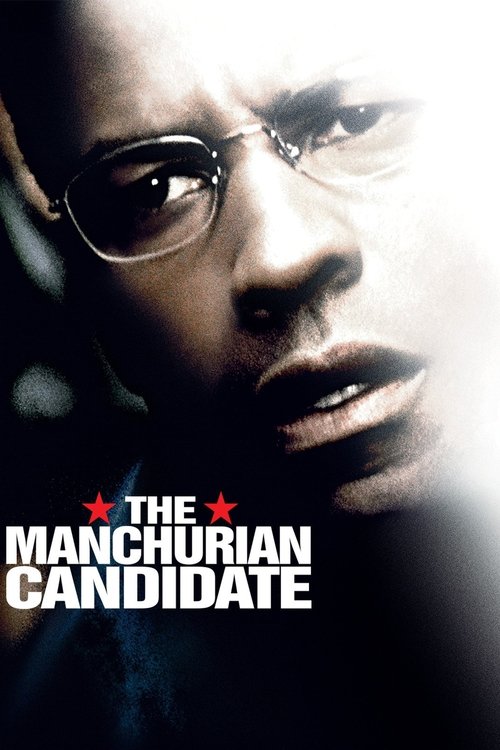
The Manchurian Candidate (2004)
Directed by Jonathan Demme
No — The Manchurian Candidate is not especially woke, scoring 22 out of 100 on our wokeness meter.
Jonathan Demme's 2004 remake of The Manchurian Candidate arrives with a respectable pedigree and a tidy substitution: the communist brainwashers of the Cold War original become Manchurian Global, a private-equity leviathan that purchases senators, funds memory-implant research, and orders assassinations from a boardroom.
Consciousness Markers
The villain is reimagined as Manchurian Global, a sinister private-equity multinational that buys politicians and engineers assassinations, giving the film a genuine corporate-greed-as-evil engine.
A Black actor (Denzel Washington) headlines a role originated by Frank Sinatra, with a notably multiracial supporting cast, though the film never comments on this and it reads as conventional 2004 colorblind casting rather than a statement.
Meryl Streep's Senator Eleanor Shaw is a formidable power player, but she is written as a monstrous villain and 'mad mommy,' not as a vehicle for feminist messaging.
PTSD, suppressed memory, and brainwashing are central plot mechanics, but they are treated as spy-thriller devices rather than as a neurodiversity-affirming statement.
The film is a propulsive political thriller that shows rather than preaches; its corporate-conspiracy critique is embedded in plot, not delivered as a sermon.
No LGBTQ+ characters, themes, or subtext appear anywhere in the film.
The film features a Black lead and diverse cast but engages with race not at all; the conspiracy is about corporate power, not racial politics.
No environmental or climate themes are present.
No body-positivity themes or messaging.
The remake swaps the original's communist brainwashers for a corporation, but this is a plot update rather than a revisionist reframing of historical events.
Why it received this score
Jonathan Demme's 2004 remake of The Manchurian Candidate arrives with a respectable pedigree and a tidy substitution: the communist brainwashers of the Cold War original become Manchurian Global, a private-equity leviathan that purchases senators, funds memory-implant research, and orders assassinations from a boardroom. The screenwriters have done their arithmetic. Where once the enemy was a foreign ideology, now the enemy is a quarterly earnings report. This is a corporate-greed-as-evil engine, and it hums along nicely, powering the paranoia without ever stopping to deliver a lecture on the subject. The film shows us the machine and lets us draw our own conclusions, which in 2004 counted as restraint.
Denzel Washington steps into the role Frank Sinatra originated, and the surrounding cast is quietly multiracial, a fact the film treats as unremarkable, which is either progress or simply the casting conventions of its moment. Meryl Streep's Senator Eleanor Shaw is a magnificent monster, a mother who handed her own son to the brainwashers for the good of the republic, and the film seems to enjoy her villainy too much to make her a vehicle for anything. The Gulf War trauma, the suppressed memories, the implant in the spine: these are spy-thriller machinery, not a statement about the wounded mind. The film is too busy being propulsive to be preachy.
The film, then, is a taut, well-acted thriller whose politics live in its plot and nowhere else. It critiques concentrated corporate power with enthusiasm and critiques nothing else at all. The result is a film of modest cultural ambition, content to frighten rather than instruct, and all the better for it. Streep's senator is a villain first and a woman second, which is either a missed opportunity or simply honest characterization. Either way, the picture keeps its sermonizing to a minimum, and the machinery of the conspiracy does the talking. We are left with a competent remake that knows exactly how much it wants to say, and says a little less than that. The implant comes out of the back. The message stays buried, which is its own quiet virtue, and the film's most radical gesture is declining to make one. It is a thriller that trusts the audience to keep up, and in this cultural moment, that is nearly a provocation.
Tags: remake, book adaptation, corporate conspiracy, no Oscar, opened at number three, not a superhero, not a true story, no sequel. The classification stands. The numbers hold. The film remains what it always was: a well-made machine that never once winks at the viewer, and perhaps that restraint is the only statement it needed to make, or the only one it could afford given the budget of eighty million dollars against a worldwide gross of ninety-six point one million dollars, which is a modest return on any ledger and a fitting one for a film this measured in its ambitions and this disciplined in its restraint and this careful never to overplay the hand it was dealt by its own screenwriters and its own director and its own very talented cast of performers who understood, apparently, exactly what kind of film they were making and made precisely that film and nothing more ambitious than that, which is either a limitation or a virtue depending on the viewer's appetite for sermons versus thrills, and this viewer prefers the thrills, thank you, and the machine that delivers them without a lecture attached.
Analysis generated by our Consciousness Algorithm
Part of


Synopsis
Years after his squad was ambushed during the Gulf War, Major Ben Marco finds himself having terrible nightmares. He begins to doubt that his fellow squad-mate Sergeant Raymond Shaw, now a vice-presidential candidate, is the hero he remembers him being. As Marco's doubts deepen, Shaw's political power grows, and, when Marco finds a mysterious implant embedded in his back, the memory of what really happened begins to return.
Questions about The Manchurian Candidate
Is The Manchurian Candidate woke?
No — The Manchurian Candidate is not especially woke, scoring 22 out of 100 on our wokeness meter. That earns it a verdict of Based.
Does The Manchurian Candidate have any woke elements?
2 of the 10 markers register at 30 or above, led by Eat the Rich (55) and Representation Casting (35). On Eat the Rich: The villain is reimagined as Manchurian Global, a sinister private-equity multinational that buys politicians and engineers assassinations, giving the film a genuine corporate-greed-as-evil engine.
How does The Manchurian Candidate compare to other 2004 movies?
It ranks #28 of the 178 films from 2004 we've scored; their average is 12. The wokest is Tropical Malady (62).
How is the Woke Score calculated?
An AI-assisted process researches the film and its reception, scores it 0–100 on ten markers, then combines those into one 0–100 Woke Score. It measures a specific set of 2020s cultural themes, not film quality.