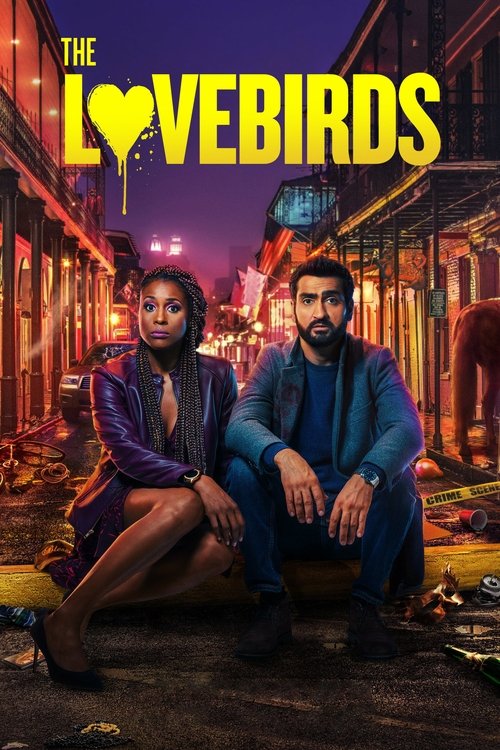
The Lovebirds (2020)
Directed by Michael Showalter
No — The Lovebirds is not especially woke, scoring 39 out of 100 on our wokeness meter.
The Lovebirds arrives as a studio romantic comedy that sold its theatrical birthright to Netflix during the pandemic.
Consciousness Markers
Stars Issa Rae and Kumail Nanjiani as an interracial couple of color in a mainstream romantic comedy, a notable diverse-casting choice though not framed as a social-justice statement.
Leilani explicitly invokes racial profiling as a reason they cannot trust police, and the leads are a Black woman and South Asian man, but race is not the film's central subject.
Leilani is a capable co-lead who drives much of the action, but the film does not advance a feminist agenda or critique patriarchy.
A brief racial-profiling argument and some social commentary, but the film is primarily a breezy comedy and never lectures.
No LGBTQ+ characters, themes, or subtext.
No climate-change themes or environmental messaging.
The secret-society blackmail plot involves wealthy elites, but the film offers no coherent anti-capitalist critique.
No body-positivity themes or messaging.
No neurodivergence themes or representation.
No historical revisionism or reimagining of past events.
Why it received this score
The Lovebirds arrives as a studio romantic comedy that sold its theatrical birthright to Netflix during the pandemic. It stars Issa Rae and Kumail Nanjiani as a couple whose breakup is interrupted by a murder, a blackmail conspiracy, and a great deal of running. The film is pleasant, forgettable, and mostly interested in jokes. That is not a criticism. It is a classification.
The casting is the most notable progressive gesture. A Black woman and a South Asian man anchor a mainstream rom-com, and the film never makes a grand statement about it. Leilani is capable and drives much of the plot, but the movie does not organize itself around a feminist argument. She invokes racial profiling as a reason not to trust the police, a real and specific beat. Race remains a detail of the characters' lives, not the film's subject. There is no LGBTQ content, no environmental sermon, no body-positivity thread, no neurodivergent representation, and no revisionist history. The blackmail plot involves wealthy people in masks, which might look like an invitation to eat the rich. The film declines. It is more interested in the orgy joke.
The social commentary stays brief. A line about profiling lands, then the movie returns to car chases and bickering. There is no lecture, no sermon, no attempt to educate the audience on the correct position regarding late capitalism or the climate. The Lovebirds is a comedy of manners with a body count. It wants to be liked. It succeeds often enough. For those of us who catalogue cultural signals for a living, the experience is akin to tasting a vintage and finding almost no tannins. The wine is fine. The cellar remains unthreatened.
Analysis generated by our Consciousness Algorithm
Part of


Synopsis
A couple experiences a defining moment in their relationship when they are unintentionally embroiled in a murder mystery. As their journey to clear their names takes them from one extreme – and hilarious - circumstance to the next, they must figure out how they, and their relationship, can survive the night.
Questions about The Lovebirds
Is The Lovebirds woke?
No — The Lovebirds is not especially woke, scoring 39 out of 100 on our wokeness meter. That earns it a verdict of Based.
Does The Lovebirds have any woke elements?
2 of the 10 markers register at 30 or above, led by Representation Casting (65) and Racial Consciousness (40). On Representation Casting: Stars Issa Rae and Kumail Nanjiani as an interracial couple of color in a mainstream romantic comedy, a notable diverse-casting choice though not framed as a social-justice statement.
How does The Lovebirds compare to other 2020 movies?
It ranks #39 of the 227 films from 2020 we've scored; their average is 21. The wokest is One Night in Miami... (83).
How is the Woke Score calculated?
An AI-assisted process researches the film and its reception, scores it 0–100 on ten markers, then combines those into one 0–100 Woke Score. It measures a specific set of 2020s cultural themes, not film quality.