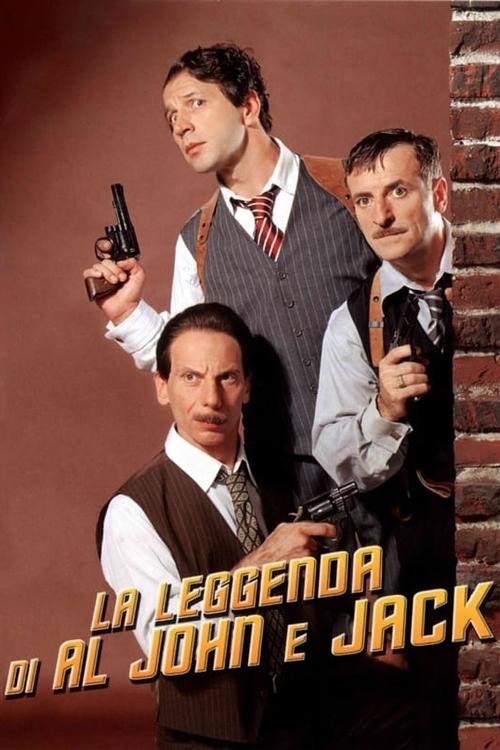
The Legend of Al, John and Jack (2002)
Directed by Massimo Venier
No — The Legend of Al, John and Jack is not woke, scoring 9 out of 100 on our wokeness meter.
The Legend of Al, John and Jack is a 2002 Italian crime comedy about three incompetent gangsters in a stylized 1959 New York.
Consciousness Markers
Includes a supporting gay character (Al's brother Herbert) whose unrequited love for Johnny is a comedic subplot, but the portrayal is light and not framed through modern progressive identity politics.
The cast is entirely Italian and white, with no attempt at diverse or inclusive casting.
No feminist themes or female-driven perspectives; women are largely absent or incidental.
No engagement with racial issues or racial identity; the Italian-American gangster setting is not used for racial commentary.
No environmental or climate-related themes.
No critique of capitalism or wealth inequality; the gangster plot is purely comedic crime fare.
No body positivity themes or diverse body representation.
Al's memory-loss syndrome is a plot device, not a portrayal of neurodivergence or neurodiverse identity.
Set in a fictionalized 1959 New York, but does not revise or reinterpret historical events for ideological purposes.
A broad Italian comedy with no preachy or didactic messaging.
Why it received this score
The Legend of Al, John and Jack is a 2002 Italian crime comedy about three incompetent gangsters in a stylized 1959 New York. Al, John, and Jack bungle their way through a plot to betray their boss, Sam Genovese, while Al suffers a rare syndrome that erases his memory every time he sleeps. The film is a broad farce built on defective guns, mistaken identities, and a dead aunt. History here is wallpaper. The period setting exists for fedoras and wisecracks, not for commentary.
In terms of modern progressive sensibilities, the film is a desert. The cast is entirely Italian and white. Women are incidental or absent. Racial consciousness, climate anxiety, anti-capitalist grievance, and body positivity are nowhere to be found. Al's memory loss functions as a mechanical gag, not as a portrait of neurodivergence. The narrative does not revise history for ideological ends. There is no sermonizing. The lone exception is Herbert, Al's gay brother, whose unrequited love for Johnny supplies a running joke. That subplot is light and farcical. It is untouched by contemporary identity politics. It registers as a faint blip.
As entertainment, the film is genial and forgettable. It wants nothing more than to watch three grown men fail upward. There is no agenda to decode, no lecture to endure, no social instruction to absorb. A sommelier of cultural markers would find this vintage thin, almost transparent. The film belongs to a pre-identity era, content to be silly. Its ambitions end at the next punchline. We can file it under harmless.
Analysis generated by our Consciousness Algorithm
Synopsis
Hapless Depression-era gangsters Al, John and Jack find out their boss wants to get rid of them and come up with a plan to sell him to the FBI, but Al's short-term memory loss could make it difficult.
Questions about The Legend of Al, John and Jack
Is The Legend of Al, John and Jack woke?
No — The Legend of Al, John and Jack is not woke, scoring 9 out of 100 on our wokeness meter. That earns it a verdict of Ultra Based.
Does The Legend of Al, John and Jack have any woke elements?
Very few. None of the 10 markers reaches 30, the level where a marker counts as present; the highest is LGBTQ+ Themes at 15.
How does The Legend of Al, John and Jack compare to other 2002 movies?
It ranks #66 of the 150 films from 2002 we've scored; their average is 12. The wokest is Far from Heaven (78).
How is the Woke Score calculated?
An AI-assisted process researches the film and its reception, scores it 0–100 on ten markers, then combines those into one 0–100 Woke Score. It measures a specific set of 2020s cultural themes, not film quality.