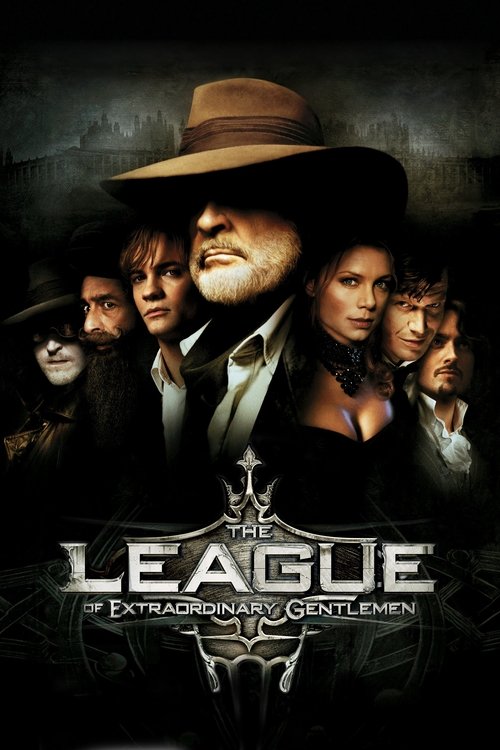
The League of Extraordinary Gentlemen (2003)
Directed by Stephen Norrington
No — The League of Extraordinary Gentlemen is not woke, scoring 13 out of 100 on our wokeness meter.
The League of Extraordinary Gentlemen arrives in 1899 with a suitcase of Victorian literary characters and a mandate to prevent a world war, and it conducts this business with the grim efficiency of a committee meeting.
Consciousness Markers
The ensemble includes Naseeruddin Shah as the Indian Captain Nemo and a globally mixed cast, though this diversity stems from the Victorian literary source material rather than a modern casting mandate.
Mina Harker is a capable vampire chemist and fighter, but the comic's own illustrator complained the film marginalized her and reduced her to a vampiric love-interest subplot.
The villain Moriarty schemes to profit by selling weapons to rival empires and fomenting a world war, giving a mild war-profiteering critique, but it is never framed as systemic anti-capitalism.
Nemo's Indian identity and the Kenya framing exist as period adventure texture, with no commentary on race or colonialism.
The film is a straightforward action-adventure romp with no preachy messaging or moralizing monologues.
No LGBTQ+ characters, themes, or subtext appear anywhere in the film.
No environmental or climate themes are present.
No body-positivity themes or messaging appear in the film.
Jekyll/Hyde's dual personality is treated as a monstrous transformation gimmick, not as neurodivergence or mental-health representation.
The film is a fantastical pastiche of Victorian fiction, not a revisionist retelling of real history.
Why it received this score
The League of Extraordinary Gentlemen arrives in 1899 with a suitcase of Victorian literary characters and a mandate to prevent a world war, and it conducts this business with the grim efficiency of a committee meeting. Sean Connery plays Allan Quatermain as a man who has seen everything and would now like to sit down. The ensemble gathers Captain Nemo, Mina Harker, Dorian Gray, an invisible thief, and a Jekyll who doubles as Hyde. The cast is a mixed international lot, and Naseeruddin Shah's Nemo carries his Indian identity with the easy confidence of a man who has captained a submarine across every ocean. That diversity comes from the source novels, not from any modern casting directive, which is the honest way to arrive at it.
Peta Wilson's Mina Harker is a chemist and a martial artist, and she kills a man with his own cursed painting, which ought to count for something. It counts for less than it should. The film steers her toward a vampiric romantic subplot, and the comic's own illustrator has publicly complained that she was marginalized and reduced to a love interest. Richard Roxburgh's Moriarty schemes to sell weapons to rival empires, gesturing at the war profiteer without ever naming the system that produces him. The critique stays at the level of a villain's business plan, which is to say it stays shallow.
There is little else to report. No queer presence, no environmental sermon, no body-positive messaging, no neurodivergent reading of Jekyll's condition, which the film treats as a monster switch. The whole affair is a loud, disjointed romp that lectures no one and means nothing beyond its own noise. It simply fails, in the ordinary way that expensive films fail, and we are left to file it accordingly.
Analysis generated by our Consciousness Algorithm


Synopsis
To prevent a world war from breaking out, famous characters from Victorian literature band together to do battle against a cunning villain.
Questions about The League of Extraordinary Gentlemen
Is The League of Extraordinary Gentlemen woke?
No — The League of Extraordinary Gentlemen is not woke, scoring 13 out of 100 on our wokeness meter. That earns it a verdict of Ultra Based.
Does The League of Extraordinary Gentlemen have any woke elements?
1 of the 10 markers register at 30 or above, led by Representation Casting (35). On Representation Casting: The ensemble includes Naseeruddin Shah as the Indian Captain Nemo and a globally mixed cast, though this diversity stems from the Victorian literary source material rather than a modern casting mandate.
How does The League of Extraordinary Gentlemen compare to other 2003 movies?
It ranks #48 of the 150 films from 2003 we've scored; their average is 12. The wokest is Mona Lisa Smile (60).
How is the Woke Score calculated?
An AI-assisted process researches the film and its reception, scores it 0–100 on ten markers, then combines those into one 0–100 Woke Score. It measures a specific set of 2020s cultural themes, not film quality.