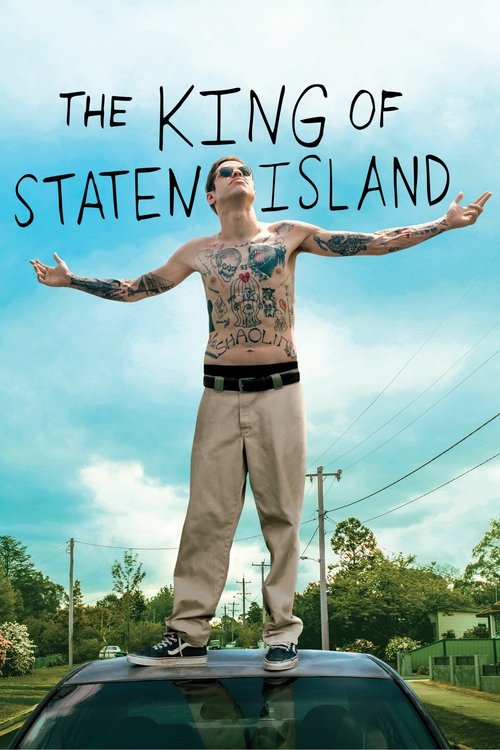
The King of Staten Island (2020)
Directed by Judd Apatow
No — The King of Staten Island is not woke, scoring 18 out of 100 on our wokeness meter.
The King of Staten Island arrives as a shaggy, overlong, genuinely affecting piece of self-mythology from Judd Apatow and Pete Davidson.
Consciousness Markers
Scott explicitly lives with ADD, Crohn's disease, and mental-health struggles, and the semi-autobiographical film treats his neuroses and arrested development as a central, sympathetically rendered subject.
The ensemble includes some diverse faces (Action Bronson, Ricky Velez, Moisés Arias), but casting is driven by Davidson's real-life circle rather than a diversity mandate.
Margie and Kelsey are given some agency (Kelsey pursues a civil service exam, Margie re-enters dating), but the film is squarely a male coming-of-age story with no feminist thesis.
Apatow's shaggy dramedy observes and jokes rather than preaches; there is no didactic messaging directed at the audience.
The cast is casually multiethnic but race is never a subject of the narrative or commentary.
A bungled pharmacy robbery occurs, but it is played for character stakes and comedy, not as an indictment of capitalism.
No LGBTQ+ characters or themes appear anywhere in the film.
No environmental or climate themes whatsoever.
No body-positivity themes or messaging present.
No historical revisionism; the film is a contemporary personal story.
Why it received this score
The King of Staten Island arrives as a shaggy, overlong, genuinely affecting piece of self-mythology from Judd Apatow and Pete Davidson. Davidson's Scott is a case study in inertia, grief, and the low-grade chaos of a man who has turned his father's death into a permanent address. The film follows him through weed, tattoos, a mother's new romance, and the slow humiliation of needing to become an adult. It is semi-autobiographical, and that shows in the best and worst ways: the details feel lived in, while the running time feels negotiated by committee.
The film's cultural awareness is mostly incidental. Its ensemble is casually multiethnic, and the women around Scott get small flares of agency: Margie re-enters the dating pool, Kelsey studies for a civil service exam. None of this amounts to a thesis. Race is not a subject. No LGBTQ characters appear. The environment does not enter the frame. The pharmacy robbery is a plot complication, not an indictment of late capitalism. Body positivity is absent. The movie is not trying to educate its audience, and it has no interest in rewriting history. It simply wants to watch Scott shuffle around Staten Island.
Where the film does commit is to Scott's interior weather. His ADD, Crohn's disease, and mental-health struggles are not decorative; they shape his days, his avoidance, his self-medication. The movie treats his neuroses with sympathy and comic patience. Apatow observes and jokes; he does not sermonize. The result is a coming-of-age story that earns its tenderness without demanding agreement. It is also indulgent, shapeless, and too pleased with its own slackness. Still, Davidson's performance holds the center. The film is a portrait of a man learning to leave the house, and it respects the difficulty of that small, enormous task.
Analysis generated by our Consciousness Algorithm
Part of


Synopsis
Scott has been a case of arrested development ever since his firefighter father died when he was seven. He's now reached his mid-20s having achieved little, chasing a dream of becoming a tattoo artist that seems far out of reach. As his ambitious younger sister heads off to college, Scott is still living with his exhausted ER nurse mother and spends his days smoking weed, hanging with the guys — Oscar, Igor and Richie — and secretly hooking up with his childhood friend Kelsey. But when his mother starts dating a loudmouth firefighter named Ray, it sets off a chain of events that will force Scott to grapple with his grief and take his first tentative steps toward moving forward in life.
Questions about The King of Staten Island
Is The King of Staten Island woke?
No — The King of Staten Island is not woke, scoring 18 out of 100 on our wokeness meter. That earns it a verdict of Ultra Based.
Does The King of Staten Island have any woke elements?
1 of the 10 markers register at 30 or above, led by Neurodivergence (45). On Neurodivergence: Scott explicitly lives with ADD, Crohn's disease, and mental-health struggles, and the semi-autobiographical film treats his neuroses and arrested development as a central, sympathetically rendered subject.
How does The King of Staten Island compare to other 2020 movies?
It ranks #88 of the 227 films from 2020 we've scored; their average is 21. The wokest is One Night in Miami... (83).
How is the Woke Score calculated?
An AI-assisted process researches the film and its reception, scores it 0–100 on ten markers, then combines those into one 0–100 Woke Score. It measures a specific set of 2020s cultural themes, not film quality.