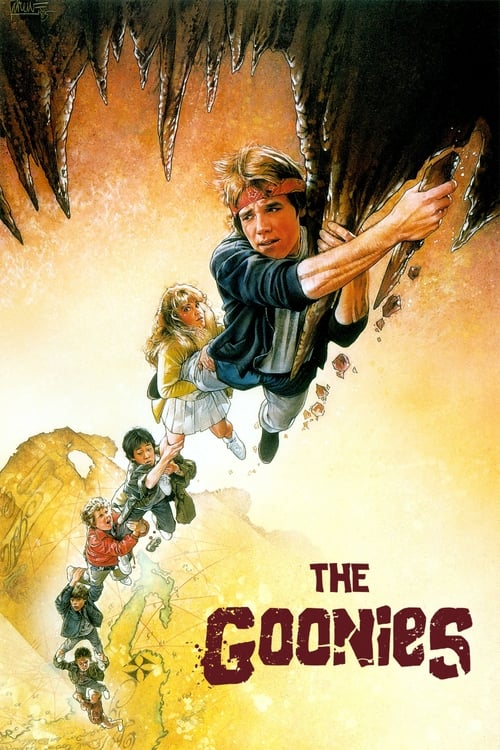
The Goonies (1985)
Directed by Richard Donner
No — The Goonies is not woke, scoring 7 out of 100 on our wokeness meter.
The Goonies arrives from 1985, a year when a gang of shouting children could carry a summer release on sheer lung power alone.
Consciousness Markers
The plot hinges on a greedy country-club developer foreclosing on the kids' homes, giving a mild anti-gentrification, save-our-neighborhood streak, though it is resolved by pirate gold rather than politics.
The kid ensemble includes Ke Huy Quan as the gadget-loving Data and Lupe Ontiveros as a Spanish-speaking housekeeper, but these are natural 1985 inclusions rather than a modern diversity mandate.
Andy and Stef are present as a cheerleader and a snarky tomboy, but they are largely along for the ride and get rescued; no feminist thesis is advanced.
Data and Rosalita add ethnic texture, but the film makes no comment on race, racism, or racial identity.
No LGBTQ+ characters, themes, or subtext of any kind.
No environmental or climate themes whatsoever.
Chunk's weight is the butt of repeated jokes, including the Truffle Shuffle, which the filmmakers themselves described as painful mockery — the opposite of body positivity.
Sloth is depicted as deformed and childlike, but this is a comic grotesque, not a neurodivergence narrative.
A straightforward pirate-treasure adventure with no historical revisionism.
Pure Spielbergian roller-coaster entertainment with no preaching or moralizing.
Why it received this score
The Goonies arrives from 1985, a year when a gang of shouting children could carry a summer release on sheer lung power alone. Richard Donner's adventure has aged into a National Film Registry citation and a permanent slot in the nostalgia economy, and yet its progressive content remains thin enough to read a newspaper through. Ke Huy Quan's Data and Lupe Ontiveros's Spanish-speaking housekeeper supply ethnic texture, but the film treats them as furniture of the neighborhood, not as statements. Nobody in Astoria has a conversation about race, and the screenplay has no interest in starting one.
A pair of teenage girls, Andy and Stef, tag along and are promptly rescued when the tunnels get serious. The film offers a cheerleader and a tomboy and then asks them to scream. Chunk's weight is the running gag, most memorably in the Truffle Shuffle, a bit the filmmakers themselves later described as mockery drawn from real pain. Sloth, the deformed and childlike brother, is a comic grotesque rather than any kind of portrait of a mind that works differently. These are not oversights so much as the comic grammar of the era, delivered without apology.
The foreclosure plot gives the film a faint anti-gentrification pulse: a country club developer wants the Goon Docks, and the kids want to keep their homes. The resolution arrives as pirate jewels in a marble bag, which is to say the movie prefers gold to politics. There is no climate anxiety, no revisionist history, no queer subtext, and no sermon. It is a fun-house ride, and it knows it.
Analysis generated by our Consciousness Algorithm
Part of


Synopsis
Young teen Mikey Walsh and his friends set off on a quest to find Pirate One-Eyed Willie's treasure in hopes of saving their homes from demolition. However, on their quest to find the treasure, they run into a family of recently escaped criminals, determined to capture the kids and reach the treasure first.
Questions about The Goonies
Is The Goonies woke?
No — The Goonies is not woke, scoring 7 out of 100 on our wokeness meter. That earns it a verdict of Ultra Based.
Does The Goonies have any woke elements?
Very few. None of the 10 markers reaches 30, the level where a marker counts as present; the highest is Eat the Rich at 20.
How does The Goonies compare to other 1985 movies?
It ranks #23 of the 68 films from 1985 we've scored; their average is 8. The wokest is The Color Purple (62).
How is the Woke Score calculated?
An AI-assisted process researches the film and its reception, scores it 0–100 on ten markers, then combines those into one 0–100 Woke Score. It measures a specific set of 2020s cultural themes, not film quality.