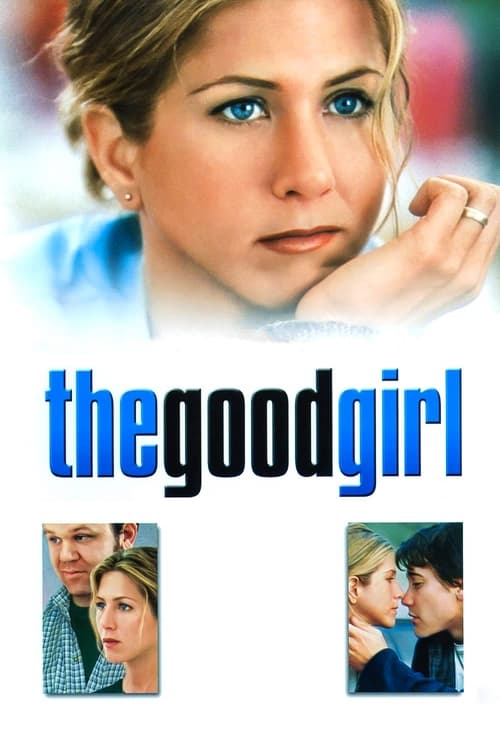
The Good Girl (2002)
Directed by Miguel Arteta
No — The Good Girl is not woke, scoring 7 out of 100 on our wokeness meter.
The Good Girl arrives from 2002, which places it in a period when a film could still be about unhappy people in a small town without also being about everything else.
Consciousness Markers
The film centers a bored, dissatisfied woman's interior life and her pursuit of fulfillment outside a stagnant marriage, but it is a character study rather than a programmatic feminist statement.
The film lightly satirizes dead-end big-box retail labor ('Retail Rodeo') and consumerist small-town life, but offers no coherent economic critique or 'eat the rich' thesis.
Holden is depicted as mentally ill and unstable, with his alienation and suicidal ideation driving the plot, but the film frames this as tragedy and danger rather than neurodivergence-affirming representation.
The film observes its characters with detached irony rather than lecturing the audience on social issues.
The cast is entirely white in a small-town Texas setting; there is no discernible representation casting effort or diverse ensemble.
No LGBTQ+ characters, themes, or subtext appear anywhere in the film.
No engagement with race whatsoever; the story is a racially homogeneous small-town melodrama.
No environmental or climate themes are present.
No body-positivity themes or body-diverse messaging are present.
No historical revisionism; the film is a contemporary original screenplay with no historical subject matter.
Why it received this score
The Good Girl arrives from 2002, which places it in a period when a film could still be about unhappy people in a small town without also being about everything else. Miguel Arteta directs Mike White's script with a flat, patient gaze. Jennifer Aniston plays Justine, a thirty-year-old clerk at a big-box store in Texas, married to a man who paints houses and smokes pot with his friend Bubba. She begins an affair with a younger cashier named Holden, who reads Salinger and believes he is the character. The arrangement ends, as these arrangements do, in blackmail, theft, and a suicide in a motel room.
The cultural inventory here is thin, and it is thin on purpose. The cast is white, the town is white, and nobody remarks on it. There are no queer characters, no engagement with race, no environmental concerns, no body-diverse messaging. Justine's dissatisfaction gets a sympathetic hearing, which is as close as the film comes to a thesis about women, and it stops well short of advocacy. The Retail Rodeo is a purgatory of fluorescent light and cheap merchandise, but the script has no economic argument to make about it. Holden's mental illness is treated as a hazard, not an identity.
What keeps the picture alive is the refusal to sermonize. Nobody turns to the camera. The film watches its characters lie to each other and lets the lies stand. Aniston is very good, sad in the shoulders, and the closing scenes offer no redemption, only continuation. That restraint is admirable and, by the standards of the current moment, nearly invisible.
Analysis generated by our Consciousness Algorithm
Synopsis
A discount store clerk strikes up an affair with a stock boy who considers himself the incarnation of Holden Caulfield.
Questions about The Good Girl
Is The Good Girl woke?
No — The Good Girl is not woke, scoring 7 out of 100 on our wokeness meter. That earns it a verdict of Ultra Based.
Does The Good Girl have any woke elements?
Very few. None of the 10 markers reaches 30, the level where a marker counts as present; the highest is Feminist Agenda at 15.
How does The Good Girl compare to other 2002 movies?
It ranks #92 of the 150 films from 2002 we've scored; their average is 12. The wokest is Far from Heaven (78).
How is the Woke Score calculated?
An AI-assisted process researches the film and its reception, scores it 0–100 on ten markers, then combines those into one 0–100 Woke Score. It measures a specific set of 2020s cultural themes, not film quality.