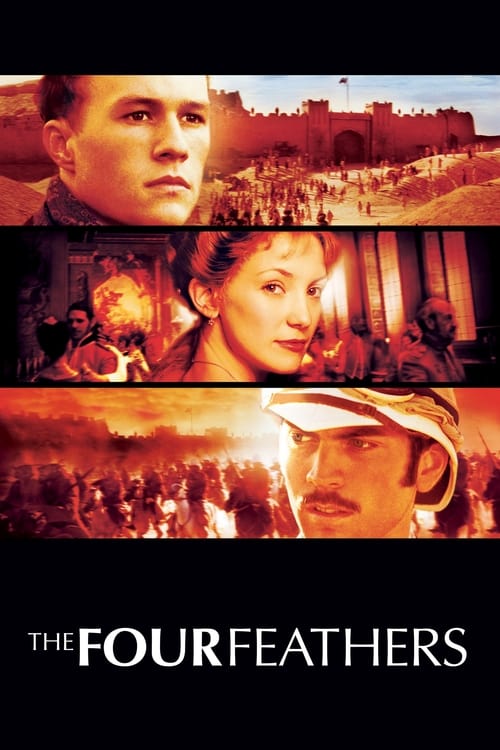
The Four Feathers (2002)
Directed by Shekhar Kapur
No — The Four Feathers is not woke, scoring 12 out of 100 on our wokeness meter.
Shekhar Kapur's 2002 adaptation of A.E.W. Mason's 1902 imperial adventure novel arrives with the polished surface of a prestige production and the interior life of a regimental dinner.
Consciousness Markers
Djimon Hounsou's Abou Fatma is a substantial and dignified supporting role, and the film populates its Sudan sequences with non-white actors, but the leads and narrative vantage remain squarely white and the casting reflects 2002 norms rather than modern representation-consciousness.
The film engages the British Empire, the Mahdi uprising, and colonial violence, and critics noted its 'ambivalent viewpoint' toward imperialism, but it filters Sudan through a white protagonist's redemption arc rather than centering colonized perspectives.
The film gestures at the costs of empire and the emptiness of martial honor, but it does so through melodrama rather than direct moral instruction, and it never breaks to preach.
Kate Hudson's Ethne exists almost entirely as the romantic prize whose feather must be reclaimed; she has no agency beyond the men's honor economy, and the film's concerns are fraternal and martial.
No LGBTQ+ characters, themes, or subtext of any kind appear in this Victorian-era military honor drama.
No environmental or climate themes are present; the desert is a setting for battle, not an ecological statement.
No critique of capitalism, class, or wealth appears; the film's conflicts are about imperial duty and personal honor.
No body-positivity themes; the film's physical concerns are starvation and battlefield injury, not body acceptance.
No neurodivergence themes; Jack's blindness is a war injury, not a neurodivergent identity.
The film is a faithful adaptation of a 1902 imperial adventure novel set against real events, not a revisionist reframing of history.
Why it received this score
Shekhar Kapur's 2002 adaptation of A.E.W. Mason's 1902 imperial adventure novel arrives with the polished surface of a prestige production and the interior life of a regimental dinner. Heath Ledger's Harry Faversham resigns his commission, receives four white feathers for his presumed cowardice, and then spends two hours redeeming himself in the Sudanese desert by disguising himself as an Arab. The film is gorgeous and hollow, and it knows it. Critics at the time reached for the phrase "ambivalent viewpoint," which is a generous way of saying the movie cannot decide whether the Empire is noble or monstrous, so it settles for both and commits to neither.
On the matter of social consciousness, the ledger is thin. Djimon Hounsou's Abou Fatma is a dignified and substantial supporting presence, and the Sudan sequences are populated with non-white faces, though the story remains filtered through a white officer's redemption and the camera never lingers on the colonized as anything other than terrain. Kate Hudson's Ethne is a feather with a face, a romantic prize whose only function is to be reclaimed once the honor economy balances. The film glances at the costs of empire, the flogging of a warning that goes unheeded, the pointless slaughter at Abu Klea, but it does so through melodrama and never stops to deliver a sermon. The desert is a battlefield, not a cause. There is no economic critique, no body politics, no neurology beyond a battlefield blinding, and no romantic or gendered subversion hiding in the tents.
The result is a film of 2002 sensibilities, which is to say it is handsomely mounted, vaguely guilty, and structurally conservative. It mourns the machinery of imperial honor while admiring the men caught inside it. The feathers are returned, the engagement is restored, and the moral questions are packed away with the red coats. A sommelier would call this a vintage that promises depth and delivers tannin. It goes down easily and leaves no impression beyond the label.
Analysis generated by our Consciousness Algorithm
Part of


Synopsis
A young British officer resigns his post when he learns of his regiment's plan to ship out to the Sudan for the conflict with the Mahdi. His friends and fiancée send him four white feathers as symbols of what they view as his cowardice. To redeem his honor, he disguises himself as an Arab and secretly saves their lives.
Questions about The Four Feathers
Is The Four Feathers woke?
No — The Four Feathers is not woke, scoring 12 out of 100 on our wokeness meter. That earns it a verdict of Ultra Based.
Does The Four Feathers have any woke elements?
Very few. None of the 10 markers reaches 30, the level where a marker counts as present; the highest is Racial Consciousness at 25.
How does The Four Feathers compare to other 2002 movies?
It ranks #45 of the 150 films from 2002 we've scored; their average is 12. The wokest is Far from Heaven (78).
How is the Woke Score calculated?
An AI-assisted process researches the film and its reception, scores it 0–100 on ten markers, then combines those into one 0–100 Woke Score. It measures a specific set of 2020s cultural themes, not film quality.