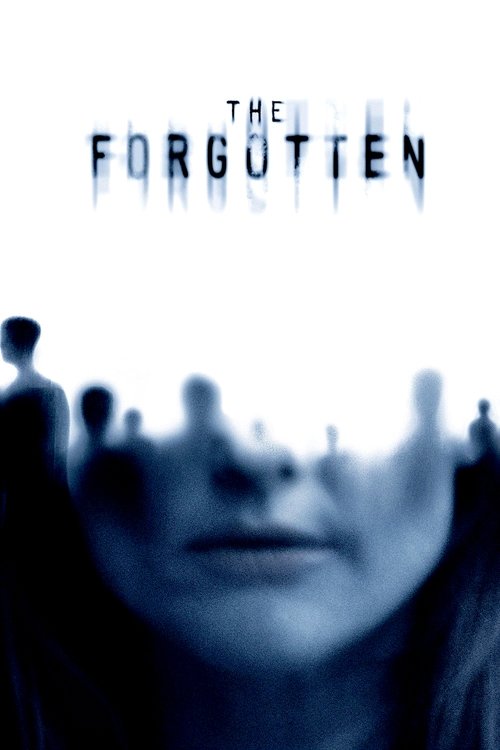
The Forgotten (2004)
Directed by Joseph Ruben
No — The Forgotten is not woke, scoring 11 out of 100 on our wokeness meter.
Joseph Ruben's The Forgotten arrived in September 2004 with a premise that asked audiences to accept a great deal: a grieving mother, nine years of fabricated memories, and a cosmic bureaucracy that erases children from existence.
Consciousness Markers
Julianne Moore leads, with Alfre Woodard and Robert Wisdom in supporting roles, but the diverse casting is incidental and never commented upon.
The plot hinges on a mother's bond and a woman whose account of reality is dismissed by her husband and psychiatrist, but the film frames this as maternal instinct rather than any feminist argument.
The finale delivers exposition about the experiment on mother-child bonds, but it functions as plot revelation rather than moral instruction.
No LGBTQ+ characters, themes, or subtext of any kind.
Black actors appear in supporting roles with no engagement of race, racism, or racial identity as a theme.
No environmental or climate content whatsoever.
The antagonists are vague cosmic 'them' and government agents; no economic or class critique is present.
No body-image or body-positivity themes.
Psychiatry and delusion appear as plot mechanics of a sci-fi conspiracy, not as a depiction of neurodivergence.
No historical events are reinterpreted or revised.
Why it received this score
Joseph Ruben's The Forgotten arrived in September 2004 with a premise that asked audiences to accept a great deal: a grieving mother, nine years of fabricated memories, and a cosmic bureaucracy that erases children from existence. Julianne Moore plays Telly Paretta with the appropriate quantity of anguish. The picture opened at number one, earned a respectable sum, and met critics with a shrug that has since hardened into consensus. It is a thriller of the amnesia school, and it knows it.
On the matter of social consciousness, the film is close to a blank slate. Alfre Woodard and Robert Wisdom appear in supporting roles, and their presence registers as ordinary casting practice for the era, not a statement. Race is never a subject. Neither is sexuality, the environment, economic inequality, or body image. The antagonists are a vague cosmic "them" plus a few NSA functionaries, which leaves no room for a critique of capital. Psychiatry functions as a mechanism of conspiracy, not as a portrait of neurodivergence, and no historical record is revised along the way.
The one thread that carries any weight is the maternal instinct driving the third act. Telly's account of reality is dismissed by her husband and her therapist, and the film treats this as a failure of institutional listening. It gestures toward something, but frames it as a mother's bond, biology with a pulse, not an argument about whose testimony counts. The hangar finale explains the experiment in plain exposition, plot revelation dressed as closure. The Forgotten remains a product of its moment: a studio thriller with a woman at its center and little on its mind beyond the next reveal.
Analysis generated by our Consciousness Algorithm


Synopsis
Telly Paretta is a grieving mother struggling to cope with the loss of her 9-year-old son. She is stunned when her psychiatrist reveals that she has created nine years of memories about a son she never had. But when she remembers a man who had a similar experience, Telly embarks on a search to prove her son's existence, and her sanity.
Questions about The Forgotten
Is The Forgotten woke?
No — The Forgotten is not woke, scoring 11 out of 100 on our wokeness meter. That earns it a verdict of Ultra Based.
Does The Forgotten have any woke elements?
Very few. None of the 10 markers reaches 30, the level where a marker counts as present; the highest is Representation Casting at 25.
How does The Forgotten compare to other 2004 movies?
It ranks #65 of the 178 films from 2004 we've scored; their average is 12. The wokest is Tropical Malady (62).
How is the Woke Score calculated?
An AI-assisted process researches the film and its reception, scores it 0–100 on ten markers, then combines those into one 0–100 Woke Score. It measures a specific set of 2020s cultural themes, not film quality.