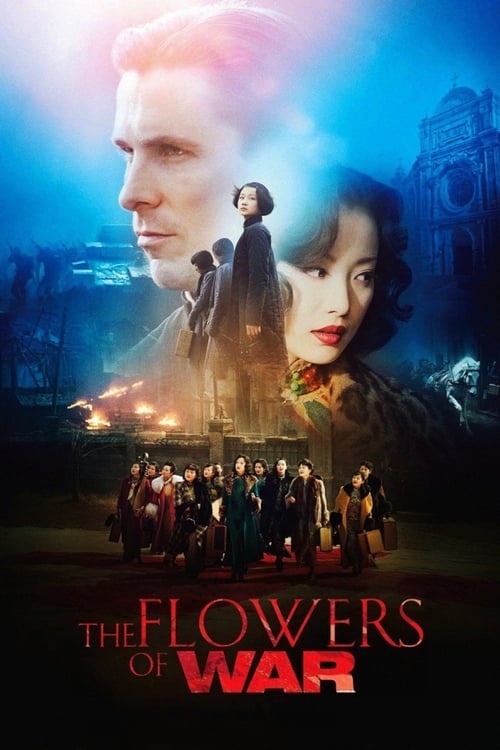
The Flowers of War (2011)
Directed by Zhang Yimou
No — The Flowers of War is not woke, scoring 15 out of 100 on our wokeness meter.
Zhang Yimou's 2011 adaptation of Geling Yan's novella arrives with the full weight of the Nanjing Massacre behind it, a historical atrocity that requires no embellishment.
Consciousness Markers
The story is told from women's perspectives, centering schoolgirls and prostitutes whose solidarity and self-sacrifice drive the climax. This is genuine female agency, though framed through a tragedy-of-sacrifice lens rather than a modern feminist polemic.
A predominantly Chinese cast authentically telling a Chinese historical tragedy, with women centered in the narrative. However, the film's own architecture hinges on Christian Bale as the Western hero, which critics like Roger Ebert flagged as a white-savior contrivance rather than a diversity-forward choice.
The film carries a somber moral weight about sacrifice and wartime suffering, but it functions as an emotionally driven historical spectacle rather than a preachy message-delivery vehicle.
The film depicts Japanese wartime atrocities against Chinese civilians, but as a historical war crime narrative rather than an exploration of systemic racial consciousness in the modern sense. Zhang Yimou deliberately humanizes the Japanese colonel rather than flattening into racial critique.
No LGBTQ+ characters or themes appear anywhere in the film.
No environmental or climate themes exist in the film.
Prostitution and brothels feature prominently, but as a setting for the characters' circumstances and moral dilemma, not as a critique of economic systems.
No body-positivity themes are present.
No neurodivergent characters or themes appear.
The film dramatizes the historical Nanjing Massacre faithfully rather than reinterpreting or revising the historical record for ideological ends.
Why it received this score
Zhang Yimou's 2011 adaptation of Geling Yan's novella arrives with the full weight of the Nanjing Massacre behind it, a historical atrocity that requires no embellishment. The film places a group of schoolgirls, a dozen prostitutes, and an American mortician inside a Roman Catholic compound and waits for the Japanese Army to come knocking. Christian Bale's John Miller poses as a priest, repairs a truck, and gradually acquires a conscience. The screenwriters appear to believe this arc is necessary. Roger Ebert asked the obvious question about whether a Chinese priest might have served just as well. The question stands unanswered.
The film does offer a genuine female perspective, and this is not nothing. The prostitutes of the Qinhuai district, led by Ni Ni's Yu Mo, elect to take the schoolgirls' place at the Japanese victory celebration, trading their lives for the younger girls' survival. Zhang has said his intent was to tell this story from women's perspectives, and the climax bears that out. The solidarity between two classes of women, one despised and one sheltered, carries real emotional force. That the sacrifice is framed as martyrdom for the sake of chastity complicates the picture, and the film is content to let the tragedy speak for itself.
Zhang also humanizes Colonel Hasegawa, giving the Japanese officer a homesick folk song and a measure of restraint. This is a deliberate refusal to flatten the enemy into caricature, and it keeps the film well clear of racial sermonizing. A somber historical spectacle remains, handsomely photographed, occasionally overwrought, and mostly interested in grief. It lectures no one. It preaches nothing. It stages a massacre and asks us to weep, which is an old and honorable cinematic tradition, and one that leaves few cultural markers for our purposes here. The film was a box office disappointment on a $94 million budget, which suggests audiences also found the exercise difficult to classify.
Analysis generated by our Consciousness Algorithm


Synopsis
A Westerner finds refuge with a group of women in a church during Japan's rape of Nanking in 1937. Posing as a priest, he attempts to lead the women to safety.
Questions about The Flowers of War
Is The Flowers of War woke?
No — The Flowers of War is not woke, scoring 15 out of 100 on our wokeness meter. That earns it a verdict of Ultra Based.
Does The Flowers of War have any woke elements?
1 of the 10 markers register at 30 or above, led by Feminist Agenda (30). On Feminist Agenda: The story is told from women's perspectives, centering schoolgirls and prostitutes whose solidarity and self-sacrifice drive the climax.
How does The Flowers of War compare to other 2011 movies?
It ranks #53 of the 245 films from 2011 we've scored; their average is 11. The wokest is Paul (68).
How is the Woke Score calculated?
An AI-assisted process researches the film and its reception, scores it 0–100 on ten markers, then combines those into one 0–100 Woke Score. It measures a specific set of 2020s cultural themes, not film quality.