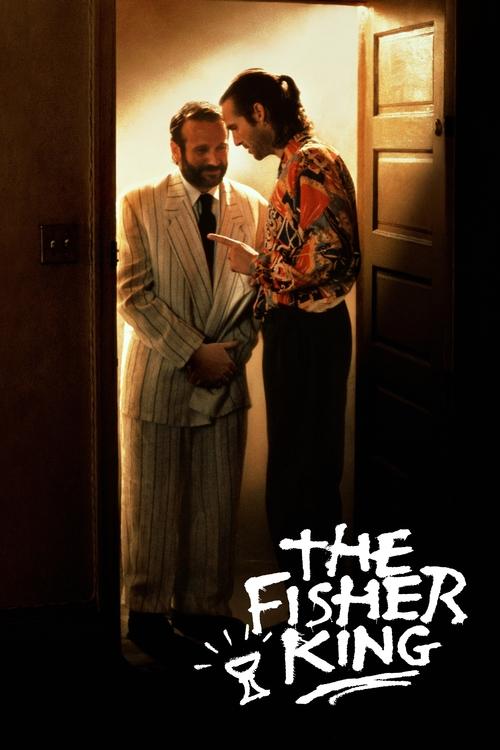
The Fisher King (1991)
Directed by Terry Gilliam
No — The Fisher King is not woke, scoring 15 out of 100 on our wokeness meter.
Terry Gilliam's 1991 fantasy comedy drama follows a disgraced radio shock jock and the delusional homeless man whose life he shattered, and asks whether one man's guilt can be converted into another man's healing.
Consciousness Markers
The film critiques yuppie narcissism, the shock-jock's vapid social circle, and the callous wealthy architect, offering a mild eat-the-rich undercurrent via its homeless-versus-penthouse contrast.
Parry's psychosis, catatonia, and fugue state are central to the plot, but the film frames mental illness as trauma to be healed rather than as an identity to be celebrated.
The film gestures at moral lessons about homelessness and redemption, but delivers them through fable and character rather than preachy direct address.
Mercedes Ruehl's Anne and Amanda Plummer's Lydia have some agency and interiority, but the narrative is squarely a male redemption fable centered on two men.
The cast is overwhelmingly white, with only minor background players of color; no meaningful diverse casting effort is present in this 1991 production.
No LGBTQ+ characters, themes, or subtext appear in the film, despite gay actor Michael Jeter appearing in a non-queer role.
The film's social-strata commentary is economic and class-based, not racial; no engagement with race or racial justice exists.
There is no environmental or climate theme anywhere in the film.
No body-positivity themes or messaging are present.
The film is a contemporary fable with no historical subject matter to revise.
Why it received this score
Terry Gilliam's 1991 fantasy comedy drama follows a disgraced radio shock jock and the delusional homeless man whose life he shattered, and asks whether one man's guilt can be converted into another man's healing. It is a redemption fable built around two male leads, with Mercedes Ruehl's Oscar-winning turn as Anne supplying warmth from the margins. The cast is almost entirely white, and the film makes no effort to correct that. Its social imagination runs along class lines, not racial ones.
Where the film does register a political pulse, it is economic. Jack's penthouse, his vapid industry friends, and the callous architect in his Upper East Side castle all stand against the park benches and subway platforms of Parry's world, and the resulting contrast carries a mild eat-the-rich charge. That charge never hardens into doctrine. There is no environmental thread, no body-positivity angle, no queer presence, and no interest in race as a subject. Michael Jeter turns up in a role that has nothing to do with his own life, which is simply how casting worked in 1991.
Parry's psychosis, his catatonia, his fugue state: these are the engine of the plot, but the film treats them as injuries to be mended, not as an identity to be affirmed. The moral instruction arrives through legend and character, a Fool offering water to a thirsty king, instead of direct address. Gilliam's New York is a place where the separated strata briefly touch, and the lesson is kindness. That is a durable humanist sentiment. It is also a pre-2015 one, and we can only grade what the film actually contains.
Analysis generated by our Consciousness Algorithm


Synopsis
Two troubled men face their terrible destinies and events of their past as they join together on a mission to find the Holy Grail and thus to save themselves.
Questions about The Fisher King
Is The Fisher King woke?
No — The Fisher King is not woke, scoring 15 out of 100 on our wokeness meter. That earns it a verdict of Ultra Based.
Does The Fisher King have any woke elements?
Very few. None of the 10 markers reaches 30, the level where a marker counts as present; the highest is Eat the Rich at 25.
How does The Fisher King compare to other 1991 movies?
It ranks #19 of the 68 films from 1991 we've scored; their average is 14. The wokest is Paris Is Burning (77).
How is the Woke Score calculated?
An AI-assisted process researches the film and its reception, scores it 0–100 on ten markers, then combines those into one 0–100 Woke Score. It measures a specific set of 2020s cultural themes, not film quality.