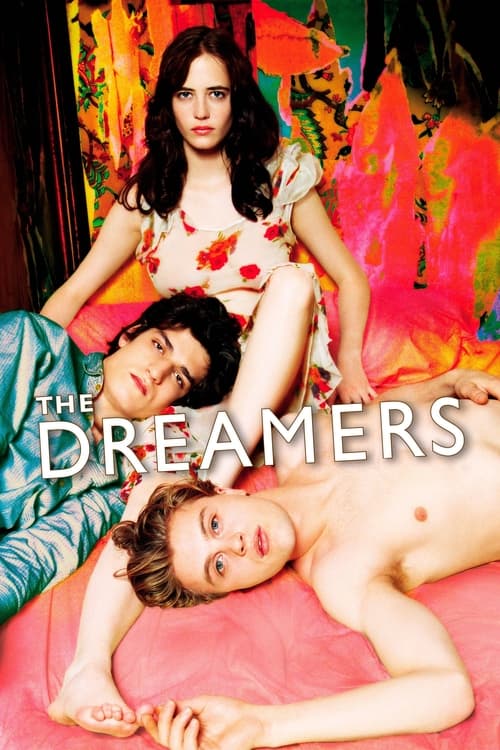
The Dreamers (2003)
Directed by Bernardo Bertolucci
No — The Dreamers is not woke, scoring 10 out of 100 on our wokeness meter.
Bernardo Bertolucci's The Dreamers arrives in 1968 Paris, where a shy American exchange student named Matthew falls in with twins Théo and Isabelle, and the three retire to a borrowed apartment to conduct an extended seminar on cinema and each other's bodies.
Consciousness Markers
Théo's fervent Maoism, the 1968 student riots, and the Molotov cocktails aimed at police give the film a revolutionary backdrop, though the politics are treated as aesthetic texture and youthful posturing rather than a coherent anti-capitalist argument.
The characters debate Maoism, Chaplin versus Keaton, and Clapton versus Hendrix, but these arguments are playful and character-driven rather than didactic sermonizing.
Bertolucci explicitly cut the novel's homosexual content between Matthew and Théo, leaving only a single desperate kiss at the climax that functions as a plea against violence rather than as queer representation.
Isabelle is largely a vessel for the male gaze and her brother's games, sentenced to masturbate before an audience and used as a prize in trivia wagers; the film's eroticism is decidedly not framed through a feminist lens.
The cast is uniformly white European and American, with no deliberate diversity casting; the film's milieu is a Parisian bourgeois bohemia and the ensemble reflects that without comment.
Race is entirely absent from the film's concerns; the 1968 Paris setting and its characters are monolithically white with no engagement with colonial or racial politics.
No environmental or climate themes appear anywhere in the narrative.
The film's abundant nudity is eroticized and voyeuristic rather than affirming of diverse bodies; there is no body-positivity framework at work.
No neurodivergent characters or themes are present.
The film uses the 1968 Paris riots as a period backdrop but makes no revisionist historical claims or reinterpretations.
Why it received this score
Bernardo Bertolucci's The Dreamers arrives in 1968 Paris, where a shy American exchange student named Matthew falls in with twins Théo and Isabelle, and the three retire to a borrowed apartment to conduct an extended seminar on cinema and each other's bodies. The Cinémathèque protests and the eventual street riots frame the proceedings, though the frame is mostly decorative. The cast is uniformly white and European, and the film regards its Parisian bohemia as the natural habitat of the species. Race, colonial memory, and the demographic reality of the city are not part of the conversation. The film has other things on its mind.
Those other things are chiefly aesthetic. Théo professes Maoism with the fervor of a young man who has recently discovered a pamphlet, and the climax involves Molotov cocktails and charging police, but the revolutionary material functions as texture and mood, a backdrop for the real business of the apartment. The debates about Chaplin against Keaton and Clapton against Hendrix are playful, character-driven, and never sermonize. Bertolucci also cut the novel's homosexual content, a decision he described as avoiding excess, which leaves a single desperate kiss at the end, offered as a plea against violence. The film's social consciousness is thus mostly a matter of atmosphere.
At the center sits Isabelle, played by Eva Green in her first credited role. She is sentenced to perform for an audience, wagered as a prize in trivia games, and framed throughout for the pleasure of the camera. The nudity is abundant and entirely eroticized. There is no body-affirming project here, no feminist reading available, and no interest in neurodivergence or the climate. What remains is a handsome, languid provocation about youth, film, and the impossibility of sustaining either. It is a period piece with a period's politics.
Analysis generated by our Consciousness Algorithm
Synopsis
When Isabelle and Theo invite Matthew to stay with them, what begins as a casual friendship ripens into a sensual voyage of discovery and desire in which nothing is off limits and everything is possible.
Questions about The Dreamers
Is The Dreamers woke?
No — The Dreamers is not woke, scoring 10 out of 100 on our wokeness meter. That earns it a verdict of Ultra Based.
Does The Dreamers have any woke elements?
Very few. None of the 10 markers reaches 30, the level where a marker counts as present; the highest is Eat the Rich at 25.
How does The Dreamers compare to other 2003 movies?
It ranks #59 of the 150 films from 2003 we've scored; their average is 12. The wokest is Mona Lisa Smile (60).
How is the Woke Score calculated?
An AI-assisted process researches the film and its reception, scores it 0–100 on ten markers, then combines those into one 0–100 Woke Score. It measures a specific set of 2020s cultural themes, not film quality.