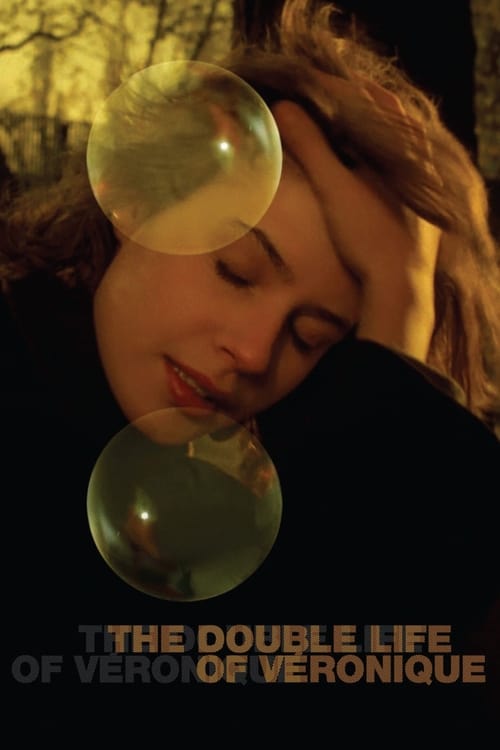
The Double Life of Véronique (1991)
Directed by Krzysztof Kieślowski
No — The Double Life of Véronique is not woke, scoring 6 out of 100 on our wokeness meter.
Krzysztof Kieślowski's The Double Life of Véronique arrives from 1991, a year in which a European art film could still be built entirely from mood, color, and the face of a single actress.
Consciousness Markers
The film centers on two women and their inner lives, but it does not advance a modern feminist political agenda or critique gender inequality.
The cast consists of French and Polish actors suited to the film's European setting; there is no modern diversity-casting agenda at work.
No LGBTQ+ characters, relationships, or themes appear in the film.
Race and racial identity are not addressed in the film.
Environmental or climate concerns are entirely absent.
The film contains no critique of capitalism or wealth inequality.
Body image and body-positivity themes are not present.
Neurodivergence is not depicted or discussed.
The film is not engaged with historical revisionism; its metaphysical story is set in the present.
Kieślowski's style is poetic, ambiguous, and non-didactic, offering no lecture to the audience.
Why it received this score
Krzysztof Kieślowski's The Double Life of Véronique arrives from 1991, a year in which a European art film could still be built entirely from mood, color, and the face of a single actress. Irène Jacob plays Weronika, a Polish soprano, and Véronique, a French music teacher, two women born on the same day who never meet and yet share a pulse. One dies onstage mid-phrase. The other feels the loss without a name for it. The camera lingers on amber filters and green glass, and the score, credited to a composer who never existed, does the heavy lifting that dialogue declines to attempt.
Two women occupy the center of the frame for the entire running time. Their inner lives, their intuitions, their quiet griefs are the subject. This is a film about feminine interiority, and it is content to leave the matter there. No argument is mounted about their place in a social order. No thesis is advanced about the condition of women. The intimacy is aesthetic, not political, and the picture trusts the audience to feel it without instruction. Alexandre, the puppeteer, sends a shoelace through the post and waits to see if she will come. She comes. He reads her a book about two women born on the same day in different places. The film offers no explanation of its own premise, and this restraint is the whole point.
By the standards of a later decade, the ledger is nearly blank. The cast is French and Polish because the story is French and Polish. No sermon follows the final scene. Kieślowski's camera asks its questions and then walks away, leaving the audience to sit with the not-knowing. It is a lovely, elusive object, and it has no interest in telling anyone how to live. The classification here is straightforward: a metaphysical poem from an earlier era, filed under beauty, with nothing on the invoice about improving us.
This is a work of quiet ambiguity, and its refusal to lecture is its most durable quality. We can admire it without being scolded by it, which in the current climate feels almost like a luxury.
(Note: this is a film, not a series.)
{"thematic_tags": []}
Wait, the response must be a single JSON object. Let me restate cleanly.
{"review": "Krzysztof Kieślowski's The Double Life of Véronique arrives from 1991, a year in which a European art film could still be built entirely from mood, color, and the face of a single actress. Irène Jacob plays Weronika, a Polish soprano, and Véronique, a French music teacher, two women born on the same day who never meet and yet share a pulse. One dies onstage mid-phrase. The other feels the loss without a name for it. The camera lingers on amber filters and green glass, and the score, credited to a composer who never existed, does the heavy lifting that dialogue declines to attempt.\n\nTwo women occupy the center of the frame for the entire running time. Their inner lives, their intuitions, their quiet griefs are the subject. This is a film about feminine interiority, and it is content to leave the matter there. No argument is mounted about their place in a social order. No thesis is advanced about the condition of women. The intimacy is aesthetic, not political, and the picture trusts the audience to feel it without instruction. Alexandre, the puppeteer, sends a shoelace through the post and waits to see if she will come. She comes. He reads her a book about two women born on the same day in different places. The film offers no explanation of its own premise, and this restraint is the whole point.\n\nBy the standards of a later decade, the ledger is nearly blank. The cast is French and Polish because the story is French and Polish. No sermon follows the final scene. Kieślowski's camera asks its questions and then walks away, leaving the audience to sit with the not-knowing. It is a lovely, elusive object, and it has no interest in telling anyone how to live. The classification here is straightforward: a metaphysical poem from an earlier era, filed under beauty, with nothing on the invoice about improving us.", "thematic_tags": []}
Analysis generated by our Consciousness Algorithm


Synopsis
Véronique is a beautiful young French woman who aspires to be a renowned singer; Weronika lives in Poland, has a similar career goal and looks identical to Véronique, though the two are not related. The film follows both women as they contend with the ups and downs of their individual lives, with Véronique embarking on an unusual romance with Alexandre Fabbri, a puppeteer who may be able to help her with her existential issues.
Questions about The Double Life of Véronique
Is The Double Life of Véronique woke?
No — The Double Life of Véronique is not woke, scoring 6 out of 100 on our wokeness meter. That earns it a verdict of Ultra Based.
Does The Double Life of Véronique have any woke elements?
Very few. None of the 10 markers reaches 30, the level where a marker counts as present; the highest is Feminist Agenda at 10.
How does The Double Life of Véronique compare to other 1991 movies?
It ranks #40 of the 68 films from 1991 we've scored; their average is 14. The wokest is Paris Is Burning (77).
How is the Woke Score calculated?
An AI-assisted process researches the film and its reception, scores it 0–100 on ten markers, then combines those into one 0–100 Woke Score. It measures a specific set of 2020s cultural themes, not film quality.