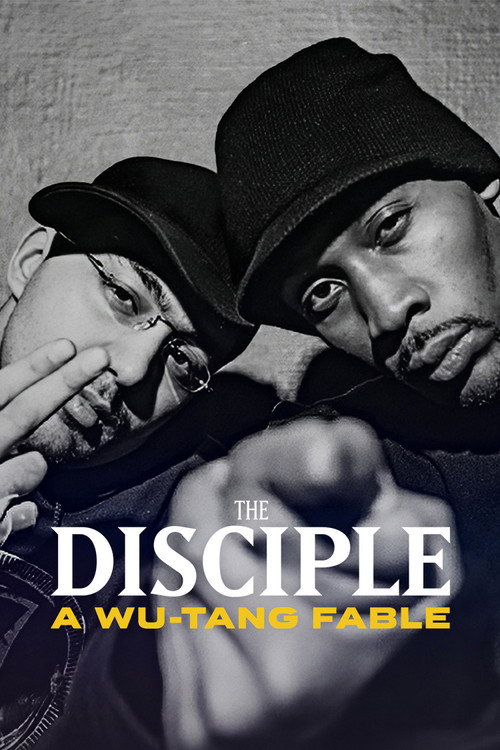
The Disciple: A Wu-Tang Fable (2026)
Directed by Joanna Natasegara
No — The Disciple: A Wu-Tang Fable is not woke, scoring 0 out of 100 on our wokeness meter.
The documentary opens on familiar territory: a young man in Rotterdam, a cassette, an obsession, and eventually a seat at the table of the most mythologized collective in hip-hop.
Consciousness Markers
Documentary features real subjects, not a fictional cast; no deliberate representation casting choices.
No LGBTQ+ themes or characters evident in the film's subject matter.
Focus is on male Wu-Tang Clan members and a male fan; no feminist agenda.
While the film centers on Black hip-hop artists, the overview emphasizes music industry and album creation rather than explicit racial justice themes.
No environmental or climate change themes present.
The story involves selling a unique album to a controversial billionaire, but no explicit anti-capitalist message is indicated.
No body positivity themes present.
No neurodivergence themes present.
Documentary recounts recent music history without revisionist reinterpretation.
No evidence of preachy social justice lecturing; likely a straightforward music documentary.
Why it received this score
The documentary opens on familiar territory: a young man in Rotterdam, a cassette, an obsession, and eventually a seat at the table of the most mythologized collective in hip-hop. The Disciple: A Wu-Tang Fable traces Cilvaringz from admirer to architect, and then to the man who persuaded a group of aging titans to lock a single album in a vault and sell it to the highest bidder. That bidder turned out to be a pharmaceutical executive with a gift for controversy. Joanna Natasegara directs with a straight face, which is the correct approach when the material already contains a man paying two million dollars for a box he cannot play for eighty-eight years.
This is a film about commerce, ego, mythmaking, and the strange devotional economy surrounding a legendary group. It is not, by any measure I can detect, a film about social instruction. The participants play themselves, so the question of casting philosophy never arises. Gender is not a subject here; the story concerns men, their catalog, and their leverage. Race enters as the ambient fact of hip-hop's origins, never as an argument the film chooses to prosecute. A billionaire appears in the third act, and the film regards him with curiosity instead of contempt, which spares us the sermon. No climate, no body, no neurology, no revision of the historical record. The record is recent enough that the participants are still alive to dispute it.
The result is a music documentary of the old school: archival footage, talking heads, a slow build toward a punchline about the art market. It is well made and mildly sad. The vault was opened, the album leaked, the myth deflated. The film watches this with the patience of someone who has seen many such transactions and expects to see more. My classification apparatus, calibrated for a different kind of picture, sits idle. Sometimes the most useful finding is an absence, and this one is thorough. The Disciple is a story about wanting in, getting in, and discovering that the room is smaller than it looked from outside.
Analysis generated by our Consciousness Algorithm


Synopsis
This documentary recounts Cilvaringz's unlikely rise from fan to Wu-Tang Clan fame — and how the infamous "Once Upon a Time in Shaolin" album came to be.
Critic Reviews
“Although Tamhane’s sedate pacing might put off those expecting a more visceral dive into the culture of Hindustani music, The Disciple is profound in its microcosmic world-building, slowly creating Sharad’s life through individually realized moments, adding up to an extraordinary portrait of a failed artist.”
“In Tamhane’s dreamy, transcendent character study, the undulating raga melodies serve as a transformative portal to self-discovery that places the audiences in the confines of its entrancing power.”
“Tamhane patiently constructs his characters out of small details, relying on his audience to pick up on small changes and muted shifts of tone that signal the passage of time and Sharad’s interior journey.”
“I wish that I enjoyed The Disciple as much as I admired it. The film is a labour of love insofar as it feels overthought and overburdened, with all the rough edges planed down.”
Questions about The Disciple: A Wu-Tang Fable
Is The Disciple: A Wu-Tang Fable woke?
No — The Disciple: A Wu-Tang Fable is not woke, scoring 0 out of 100 on our wokeness meter. That earns it a verdict of Ultra Based.
Does The Disciple: A Wu-Tang Fable have any woke elements?
No. All 10 markers score zero.
How does The Disciple: A Wu-Tang Fable compare to other 2026 movies?
It ranks #732 of the 800 films from 2026 we've scored; their average is 23. The wokest is Between Us (89).
How is the Woke Score calculated?
An AI-assisted process researches the film and its reception, scores it 0–100 on ten markers, then combines those into one 0–100 Woke Score. It measures a specific set of 2020s cultural themes, not film quality.